Bentley Torcal EV
450 Lakh*

 Khyati Sharma 2026-11-27

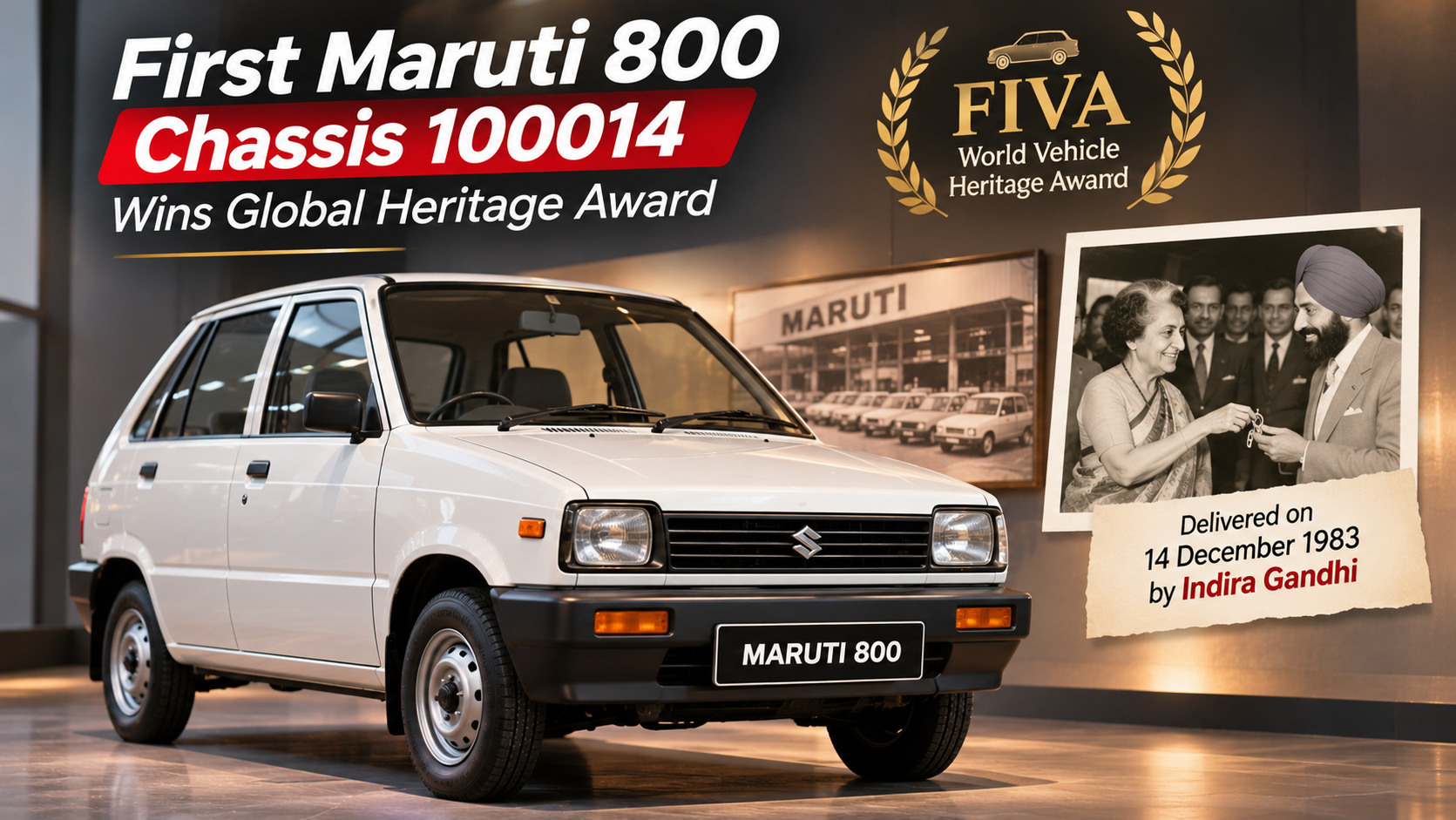
India's iconic Maruti 800 has received international recognition for its contribution to the country's automotive history. The first Maruti 800 sold to a customer, carrying chassis number 100014, has won the inaugural Fédération Internationale des Véhicules Anciens (FIVA) World Vehicle Heritage Award.
The award recognises historic vehicles that have made an important contribution to society, mobility, industrial development and national identity. The Maruti 800 was selected as the only Indian vehicle among 21 award-winning vehicles representing 20 countries.
The recognition highlights the role played by the small hatchback in making car ownership more accessible to Indian families and transforming the country's passenger vehicle market.
The award was presented on November 13, 2026, during FIVA's General Assembly in Brussels, Belgium, as part of the organisation's 60th anniversary celebrations.
The award-winning vehicle holds a special place in Indian automotive history. It was delivered to its first owner, Harpal Singh, on December 14, 1983.
The keys were personally handed over to Singh by then Prime Minister Indira Gandhi. The delivery marked an important moment in India's journey towards affordable personal transportation.
The car carries chassis number 100014 and was among the earliest production examples of the Maruti 800.
In 2017, ownership of the historic vehicle was transferred to Maruti Suzuki. The company subsequently restored it to preserve its original condition.
Today, the first customer-delivered Maruti 800 is displayed at Maruti Suzuki's headquarters, where it remains an important reminder of the company's beginnings and the transformation of India's automobile industry.
The FIVA World Vehicle Heritage Award was introduced in 2026 to recognise vehicles that have influenced the development of mobility and society.
Unlike conventional automotive awards, which often focus on performance, technology, rarity or luxury, this recognition considers the broader historical and cultural contribution of vehicles.
The inaugural awards selected 21 vehicles from 20 countries. India's Maruti 800 was included because of its role in making personal transportation more accessible and supporting the growth of the domestic automobile industry.
The award ceremony took place in Brussels on November 13, 2026. The recognition also highlights how an affordable mass-market car can become an important part of a country's industrial and social history.
According to FIVA, the award celebrates vehicles that have shaped national identities, transformed everyday mobility and contributed to industrial development.
When the Maruti 800 arrived in December 1983, India's passenger vehicle market was very different from what it is today.
Car ownership was limited, and the market was dominated by a small number of established models. The introduction of the Maruti 800 offered customers a compact, relatively affordable and easy-to-drive alternative.
Its small dimensions made it suitable for Indian roads, while its practical design and manageable running costs helped attract families purchasing their first car.
The hatchback gradually became one of the most recognisable vehicles in the country. For many Indian households, buying a Maruti 800 represented their first experience of personal car ownership.
Its popularity also helped change customer expectations regarding vehicle design, convenience, reliability and affordability.
The original Maruti 800 was powered by a 796cc, three-cylinder petrol engine. It featured a compact front-wheel-drive layout and a lightweight monocoque body construction.
The model introduced several features that helped distinguish it from many established cars available in India at the time.
Its compact dimensions, simple mechanical package and practical cabin made it suitable for everyday family transportation.
The Maruti 800 also became known for its easy-to-use controls, small turning footprint and relatively straightforward maintenance requirements.
|
Particulars |
Details |
|
Model |
Maruti 800 |
|
Chassis Number |
100014 |
|
First Customer |
Harpal Singh |
|
First Delivery Date |
14-Dec-83 |
|
Keys Handed Over By |
Indira Gandhi |
|
Original Engine |
796cc, 3-cylinder petrol |
|
Drive Configuration |
Front-wheel drive |
|
Heritage Award |
FIVA World Vehicle Heritage Award |
|
Award Presentation |
13-Nov-26 |
|
Award Location |
Brussels, Belgium |
|
Production Period |
1983–2014 |
|
Total Production |
More than 2.9 million units |
The success of the Maruti 800 was not limited to its first few years. It remained an important part of India's passenger vehicle market for more than three decades.
According to Suzuki Motor Corporation, cumulative production exceeded 2.9 million units during its approximately 30-year production journey.
The car also played a role in developing India's automotive export industry. Maruti 800 exports began in 1987, with Hungary, France and Belgium among the early European markets.
Its success helped establish manufacturing capabilities, supplier relationships, dealerships and service infrastructure that contributed to the growth of India's automobile ecosystem.
The model's production journey eventually came to an end in January 2014, but its place in Indian automotive history remains significant.
Maruti Suzuki Chairman R.C. Bhargava welcomed the international recognition and highlighted how the Maruti 800 helped demonstrate India's ability to manufacture quality engineering products.
Suzuki Motor Corporation President Toshihiro Suzuki also acknowledged the importance of the model, pointing to its long production history and its contribution to the development of India's automotive market.
The company began production with an annual manufacturing scale of around 40,000 cars. Over the following decades, the Maruti 800 became one of the most widely recognised cars in the country.
Its impact extended beyond vehicle sales, supporting employment and the growth of India's automotive manufacturing and component industries.
The FIVA recognition is significant because it celebrates the social and industrial influence of the Maruti 800 rather than simply its technical specifications.
The car helped make personal transportation accessible to a much wider section of Indian society. It also contributed to the development of local manufacturing, component suppliers, exports and automotive employment.
The first customer-delivered example, chassis number 100014, represents the beginning of that journey.
Its recognition at an international automotive heritage event places an important Indian vehicle alongside historic automobiles from other countries.
The first Maruti 800, chassis number 100014, has earned a special place in international automotive history by receiving the inaugural FIVA World Vehicle Heritage Award.
Delivered to Harpal Singh in December 1983 with its keys handed over by then Prime Minister Indira Gandhi, the historic hatchback represents a turning point in India's personal mobility journey.
With more than 2.9 million units produced during its lifetime, the Maruti 800 helped transform India's car market and supported the growth of the domestic automobile manufacturing industry.
More than four decades after its first delivery, the iconic hatchback continues to represent an important chapter in India's automotive story.














Mahindra
₹14.06 - 19.67 Lakh