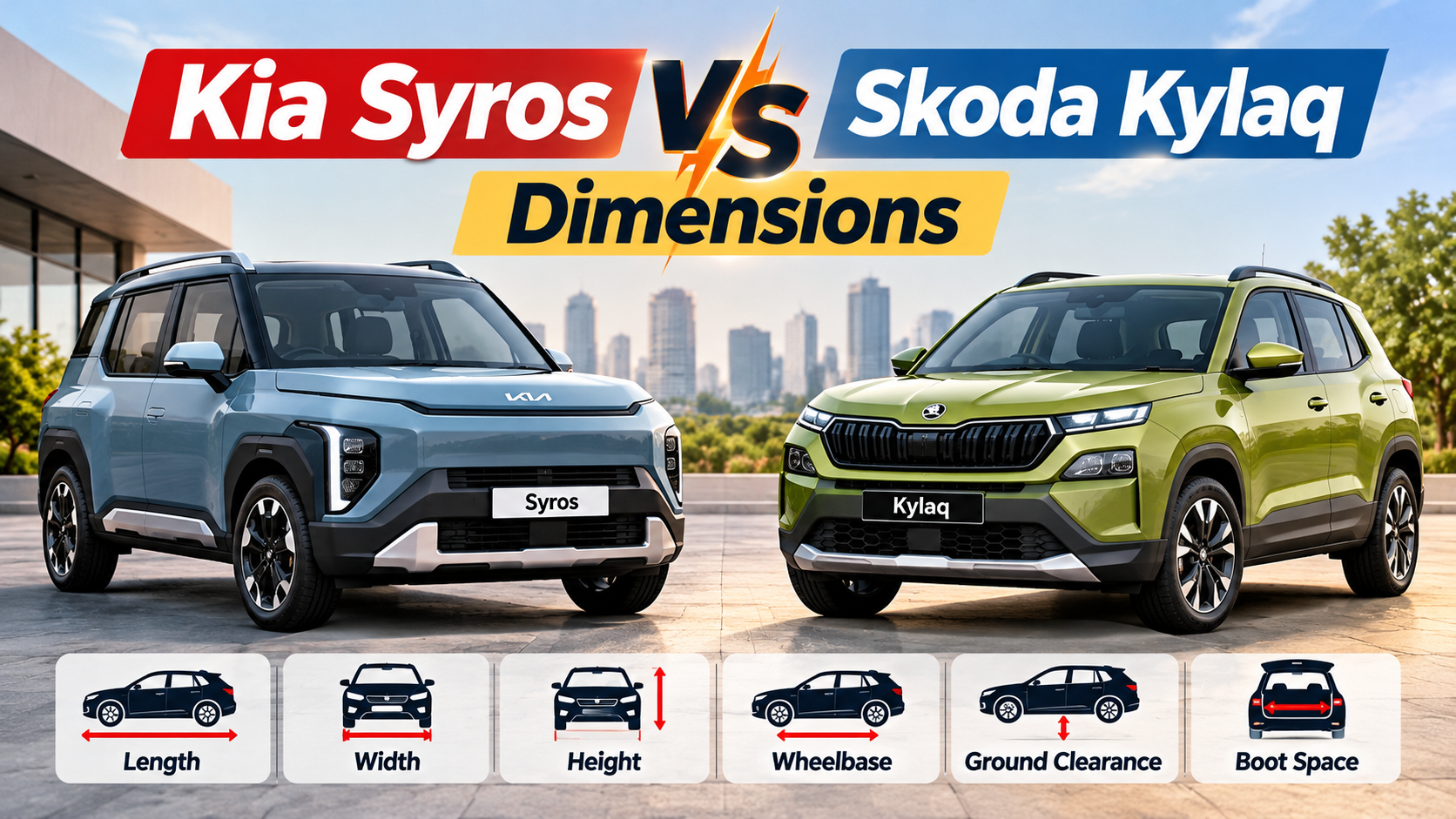
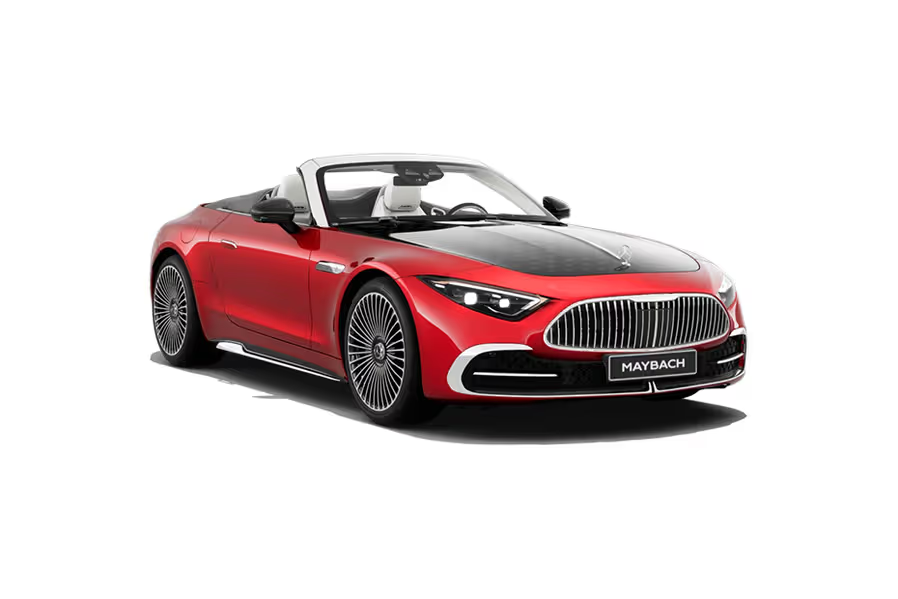
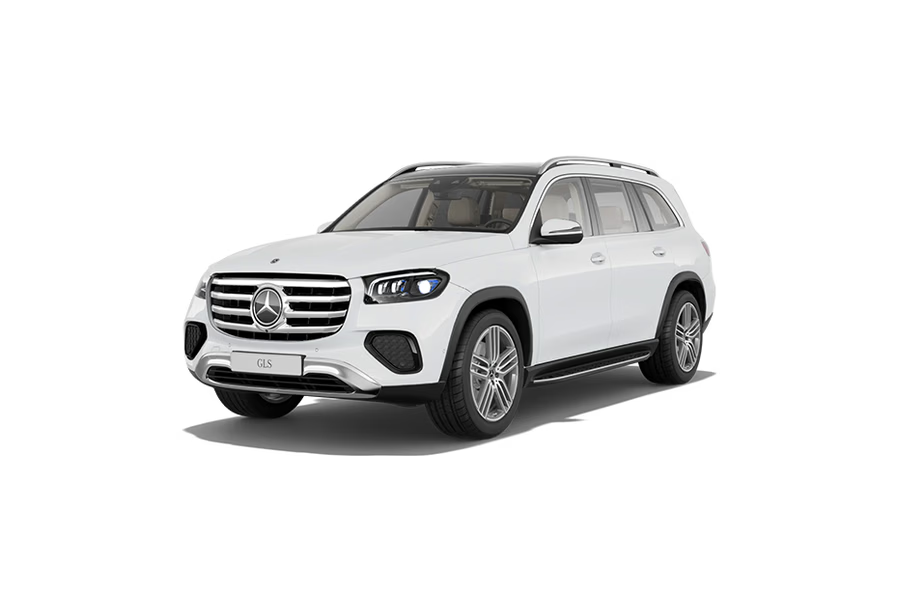
The Kia Syros and Skoda Kylaq are two compact SUVs designed for Indian buyers who want SUV cars styling, practical cabin space and easy manoeuvrability in urban conditions. Both models measure less than four metres in length, but their dimensions reveal some important differences.
The Kia Syros stands out with its wider body and flexible rear-seat arrangement, while the Skoda Kylaq offers a slightly longer wheelbase and a larger published boot capacity. These differences may matter to families comparing luggage space, rear-seat comfort and everyday usability.
Kia Syros vs Skoda Kylaq: Dimensions Comparison Table

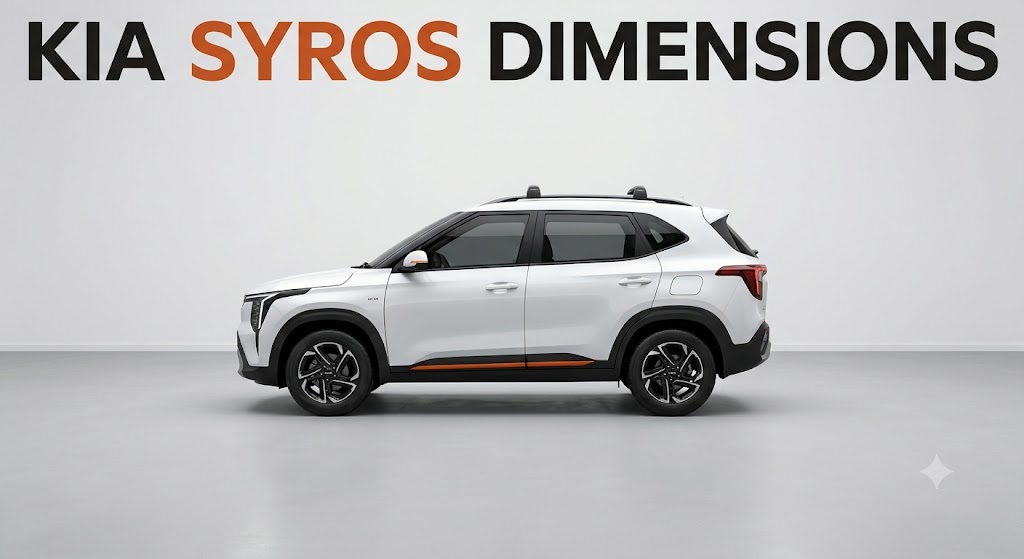
Kia Syros

Skoda Kylaq
|
Dimension
|
Kia Syros
|
Skoda Kylaq
|
|
Length
|
3,995 mm
|
3,995 mm
|
|
Width
|
1,805 mm
|
1,783 mm
|
|
Height
|
1,625–1,680 mm, depending on configuration
|
1,619 mm with roof rails
|
|
Wheelbase
|
2,550 mm
|
2,566 mm
|
|
Ground clearance
|
Not stated here due to inconsistent published figures
|
189 mm
|
|
Boot space
|
390 litres; up to 465 litres with rear seats slid forward
|
446 litres
|
|
Boot space with rear seats folded
|
Up to 1,434 litres, as listed in the owner's manual
|
1,265 litres
|
|
Seating capacity
|
5
|
5
|
1. Kia Syros vs Skoda Kylaq Length
Both SUVs measure 3,995 mm in length, putting them in the same sub-four-metre category. Neither has an advantage in overall length.
This compact footprint can be useful in crowded city traffic, narrow streets and tight parking spaces. However, a vehicle's turning radius and visibility also influence how easy it is to manoeuvre.
For buyers choosing between the two, length alone does not provide a reason to prefer one model over the other.
2. Width Comparison: Which SUV Is Wider?
The Kia Syros measures 1,805 mm in width, while the Skoda Kylaq measures 1,783 mm.
The Syros is therefore 22 mm wider than the Kylaq. Its broader body gives it a more substantial stance and may offer an advantage in cabin packaging, although actual shoulder room depends on the interior layout and seat design.
The Kylaq's slightly narrower body may be useful when manoeuvring through tight spaces, but the difference is relatively small. Buyers should also consider the width of the mirrors when assessing parking requirements.
3. Height Comparison
The height figures require a little care because manufacturers may quote measurements with or without roof rails.
The Kia Syros's official specifications list different heights depending on the wheel and roof-rack configuration, ranging from 1,625 mm without roof rails on a specified configuration to 1,680 mm with roof rails. The Skoda Kylaq is listed at 1,619 mm with roof rails.
On the published figures, the Syros can be taller. Its upright styling gives it a distinctive SUV profile, while the Kylaq maintains a relatively compact exterior height.
For buyers using basement parking, always check the exact variant's height and account for roof accessories.
4. Wheelbase: Kia Syros vs Skoda Kylaq
The wheelbase is the distance between the front and rear wheel centres. It can influence cabin packaging, rear-seat space and how a vehicle behaves on the road.
The Kia Syros has a wheelbase of 2,550 mm, while the Skoda Kylaq has a wheelbase of 2,566 mm.
The Kylaq's wheelbase is 16 mm longer. This is a small difference, and it does not automatically mean the Kylaq has more rear legroom. Seat design, seat travel and the positioning of interior components also affect passenger comfort.
The best way to compare rear-seat practicality is to sit in both SUVs and check knee room, foot space and headroom.
5. Ground Clearance Comparison
Ground clearance matters on uneven roads, steep ramps and speed breakers.
Skoda lists the Kylaq's ground clearance at 189 mm.
A directly comparable official ground-clearance figure for the Syros is not included here because published specifications are not consistent enough to make a reliable like-for-like comparison.
For Indian road conditions, buyers should consider the official clearance for their exact variant, the vehicle's load and the shape of the front and rear overhangs. Ground clearance alone does not guarantee that a vehicle will clear every obstacle.
6. Boot Space: Which SUV Offers More Luggage Room?
Boot space is one of the most useful measurements for family buyers.
The Skoda Kylaq offers a published boot capacity of 446 litres, expanding to 1,265 litres with the rear seats folded.
The Kia Syros offers 390 litres in the standard rear-seat position, with the capacity increasing to 465 litres when the sliding rear seats are moved forward. Its owner's manual also lists a maximum luggage volume of 1,434 litres with the rear seats folded.
This means the Kylaq has the larger quoted boot capacity in its standard seating configuration compared with the Syros's standard 390-litre figure. However, sliding the Syros's rear seats forward increases its luggage capacity to 465 litres.
The figures are not necessarily measured under identical conditions, so the most useful comparison is to try fitting your usual luggage into both vehicles.
7. Which SUV Is More Practical for Families?
Both SUVs offer five-seat layouts, but they approach practicality differently.
The Kia Syros features sliding second-row seats, allowing passengers to adjust the balance between rear legroom and luggage space. This flexibility can be useful for families who alternate between carrying passengers and carrying more luggage.
The Skoda Kylaq offers a 446-litre boot in its standard five-seat layout and a longer wheelbase than the Syros. It may appeal to buyers who prioritise conventional luggage capacity and a compact overall footprint.
Neither vehicle is automatically better for every family. Rear-seat comfort, child-seat installation, storage compartments and visibility should all be considered before making a decision.

 Khyati Sharma 2026-10-16