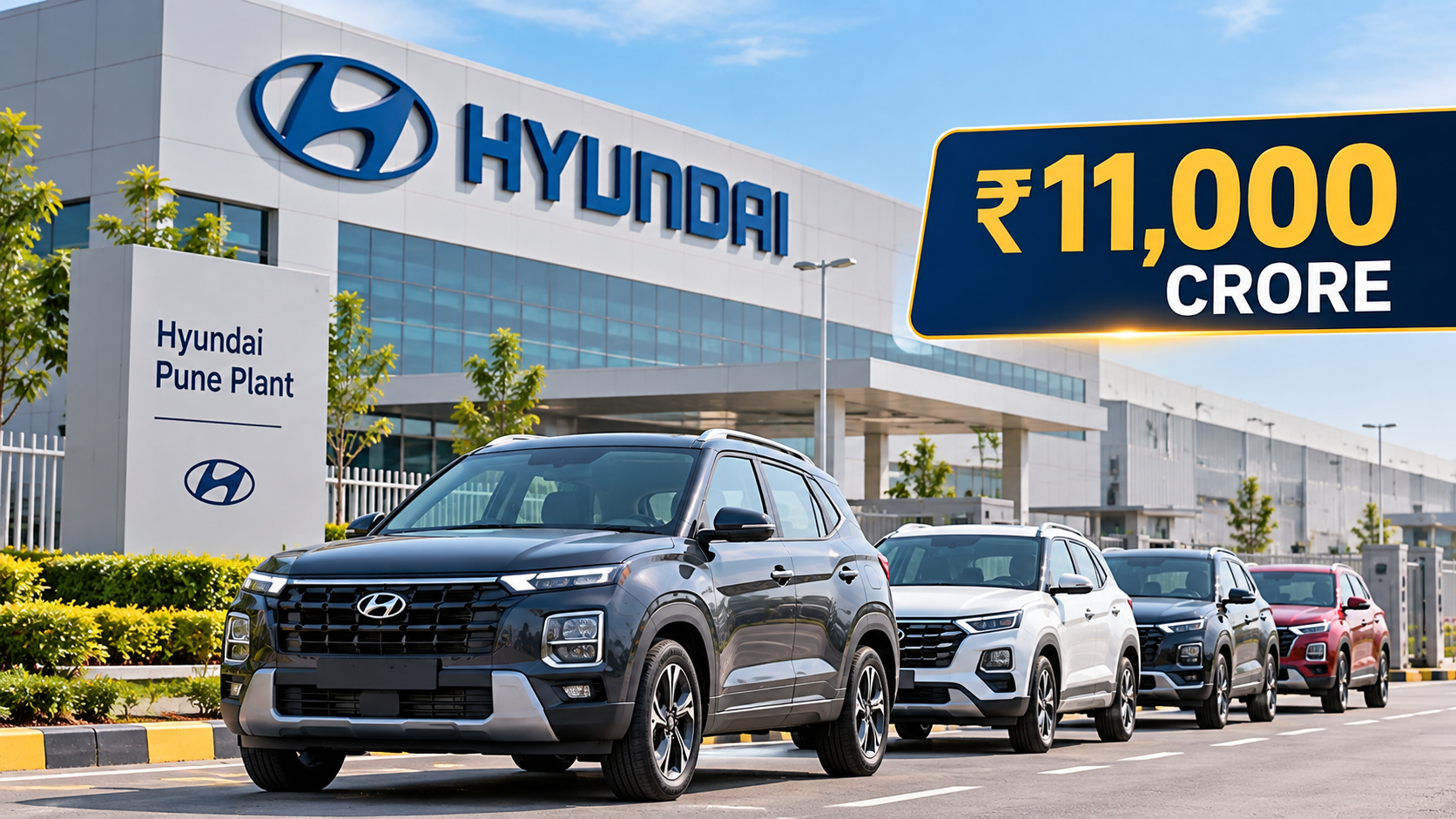
Hyundai Motor India has inaugurated its manufacturing facility in Talegaon, Pune, Maharashtra, and announced a phased investment of ₹11,000 crore to expand production capacity. The investment will support the company's long-term manufacturing plans, with the plant's annual capacity expected to increase from 1.7 lakh vehicles to 3.2 lakh vehicles by 2030.
The new facility marks a significant expansion of Hyundai's manufacturing footprint beyond Tamil Nadu. It is expected to strengthen the company's production capabilities, support future vehicle technologies and expand its role in India's automotive industry.
Hyundai Motor India Limited (HMIL) inaugurated its Talegaon manufacturing facility on October 14, 2026, in the presence of Maharashtra Chief Minister Devendra Fadnavis and senior Hyundai Motor Group executives. The company said the facility would receive ₹11,000 crore in investment in phases, supporting manufacturing expansion, industrial development and employment generation in Maharashtra.
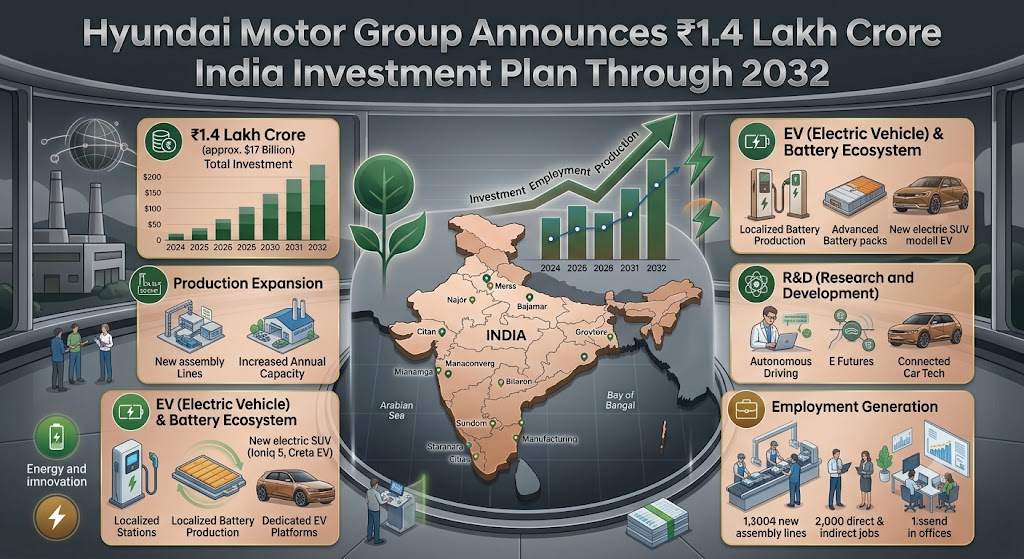
The announcement comes as Hyundai strengthens its position in India, one of its key global automotive markets. The investment is separate in announcement from the parent group's broader commitment of US$15.5 billion towards India through 2032, although both form part of Hyundai's wider growth strategy.
Hyundai Pune Plant Production Capacity to Reach 3.2 Lakh Units
The Talegaon plant currently has an installed annual production capacity of 1.7 lakh vehicles. Hyundai plans to increase this to 3.2 lakh units by 2030 through phased expansion.
Once the planned capacity increases at Pune are combined with the company's Chennai operations, Hyundai Motor India's total annual manufacturing capacity is expected to reach approximately 11.4 lakh vehicles by 2030.
The expansion should give Hyundai additional flexibility to serve domestic demand and international markets. It also strengthens the company's manufacturing network in western India, complementing its established operations in Tamil Nadu.
Hybrid Vehicle Production Planned for the Pune Facility
One of the notable features of the Pune facility is its flexible manufacturing setup, designed to accommodate internal combustion engine (ICE) vehicles and support hybrid vehicle production.
This flexibility could become important as Indian carmakers expand their powertrain portfolios to include petrol, diesel, hybrid and electric options. Hybrid vehicles combine an internal combustion engine with an electric motor and battery system, helping improve fuel efficiency in suitable driving conditions.
However, Hyundai has not confirmed which hybrid models will be manufactured at the Pune plant or when hybrid production will begin. Details regarding specific models, powertrains and production schedules remain awaited.
The facility's flexible manufacturing capabilities could allow Hyundai to adapt production according to market demand as its product strategy evolves.
Engine Manufacturing and Advanced Factory Technology
The Pune plant also houses an engine manufacturing shop with an annual production capacity of 1.5 lakh engines. This infrastructure is intended to support vehicle manufacturing and strengthen the facility's production capabilities.
Hyundai has incorporated its E-FOREST digital factory platform and modern manufacturing technologies at the site. These include artificial intelligence-assisted quality inspections, predictive maintenance, digital simulations and augmented reality-based employee training.
Such systems can help manufacturers identify quality issues, monitor machinery and improve production processes. Digital manufacturing tools also allow production operations to be planned and assessed more efficiently.
The plant's technology-led approach is intended to support consistent manufacturing quality while preparing the facility for future production requirements.
Hyundai Venue Production and Export Opportunities
The Pune facility is also significant for Hyundai's vehicle portfolio. The new-generation Hyundai Venue is scheduled to be manufactured exclusively at this plant, with exports planned to more than 35 countries, according to reports on the inauguration.
The additional manufacturing capacity could support both Indian customers and overseas markets. Hyundai has a long-standing export presence in India and has reported cumulative passenger vehicle exports of four million units since it began exporting from the country in 1999.
Expanding production in Pune could further strengthen India's role in Hyundai's global supply and manufacturing network.
Supplier Network and Employment in Maharashtra
The investment is expected to benefit the automotive supplier ecosystem around Pune and Talegaon. Hyundai has reported that 55 supplier partners have invested approximately ₹4,600 crore in Maharashtra. The wider Tier-1 and Tier-2 supplier network has generated more than 18,000 employment opportunities in the state.
A strong local supplier base can help manufacturers source components more efficiently and support production operations. It can also create opportunities for component manufacturers, logistics providers, engineering businesses and other industrial services.
As plant capacity expands, the region could see further economic activity. However, the final number of additional jobs directly created by Hyundai's planned ₹11,000 crore investment has not been separately confirmed.
What the Investment Means for Hyundai in India
Hyundai's Pune expansion reflects its intention to strengthen local manufacturing while preparing for changes in customer demand and automotive technology. Higher production capacity, flexible powertrain manufacturing and advanced factory systems could help the company respond to a wider range of market requirements.
For Indian buyers, the investment does not automatically confirm new model launches or immediate price changes. Its longer-term significance lies in the additional manufacturing capacity and the possibility of a broader powertrain strategy, including hybrid vehicles.
The key details to watch next are the pace of capacity expansion, the start of hybrid production, the models allocated to Pune and Hyundai's future product announcements.

 Khyati Sharma 2026-10-14