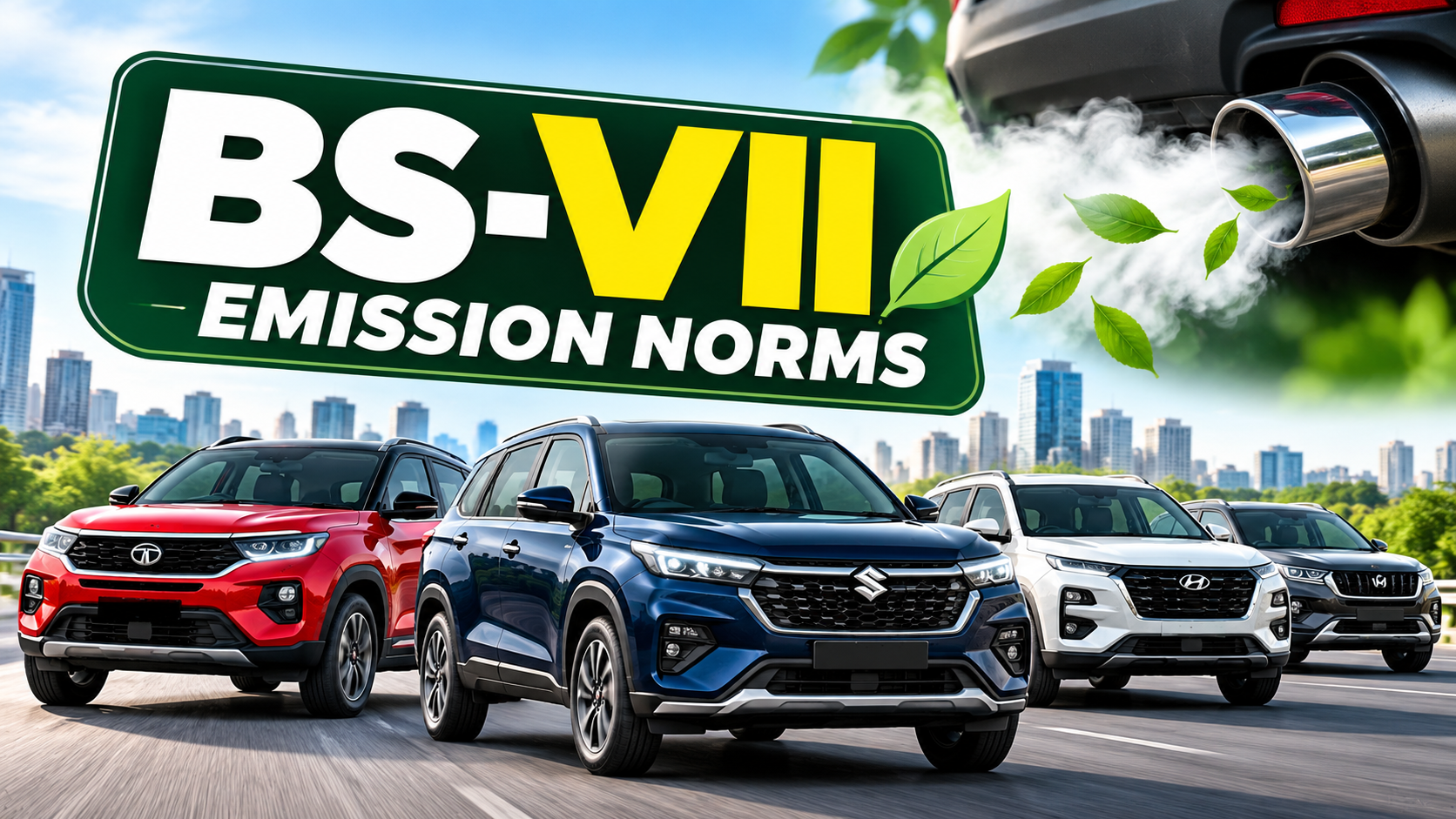
India is preparing for its next major vehicle emission regulation transition, with the Ministry of Road Transport and Highways (MoRTH) proposing the introduction of Bharat Stage VII (BS-VII) emission norms for passenger vehicles from April 1, 2029. The proposed standards aim to strengthen pollution monitoring and expand regulatory requirements beyond conventional exhaust emissions.
According to reports published on October 14 and 15, 2026, the government has issued draft amendments to the Central Motor Vehicles Rules, 1989. The proposal outlines a phased implementation plan extending through 2035, with additional requirements covering real-world emissions, brake and tyre particles, and battery durability for eligible electric vehicles.
The draft is open to public consultation, meaning the proposed dates and requirements should not yet be treated as a final, fully implemented regulatory framework.
BS-VII Rollout Timeline in India
| Proposed timeline |
Key development |
| April 1, 2029 |
Initial BS-VII requirements proposed for new passenger cars and SUVs |
| April 1, 2031 |
Additional requirements proposed for brake particle emissions and tyre wear |
| April 1, 2035 |
Further tightening of selected requirements, including brake particle limits across vehicle types |
What Are BS-VII Emission Norms?
Bharat Stage standards regulate the pollutants emitted by vehicles sold in India. These standards establish requirements for vehicle manufacturers and help control emissions that contribute to air pollution.
India currently follows BS-VI emission standards, which became applicable to new vehicles nationwide in April 2020. The proposed BS-VII framework would build on this system by expanding the way vehicles are tested and monitored.
The draft covers pollutants such as nitrogen oxides (NOx), hydrocarbons, carbon monoxide and particulate matter. It also introduces additional attention to pollution produced outside the exhaust system, including particles generated by brake wear and tyre abrasion.
How BS-VII Could Change Vehicle Emission Testing
One of the key features of the proposed framework is its focus on emissions under real-world driving conditions.
Laboratory tests remain important for checking whether a vehicle meets regulatory requirements. However, actual driving conditions can differ because of traffic, acceleration, road gradients, temperature and other operating factors.
The proposed framework includes more stringent real-driving emissions checks and expanded onboard monitoring of emissions-related performance. These measures are intended to help assess whether vehicles continue to operate within the applicable requirements beyond controlled laboratory conditions.
Manufacturers may consequently need to review engine calibration, exhaust after-treatment systems, sensors, diagnostic equipment and vehicle testing procedures.
Brake and Tyre Pollution to Receive Greater Attention
The proposed BS-VII rules also address particles produced by vehicle components rather than only those released through the exhaust.
Brake emissions: Friction between brake components can generate fine particles. The draft proposes brake particle limits from April 2031, with requirements varying according to vehicle powertrain in the initial stage.
Tyre wear: Tyres release particles as their tread wears during normal driving. The proposed framework includes tyre abrasion requirements from April 2031, although some detailed limits and testing procedures may require further notification.
These provisions are relevant to electric vehicles as well as petrol, diesel and hybrid vehicles. Although EVs do not produce exhaust emissions while driving, they can still generate particles from tyres and brakes.
The Complete Guide to Buying a New Car in India: The Wheels42 7-Step Framework
Proposed Battery Durability Requirements for Electric Cars
The draft also includes minimum battery performance requirements for specified electric vehicles and plug-in hybrid vehicles. The aim is to establish benchmarks for battery performance as vehicles age.
Under the reported proposal, applicable vehicles would need to retain at least 75% of their original battery energy capacity up to five years or 100,000 km, whichever comes first. A further threshold of 67% is proposed for the period beyond that point, up to eight years or 160,000 km, whichever comes first.
These figures relate to the proposed regulatory requirements and their stated applicability. They should not be interpreted as a universal battery warranty for every electric vehicle currently on sale.
If adopted, the requirements could make battery durability and long-term performance more important considerations for EV manufacturers.
What Could BS-VII Mean for Car Manufacturers?
The proposed regulations could require automakers to invest in engineering, validation, testing equipment and compliance systems.
Potential areas of impact include:
-
Petrol and diesel vehicles: Manufacturers may need to refine emission-control systems and demonstrate compliance under specified real-world conditions.
-
Electric vehicles: Battery durability and non-exhaust particle emissions could become more important regulatory considerations.
-
Hybrid vehicles: These vehicles may need to meet requirements relevant to both their combustion engines and other applicable systems.
-
Vehicle development: New testing procedures and technical requirements could influence product development schedules and launch planning.
The actual cost impact will depend on the final rules, the technologies already used by manufacturers and the modifications required for individual models. It is too early to assign a confirmed price increase to future vehicles based solely on the draft proposal.
Will Existing BS-VI Cars Be Affected?
The proposed transition is aimed at vehicles covered by the new requirements from their applicable manufacturing and implementation dates. Reports on the draft indicate that existing BS-VI-compliant vehicles are not intended to be retroactively brought under the new standards simply because BS-VII is introduced.
Buyers should therefore avoid assuming that their existing vehicle will automatically become illegal when the proposed new standards begin.
The final notification and applicable provisions will determine the precise legal requirements. Anyone planning a vehicle purchase should follow official government updates rather than make a decision based only on the proposed timeline.
Will BS-VII Make Cars More Expensive?
A potential increase in development and compliance costs is one consideration for the automotive industry. New sensors, emission-control technology, validation procedures and monitoring systems can add engineering complexity.
However, the effect on showroom prices is not yet known. It will depend on the final regulatory requirements, manufacturer strategies, production volumes and the technologies needed for each vehicle.
It is also too early to conclude that every car launched after April 2029 will receive the same changes or price increase. Different powertrains and vehicle categories may be subject to different provisions and implementation dates.
Conclusion
The proposed BS-VII emission norms represent another step in India's effort to strengthen vehicle pollution regulation. With an initial passenger-vehicle rollout proposed for April 2029 and further requirements extending through 2035, the draft framework covers real-world emissions, brake and tyre particles, and battery durability for applicable electric vehicles.
For manufacturers, the proposal could mean additional engineering and compliance work. For buyers, it highlights the growing importance of emission performance, vehicle technology and long-term durability. However, the dates and provisions remain subject to the final government notification.

 Khyati Sharma 2026-10-15