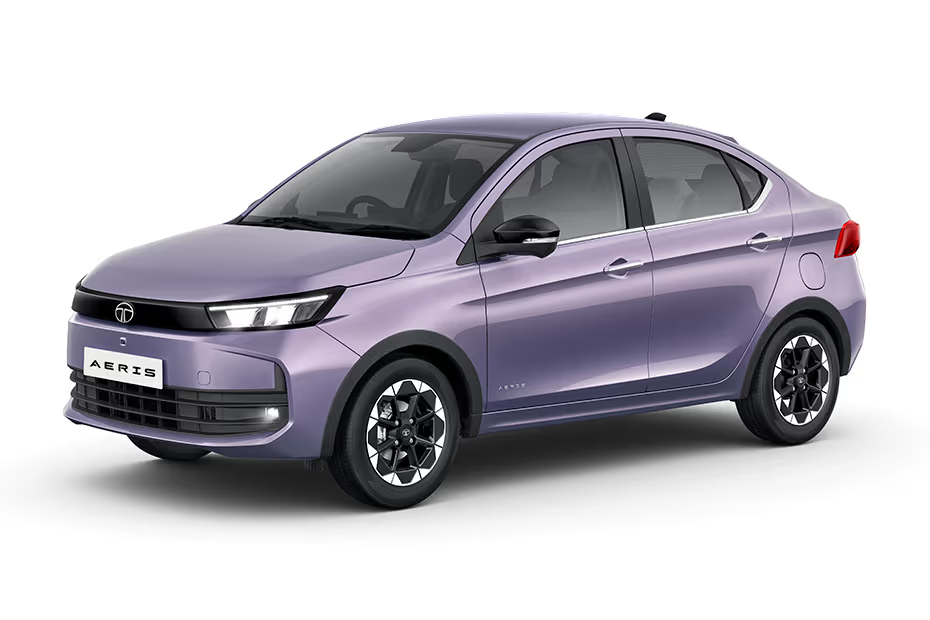
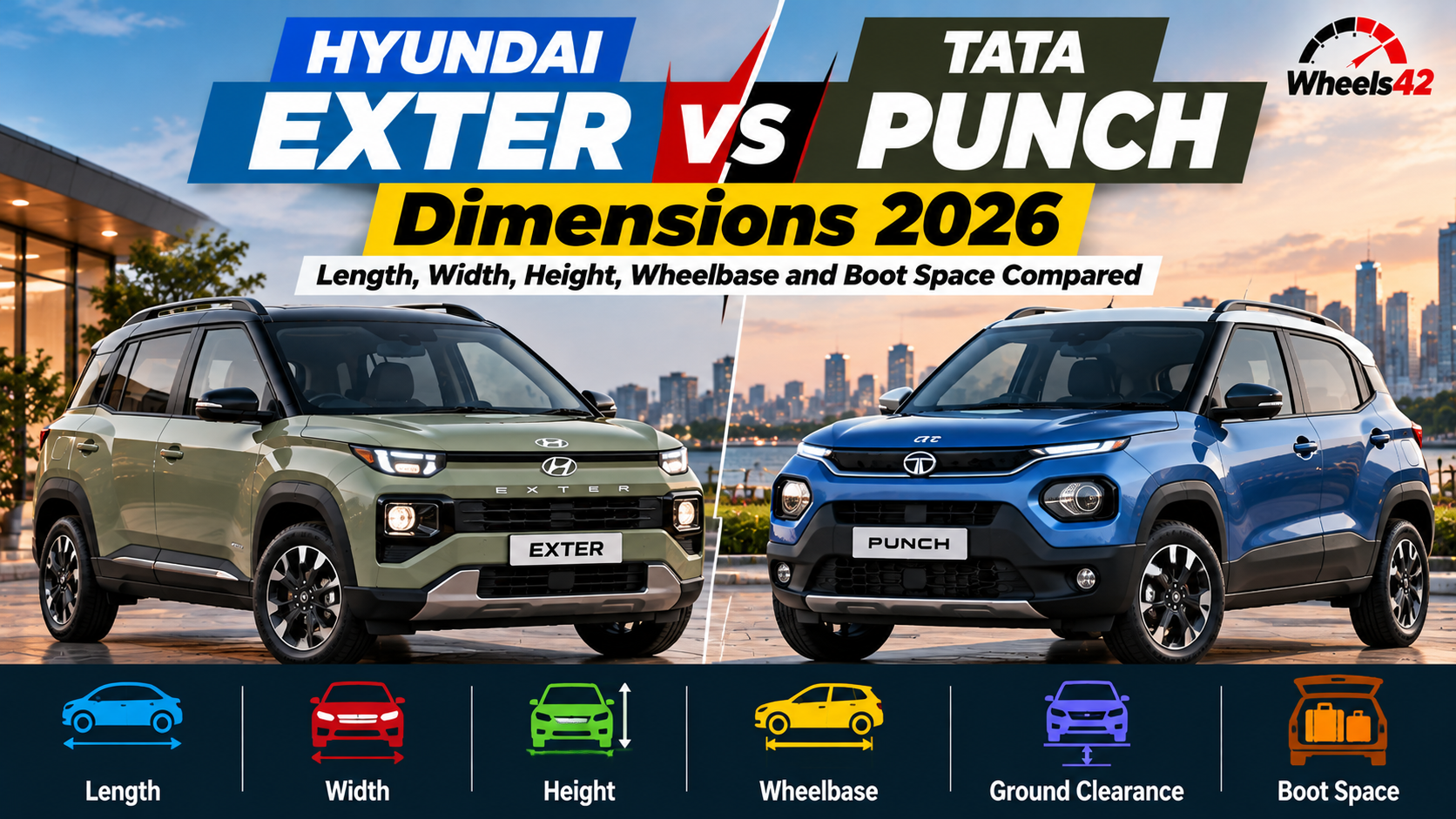
The Hyundai Exter and Tata Punch are two popular options for buyers looking for a compact SUV suited to Indian roads. Both models have a tall stance, practical five-seat cabins and dimensions designed to balance city driving with everyday usability.
However, their exterior measurements differ in several important areas. The Hyundai Exter offers a taller body and longer wheelbase, while the Tata Punch is longer and wider. Boot capacity and ground clearance are also key factors for buyers who regularly carry luggage or drive on uneven roads.
In this comparison, we look at the Hyundai Exter vs Tata Punch dimensions, including length, width, height, wheelbase, ground clearance and boot space.
Hyundai Exter vs Tata Punch Dimensions: Specification Table
|
Dimensions
|
Hyundai Exter
|
Tata Punch
|
|
Length
|
3,830 mm
|
3,876 mm
|
|
Width
|
1,723 mm
|
1,742 mm
|
|
Height
|
1,643 mm
|
1,615 mm
|
|
Wheelbase
|
2,450 mm
|
2,445 mm
|
|
Ground Clearance
|
185 mm
|
193 mm
|
|
Boot Space (petrol)
|
391 litres
|
366 litres
|
|
Seating Capacity
|
5
|
5
|
1. Length: Which SUV Is Longer?
The Tata Punch measures 3,876 mm in length, compared with 3,830 mm for the updated Hyundai Exter. This gives the Punch a 46 mm advantage in overall length.
The Punch's longer body contributes to its compact SUV proportions and may offer advantages in how the cabin and luggage area are packaged. However, exterior length alone does not determine passenger comfort or usable interior space.
The Exter remains relatively compact, which can be helpful when navigating narrow urban streets or fitting into tight parking spaces.
Winner by length: Tata Punch.
2. Width: Which SUV Is Wider?
The Tata Punch is 1,742 mm wide, while the Hyundai Exter measures 1,723 mm. The Punch is therefore 19 mm wider.
A wider body can help create a more substantial road presence and potentially provide additional shoulder room, although actual cabin comfort depends on interior design, seat dimensions and door trim.
For buyers comparing the two vehicles in person, checking rear-seat comfort with all intended passengers is more useful than relying on exterior width alone.
Winner by width: Tata Punch.
3. Height: Which SUV Is Taller?
The Hyundai Exter has a published height of 1,643 mm with roof rails, making it 28 mm taller than the Tata Punch at 1,615 mm.
Its taller profile contributes to the upright SUV cars appearance and can help with a commanding seating position. The Exter's overall cabin experience also depends on seat adjustment, roof design and available headroom.
The Punch has a slightly lower roofline, but that does not automatically mean its cabin is less comfortable. Buyers should consider seating posture and visibility during a test drive.
Winner by height: Hyundai Exter.
4. Wheelbase: Which SUV Has the Longer Wheelbase?
Wheelbase is the distance between the front and rear wheels. It can influence cabin packaging, rear-seat legroom and vehicle stability, although suspension tuning and seat design also matter.
The Hyundai Exter has a 2,450 mm wheelbase, compared with 2,445 mm for the Tata Punch. The difference is only 5 mm.
While the Exter has a marginally longer wheelbase, this small difference should not be treated as proof that it offers significantly more legroom. Both vehicles should be evaluated for actual passenger comfort.
Winner by wheelbase: Hyundai Exter, by 5 mm.
5. Ground Clearance: Which SUV Is Better for Rough Roads?
Ground clearance is important for Indian buyers who regularly encounter speed breakers, potholes, steep ramps and uneven roads.
The Hyundai Exter has a published ground clearance of 185 mm, while the Tata Punch offers 193 mm in the current specification listing used for this comparison.
The Punch therefore has an 8 mm advantage in ground clearance. This may provide additional clearance in certain situations, but the risk of scraping also depends on vehicle load, approach and departure angles, tyre size and road conditions.
Drivers should still approach large speed breakers and broken roads carefully, regardless of which model they choose.
Winner by published ground clearance: Tata Punch.

6. Boot Space: Which SUV Carries More Luggage?
Boot space is an important consideration for families, weekend trips and airport transfers.
The Hyundai Exter offers a claimed 391 litres of boot space in petrol versions, while the Tata Punch provides 366 litres in petrol versions. The Exter has a nominal advantage of 25 litres.
That difference could be useful for carrying shopping bags or smaller travel items. However, the actual number of bags that fit depends on their shape, the boot opening and how luggage is arranged.
CNG versions require separate consideration. The published figures for the Tata Punch CNG and Hyundai Exter Hy-CNG Duo differ from their petrol counterparts because of their gas-storage arrangements. Buyers should check the exact variant's usable luggage capacity before making a decision.
Winner by claimed petrol boot capacity: Hyundai Exter.
7. Which SUV Is More Practical for City Driving?
Both the Hyundai Exter and Tata Punch are designed for everyday use, but their dimensions offer slightly different advantages.
The Exter's shorter length can make it easier to position in tight parking spaces, while its taller body and longer wheelbase contribute to its upright stance. Its larger claimed petrol boot capacity is another practical benefit.
The Punch is longer and wider, with greater published ground clearance. These characteristics may appeal to buyers who prefer a broader stance and want extra clearance for uneven roads.
Neither vehicle is automatically easier to drive based on dimensions alone. Turning radius, steering response, visibility, parking sensors and camera systems can all influence daily convenience.
Hyundai Exter vs Tata Punch Dimensions: Final Verdict
The Hyundai Exter and Tata Punch have closely matched overall dimensions, but each has a few advantages.
The Tata Punch is longer and wider, and it offers greater published ground clearance. The Hyundai Exter is taller, has a marginally longer wheelbase and provides a larger claimed petrol boot.
Buyers who prioritise luggage capacity and a taller cabin profile may prefer the Exter. Those who value a wider body and the Punch's ground-clearance advantage may lean towards the Tata.
Ultimately, the best choice depends on your regular driving conditions, passenger needs, luggage requirements and preferred features. Compare the exact variants and take both vehicles for a test drive before deciding.

 Khyati Sharma 2026-10-12