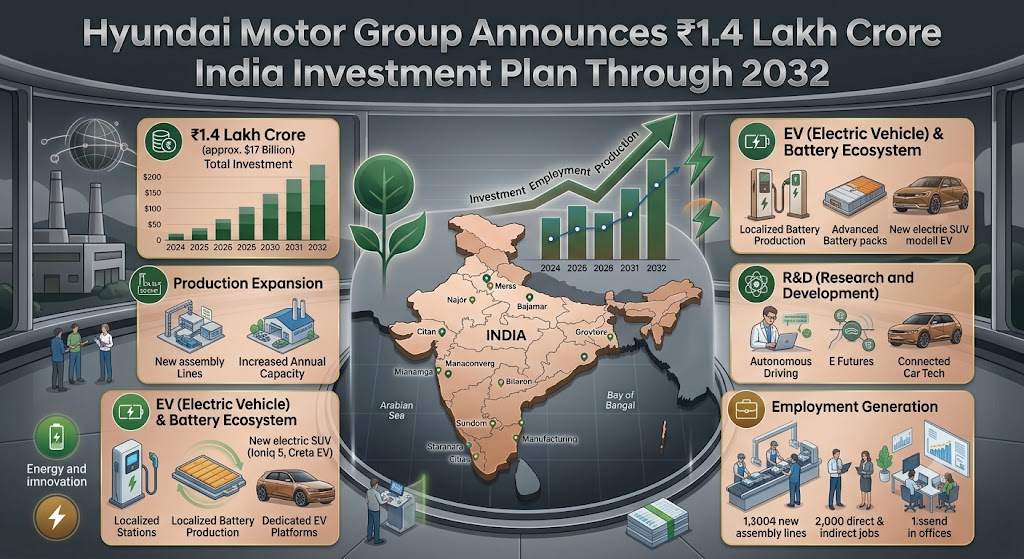
Hyundai Motor Group has announced a major investment plan worth US$15.5 billion (approximately ₹1.4 lakh crore) in India between 2026 and 2032, reinforcing the country's importance in its global automotive strategy. The investment programme will cover manufacturing expansion, research and development (R&D), local supplier development and emerging mobility businesses.
The announcement was made on October 13, 2026, following a meeting between Hyundai Motor Group Executive Chair Euisun Chung and Indian Prime Minister Narendra Modi in New Delhi. The investment is intended to strengthen India's position as a major automotive production, technology and export hub.
The announcement covers the wider Hyundai Motor Group, which includes Hyundai and Kia cars. However, the company has not disclosed a complete year-by-year investment schedule or the exact amount allocated to each business.
Hyundai Motor Group India Investment: Key Details
|
Particulars
|
Details
|
|
Total planned investment
|
US$15.5 billion
|
|
Approximate Indian value
|
₹1.4 lakh crore
|
|
Investment period
|
2026–2032
|
|
Companies involved
|
Hyundai and Kia businesses in India
|
|
Planned R&D investment
|
Approximately US$700 million
|
|
Main focus areas
|
Manufacturing, R&D, localisation and mobility
|
|
Key objective
|
Strengthen India's global automotive role
|
|
Announcement date
|
46308
|
Manufacturing Capacity Expansion Planned
A major part of Hyundai Motor Group's investment strategy will focus on expanding manufacturing capabilities in India. The group already operates a significant production network, with facilities supporting Hyundai and Kia vehicles.
Its combined annual manufacturing capacity in India exceeds 1.4 million vehicles, according to the company's investment announcement and industry reports. The group intends to expand capacity in phases to support future demand, new model introductions and export opportunities.
Hyundai's manufacturing operations include facilities in Chennai and Pune, while Kia operates its production facility in Anantapur, Andhra Pradesh. Hyundai is planning further expansion at its Pune facility.
The group is also assessing its longer-term manufacturing requirements. However, the latest announcement does not confirm a location, timeline or production target for an additional manufacturing plant. Any proposed new facility should therefore be treated as under consideration rather than a confirmed project.
US$700 Million Investment in Research and Development
Research and development is another important part of the investment programme. Hyundai Motor Group plans to invest approximately US$700 million in its Indian R&D centre, including a vehicle testing track.
The investment is expected to support the development and testing of future automotive technologies, improve engineering capabilities and strengthen local research expertise.
India's growing automotive market offers manufacturers opportunities to develop vehicles suited to local driving conditions, customer requirements and regulatory standards. A stronger R&D presence could also help the group develop technologies and products for export markets.
The announcement does not specify the complete list of future vehicle models or technologies that will be developed through this investment.
Greater Focus on Local Suppliers and Component Manufacturing
Hyundai Motor Group also plans to strengthen its local supplier network. Increasing component localisation can help manufacturers build a more resilient supply chain, work more closely with domestic businesses and reduce dependence on imported components where local alternatives are viable.
The programme is expected to support supplier development and encourage partnerships across India's automotive ecosystem. This could create opportunities for component manufacturers, engineering companies and technology providers that work with Hyundai and Kia.
The exact localisation targets and the investment allocated specifically to suppliers have not yet been announced.
Investment in Electric Vehicles and New Mobility Businesses
Beyond conventional vehicle manufacturing, the investment strategy includes future mobility opportunities. These areas include electric vehicle charging infrastructure, automotive financing, end-of-life vehicle recycling and support for promising start-ups.
These businesses could help Hyundai Motor Group expand its presence beyond vehicle sales and manufacturing. Charging infrastructure is relevant to electric vehicle adoption, while recycling initiatives could support more efficient management of vehicles and automotive materials at the end of their useful lives.
The group is also working on electric three-wheelers with TVS Motor Company under a separate development partnership. Such initiatives reflect the broader opportunity to develop mobility products for India and potentially other markets.
However, the US$15.5 billion programme does not come with a publicly disclosed project-by-project budget for these businesses.
India to Strengthen Its Role as an Export Hub
Hyundai Motor Group's investment signals its intention to use India as a strategic base for long-term growth. Alongside domestic demand, the country's manufacturing ecosystem and supplier network can support exports to international markets.
Expanding production capacity, developing local engineering capabilities and strengthening component sourcing could improve the group's ability to serve multiple markets from India.
The investment may also create employment opportunities across manufacturing, engineering, R&D and supplier operations. Nevertheless, Hyundai Motor Group has not announced a specific job-creation target for the programme, so the overall employment impact remains to be quantified.
What the Investment Means for India's Auto Industry
Hyundai Motor Group's US$15.5 billion commitment represents a significant long-term investment in India's automotive sector. It combines manufacturing expansion with R&D, supplier development and emerging mobility businesses rather than focusing only on increasing vehicle production.
For India, the programme could support industrial investment, technology development and export growth. For Hyundai and Kia, it provides a framework for expanding their manufacturing and engineering presence in one of their important strategic markets.
The investment will be implemented over seven years, and its final impact will depend on how individual projects progress. Details such as annual spending, additional production capacity, new plant locations and employment targets remain to be confirmed.
In summary, Hyundai Motor Group's planned ₹1.4 lakh crore investment through 2032 reinforces India's role in its future automotive strategy. Manufacturing expansion, a stronger R&D network and deeper local sourcing are expected to be central to the group's next phase of growth in the country.

 Khyati Sharma 2026-10-14