BYD Denza Z9 GT
156.8 Lakh*

 Khyati Sharma 2026-11-23

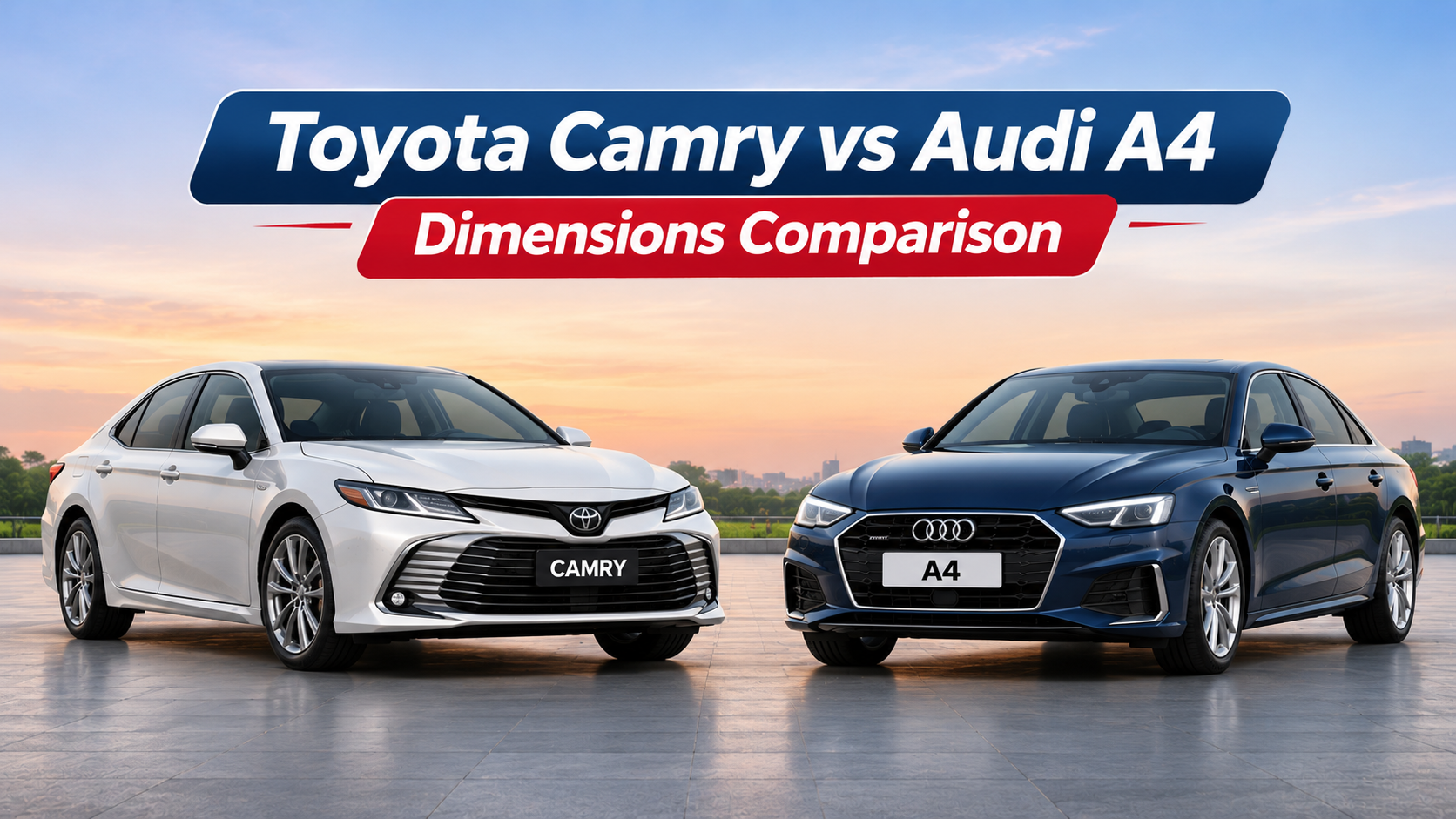
The Toyota Camry and Audi A4 are two premium sedans offering different approaches to luxury, comfort and driving experience. While the Toyota Camry focuses on hybrid technology, rear-seat comfort and a spacious cabin, the Audi A4 offers German styling, sporty driving characteristics and a premium interior.
One of the important factors buyers consider when comparing these two sedans is their overall size. Dimensions such as length, width, height and wheelbase influence road presence, passenger space and parking convenience.
Toyota Camry vs Audi A4: Dimension Comparison
|
Dimensions |
Toyota Camry |
Audi A4 |
|
Length |
4,920 mm |
4,762 mm |
|
Width |
1,840 mm |
1,847 mm |
|
Height |
1,455 mm |
1,433 mm |
|
Wheelbase |
2,825 mm |
2,826 mm |
|
Ground Clearance |
145 mm |
165 mm |
|
Boot Space |
524 litres |
460 litres |
|
Seating Capacity |
5 passengers |
5 passengers |
|
Fuel Tank Capacity |
50 litres |
54 litres |
The Toyota Camry measures 4,920 mm in length, while the Audi A4 measures 4,762 mm.
This means the Camry is 158 mm longer than the Audi A4.
A longer body generally provides more flexibility for cabin packaging and contributes to a more substantial road presence.
The Camry's extended length also helps create a spacious-looking rear passenger area, making it attractive for buyers who regularly travel with family or use a chauffeur-driven sedan.
The Audi A4, on the other hand, has a comparatively shorter body, which can make it easier to manoeuvre and park in compact urban spaces.
Winner: Toyota Camry, as it offers a considerably longer body.
The Audi A4 measures 1,847 mm in width, whereas the Toyota Camry measures 1,840 mm.
The Audi A4 is 7 mm wider than the Camry.
Although the difference is relatively small, a wider body can contribute to additional shoulder room and a broader road stance.
Both sedans offer comfortable seating for five occupants, although actual passenger comfort also depends on seat design and cabin layout.
The Audi A4's slightly greater width gives it a marginal advantage on paper.
Winner: Audi A4, with a 7 mm advantage in width.
The Toyota Camry stands 1,455 mm tall, while the Audi A4 has a height of 1,433 mm.
The Camry is 22 mm taller than the Audi A4.
Height is an important measurement because it influences the overall proportions of a sedan and can affect available headroom.
The Camry's taller body gives it slightly more vertical space for cabin packaging, while the Audi A4 follows a lower and sportier sedan profile.
Both vehicles offer premium interiors, but the actual headroom experience depends on the seat position and roof design.
Winner: Toyota Camry, with a 22 mm height advantage.
The Toyota Camry has a wheelbase of 2,825 mm, while the Audi A4 offers a slightly longer 2,826 mm wheelbase.
The Audi A4 leads by just 1 mm.
Wheelbase refers to the distance between the front and rear wheels. It plays an important role in determining cabin packaging, rear-seat legroom and driving stability.
Despite having a marginally shorter wheelbase, the Camry is considerably longer overall.
Both sedans offer a spacious five-seat cabin, with the Camry particularly focused on rear-seat comfort.
The difference of just 1 mm is practically insignificant for buyers.
Winner: Audi A4, by a negligible 1 mm.
Ground clearance is particularly important for Indian roads, where vehicles frequently encounter speed breakers, uneven surfaces and potholes.
The Toyota Camry offers approximately 145 mm of ground clearance, while the Audi A4 offers around 165 mm.
This means the Audi A4 has 20 mm more ground clearance than the Camry.
The additional clearance can be useful when negotiating speed breakers and uneven road surfaces.
However, drivers should still approach tall speed breakers and steep ramps carefully, particularly when the vehicle is carrying several passengers.
Winner: Audi A4, with 20 mm more ground clearance.
Boot space is another important factor for customers who regularly travel with luggage.
The Toyota Camry offers approximately 524 litres of boot capacity, while the Audi A4 provides around 460 litres.
This gives the Camry a 64-litre advantage.
The additional luggage capacity can be useful for family holidays, airport transfers and long-distance highway journeys.
The Audi A4 also offers a practical luggage compartment, but its smaller capacity puts it behind the Camry in this comparison.
Winner: Toyota Camry, with 64 litres more boot space.
Both the Toyota Camry and Audi A4 offer seating for five passengers.
However, their overall dimensions create slightly different cabin experiences.
The Camry's longer body and taller profile provide greater flexibility for passenger comfort and luggage accommodation.
Its focus on rear-seat comfort makes it particularly suitable for buyers who frequently travel with family members or prefer chauffeur-driven journeys.
The Audi A4 focuses more on a balanced luxury sedan experience, combining comfortable seating with a relatively compact exterior footprint.
Its wheelbase is almost identical to the Camry's, although actual rear-seat space also depends on the cabin layout.
For buyers prioritising rear-seat comfort and luggage capacity, the Camry has an advantage on paper.
Apart from dimensions, both sedans use different engine technologies.
|
Engine Specifications |
Toyota Camry |
Audi A4 |
|
Engine Type |
2.5-litre Petrol Hybrid |
2.0-litre Turbo Petrol |
|
Engine Capacity |
2,487 cc |
1,984 cc |
|
Maximum Power |
230 PS (combined) |
204 hp |
|
Engine Torque |
221 Nm |
320 Nm |
|
Transmission |
e-CVT |
7-speed DCT |
|
Drive Type |
Front-Wheel Drive |
Front-Wheel Drive |
|
Claimed Mileage |
25.49 km/l |
17.4 km/l |
The Toyota Camry combines a petrol engine with an electric motor to deliver a combined output of 230 PS.
The Audi A4 focuses on turbocharged petrol performance, producing 204 hp and 320 Nm of torque.
The Camry has an advantage in claimed fuel efficiency, while the Audi A4 offers higher engine torque.
This makes the two sedans suitable for different types of buyers.
Based on the dimensions, the Toyota Camry is larger overall in terms of length and height, while the Audi A4 is slightly wider and has a marginally longer wheelbase.
The Camry also offers more boot space, making it a practical option for buyers who regularly travel with luggage.
|
Comparison |
Winner |
|
Length |
Toyota Camry |
|
Width |
Audi A4 |
|
Height |
Toyota Camry |
|
Wheelbase |
Audi A4 |
|
Ground Clearance |
Audi A4 |
|
Boot Space |
Toyota Camry |
|
Overall Exterior Length |
Toyota Camry |
The Toyota Camry and Audi A4 offer two different approaches to the premium sedan segment.
The Toyota Camry measures 4,920 mm in length, making it 158 mm longer than the Audi A4. It is also taller and offers a larger 524-litre boot.
The Audi A4, meanwhile, is slightly wider, has a marginally longer wheelbase and offers greater ground clearance.
For buyers looking for a larger sedan with more luggage capacity and a spacious rear-seat experience, the Toyota Camry is the stronger choice on paper.
However, customers who prefer a slightly more compact luxury sedan with sporty styling and turbocharged petrol performance may find the Audi A4 more appealing.


















.avif)