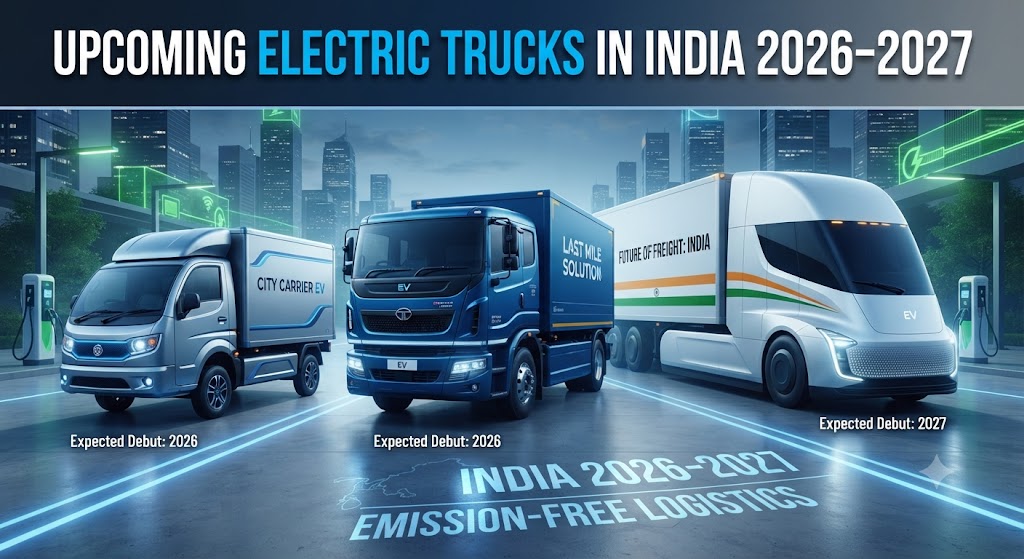
India's commercial vehicle industry is entering a new phase of electrification, with electric trucks moving beyond small pilot projects and into logistics, construction, mining, port operations and regional freight.
The 2026–2027 period is expected to be particularly important for electric trucks in India, as established commercial vehicle manufacturers expand their EV portfolios while new players prepare to enter the market.
Tata Motors has already introduced a broad electric truck portfolio covering applications from light-duty urban operations to heavy-duty freight. Meanwhile, companies such as JSW Greentech and Olectra Greentech are preparing additional electric truck products, while Ashok Leyland is expanding customer exposure to its existing electric truck range.
Here is a look at the major electric truck developments that could shape India's market through 2026 and 2027.
Why Are Electric Trucks Becoming Important in India?
Electric trucks are particularly suited to certain commercial applications where vehicles follow predictable routes and return to a fixed location for charging.
This includes:
-
City and regional logistics
-
E-commerce deliveries
-
Port operations
-
Mining
-
Construction
-
Industrial transport
-
Dedicated freight corridors
-
Warehouse-to-warehouse movement
-
Short and medium-distance haulage
The economics can become more attractive when a truck operates repeatedly on the same route because charging infrastructure can be planned around its regular operating cycle.
Government support is also playing a role. The PM E-DRIVE scheme includes incentives for eligible N2 and N3 electric trucks, with the maximum incentive specified at ₹9.6 lakh per vehicle. The scheme is intended to support the deployment of approximately 5,600 electric trucks.
1. JSW AMPSTAR Electric Truck
One of the newest entries into India's electric commercial vehicle space is JSW's AMPSTAR brand.
JSW Greentech launched AMPSTAR in September 2026 as its electric commercial mobility brand covering both buses and trucks. The company has started with a 55-tonne tractor-trailer, with plans to expand into tippers and fixed-body dumpers.
The company says its truck programme has been developed in-house for Indian operating conditions.
Expected Applications
The AMPSTAR truck is being developed for demanding commercial operations such as:
The initial 55-tonne platform is planned in different configurations, including tractor-trailer and tipper applications.
The truck uses a high-voltage electric drivetrain, with the company offering flexibility around battery configuration and charging requirements. Production is expected to begin around the end of 2026 following required approvals, with initial deliveries planned during the October 2026–March 2027 period.
What Makes AMPSTAR Important?
The entry of JSW adds another major manufacturer to India's electric heavy-truck landscape.
It also signals that the market is moving towards multiple electric truck platforms rather than a small number of pilot products.
2. Olectra Greentech Electric Trucks
Olectra Greentech is preparing to move beyond its established electric bus business and enter India's electric truck segment.
The company has announced plans for a new electric truck portfolio covering approximately 28-tonne to 55-tonne GVW applications.
The planned range is expected to include multiple commercial applications, including:
-
Haulage trucks
-
Tractor-trailers
-
Dump trucks
-
Mining trucks
-
Concrete mixers
Olectra has indicated that its truck programme is targeted for the last quarter of FY2027, which means the expected launch window falls between January and March 2027.
The company is also developing truck manufacturing capability at its facility near Hyderabad.
Why Olectra's Entry Matters
Olectra already has experience with electric commercial vehicles through its electric bus operations.
Its move into trucks could therefore bring another established electric mobility manufacturer into the heavy commercial vehicle segment.
The company has said the initial truck range will focus on B2B and B2C applications before potentially expanding into additional commercial vehicle categories.

3. Tata Trucks.ev Range
Tata Motors is already a major participant in India's electric truck market rather than a purely upcoming entrant.
In January 2026, Tata Motors launched a broad Tata Trucks.ev portfolio spanning electric trucks from 7 tonnes to 55 tonnes. The range is based on the company's I-MOEV electric architecture.
The portfolio includes:
-
Ultra EV
-
Prima E.55S
-
Prima E.28K
The Ultra EV range covers 7-, 9- and 12-tonne configurations aimed at urban, regional and closed-loop operations.
At the heavier end, the Prima E.55S is designed for heavy-duty freight applications, while the Prima E.28K is aimed at applications such as mining and construction.
Tata Prima E.55S
The Prima E.55S has already moved from product launch to customer deliveries.
Tata Motors began deliveries in April 2026 and announced an additional order for 250 electric prime movers from BillionE Mobility.
The truck uses a 450kWh battery pack and Tata quotes a range of up to 350km on a single charge. It also features dual-gun fast charging and an integrated electric axle.
This makes Tata's electric truck programme particularly significant heading into 2027 because the company is already moving beyond demonstrations into commercial fleet deployment.
4. Ashok Leyland Electric Trucks
Ashok Leyland is another established player in India's electric truck market.
Its current electric portfolio includes the BOSS Electric range and the AVTR 55T Electric.
The BOSS platform is available in different weight categories, while the AVTR 55T is aimed at heavy-duty tractor applications.
The manufacturer's current specifications list the AVTR 55T Electric with a 302.5kWh battery, 220kW rated motor power and a 55-tonne GVW. Ashok Leyland quotes a range of 180km for the model.
The BOSS 19T Electric, meanwhile, uses a 201.5kWh battery and a 150kW rated electric motor, while the BOSS 14T Electric is listed with a 201.5kWh battery and a claimed range of 230km.
What Is Happening in 2026–2027?
Rather than being an entirely new upcoming product, Ashok Leyland's focus is increasingly on expanding real-world adoption.
In September 2026, the company began a 40-city electric truck awareness and demonstration initiative with IIT Madras. The programme will run through February 2027 and will showcase the BOSS Electric truck and charging ecosystem to fleet operators and other stakeholders.
This could help increase awareness of electric trucks among operators who are still evaluating whether the technology fits their routes.
5. Energy In Motion Electric Heavy Trucks
Energy In Motion is also becoming an important part of India's electric freight ecosystem.
The company has developed a 55-tonne electric tractor and is combining vehicle deployment with charging and battery-swapping infrastructure.
Its current ecosystem includes:
The company says it has received ARAI CMVR homologation for its 282kWh battery version and a newer 350kWh version.
A deployment programme announced in 2026 targets 500 electric heavy commercial vehicles across key freight corridors, beginning with an initial rollout on the Mumbai-Pune route.
The battery-swapping approach is particularly relevant for commercial operators because it is designed to reduce vehicle downtime compared with conventional charging.
Upcoming Electric Trucks in India: Quick Overview
| Manufacturer |
Electric Truck / Programme |
Segment |
2026–27 Status |
| JSW AMPSTAR |
55T electric truck |
Heavy-duty |
Production/deliveries expected from late 2026 |
| Olectra Greentech |
New electric truck range |
28T–55T |
Planned for Q4 FY2027 |
| Tata Motors |
Trucks.ev / Ultra EV / Prima EV |
7T–55T |
Already launched; expanding deployment |
| Ashok Leyland |
BOSS Electric / AVTR 55T Electric |
14T–55T |
Already available; expanding demonstrations and adoption |
| Energy In Motion |
55T electric tractor |
Heavy-duty freight |
Expanding deployment and energy ecosystem |
What Will Electric Trucks Be Used For?
Electric trucks are unlikely to replace diesel trucks across every application immediately.
Instead, adoption is likely to begin where operating conditions are predictable.
Urban Logistics
Electric trucks can be particularly useful for city deliveries because routes are generally shorter and vehicles can return to a depot for charging.
E-Commerce
The rapid expansion of e-commerce and quick-commerce logistics is creating demand for frequent intra-city movement.
Eicher, for example, has been working with Amazon on electric trucks designed specifically for quick-commerce operations. Amazon announced plans in 2026 to deploy around 1,000 Eicher electric trucks, with routes generally expected to cover 100–180km per day.
Ports
Ports can provide favourable conditions for electrification because trucks often operate on predictable, closed or semi-closed routes.
Mining and Construction
Heavy electric tippers are being developed for applications where vehicles operate on defined routes and can recharge at designated locations.
Regional Freight
Medium-distance freight could become another important application as battery capacity and charging infrastructure improve.
What Could Hold Back Electric Truck Adoption?
Despite increasing activity, electric trucks still face several challenges.
High Initial Cost
Electric trucks generally have a higher purchase price than comparable diesel models.
The cost difference can be substantial, particularly in the heavy-duty segment.
Charging Infrastructure
Fleet operators need charging infrastructure that matches their operating schedules.
A truck that spends too much time waiting to recharge can affect fleet productivity.
Battery Weight
Large battery packs add considerable weight, which can influence payload and vehicle efficiency.
Range and Route Planning
Electric trucks work best when their daily routes are predictable.
Long-distance operations require careful planning around charging or battery-swapping locations.
Financing
The higher upfront cost means financing and leasing models can become particularly important for fleet operators.
Battery-as-a-Service and leasing models are already being explored as ways to reduce the initial financial burden.
Will Electric Trucks Replace Diesel Trucks by 2027?
A complete replacement is unlikely in the short term.
India's trucking industry includes a wide range of applications, from short urban deliveries to extremely long-distance freight and heavy construction work.
Electric trucks are likely to gain ground first in applications where:
-
Daily routes are predictable
-
Vehicles return to a fixed depot
-
Charging can be planned
-
Energy costs can be controlled
-
High vehicle utilisation improves the economics
Diesel trucks will continue to have a role where long-distance range, rapid refuelling and widespread infrastructure remain critical.
The transition is therefore likely to involve multiple powertrain technologies operating alongside each other.
What Can Buyers Expect From Electric Trucks in 2026–2027?
The next stage of India's electric truck market is expected to focus less on simply proving that an electric truck can operate and more on demonstrating whether it can make commercial sense.
Fleet operators will increasingly look at:
This means electric truck manufacturers will have to compete not only on battery size and range but also on the complete operating ecosystem.
The 2026–2027 period could mark an important transition for India's electric trucking industry.
Tata Motors has already established a broad 7–55-tonne electric portfolio, while Ashok Leyland is expanding real-world demonstrations and customer awareness. At the same time, JSW AMPSTAR is entering the electric truck market with a 55-tonne platform, while Olectra is preparing a 28–55-tonne truck portfolio for FY2027.
The biggest change could be the move from limited pilot programmes towards larger commercial deployments.
For fleet operators, the key question will not simply be whether electric trucks are available. It will be whether the combination of range, charging, payload, uptime, financing and operating costs makes sense for their specific routes.
As more manufacturers introduce products and more freight companies begin deploying them, India's electric truck market is likely to become considerably more diverse through 2026 and 2027.

 Khyati Sharma 2026-10-01