
2026-09-17
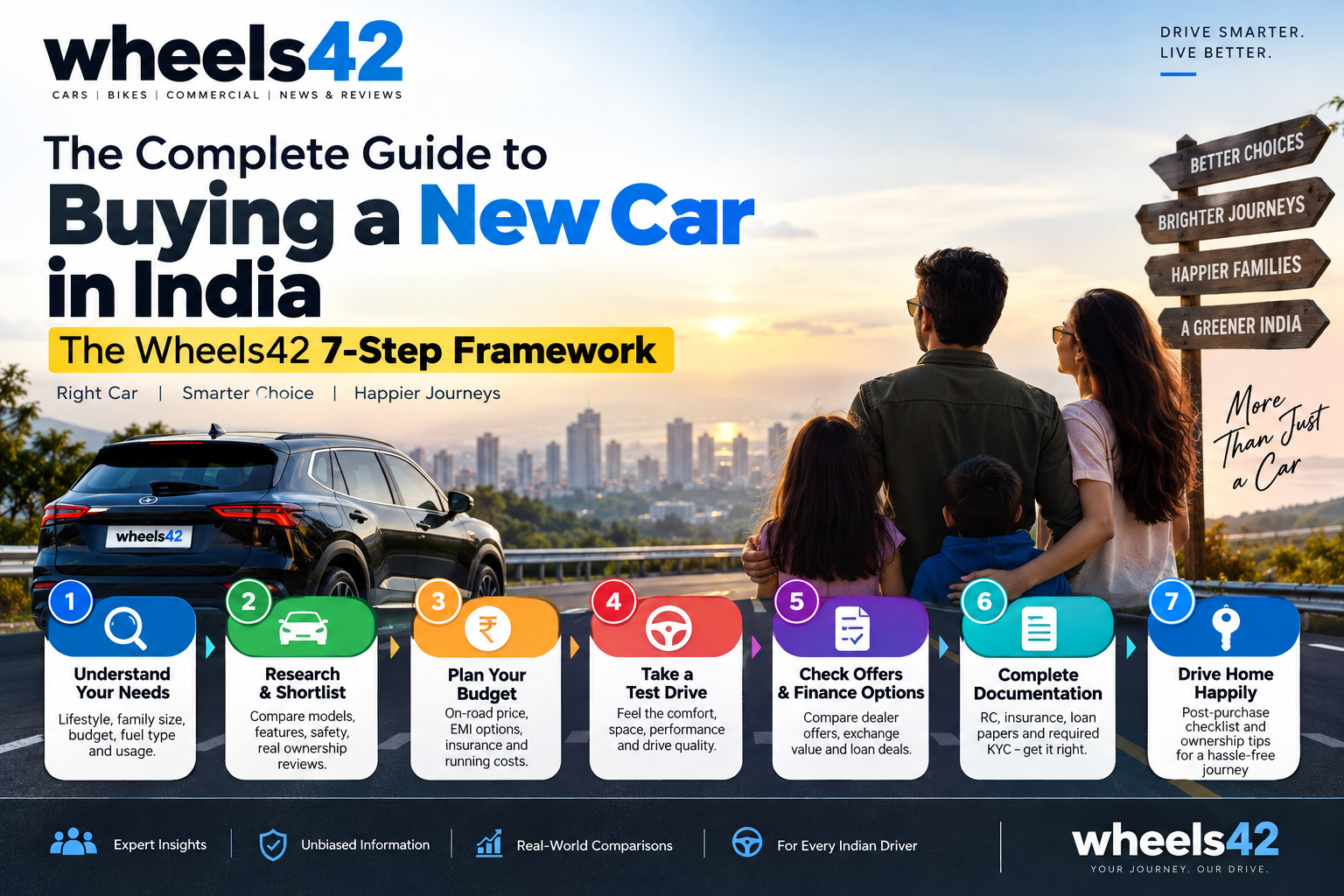
A practical New Car Buying Guide that takes you from "I think I need a car" to "I know exactly what to buy, what I can afford, and what to check before I take delivery."
The short version: buying a new car in India comes down to seven decisions, in this order. We call it the Wheels42 7-Step Framework, Fit, Affordability, Value, Safety, Ownership, Deal, Delivery. Get that order right and everything else falls into place. Get it wrong, say, falling for a fully loaded top variant before you've fixed your budget, and you'll overspend without even noticing it happened.
If you're a first time car buyer, read this once, start to finish. This isn't a generic template either, it's a car buying guide built for India, for the actual rules and habits you'll run into here. We didn't sit down to write the best car buying guide on the internet. We sat down to write real tips to buy a new car, the kind that still hold up once you're standing in a dealership, not just car buying tips that sound good in a listicle.
Before you fall for a specific model, settle what you actually need, not what looks good in the showroom lighting.
Petrol, diesel, CNG or electric each change your running cost in a different way, and the right pick depends on your driving pattern, not what your cousin bought last year. If you drive relatively little, especially in the city, work out the fuel-cost savings before paying extra for a diesel. The purchase-price gap, the fuel-price gap, your actual mileage, and how long you plan to keep the car all decide whether diesel pays off. For a low-mileage buyer, it can take years to earn back that upfront cost, sometimes longer than you'll even own the car.
Body type works the same way. Hatchback, sedan or SUV isn't really about looks. It's about what you carry, where you park at night, and how many people ride with you on a normal Tuesday, not just on road trips.
Then there's manual or automatic, which is becoming less of a debate every year. Clutch fatigue in bumper-to-bumper traffic is real, and automatics are winning more buyers because of it. Just know they cost a bit more to buy, and a bit more to fix later.
Here's the catch nobody explains well: the price on the brochure isn't what you'll pay. There's a real gap between ex-showroom and on-road price, once you add registration, insurance and handling charges, and that gap can run into six figures depending on your state and the car.
So build your realistic budget around the on-road number, not the ex-showroom one. A useful check: keep your total monthly car cost, EMI plus fuel plus insurance plus maintenance, comfortably within your take-home income. A commonly used rule of thumb is around 15 to 20%, but honestly, your existing EMIs, rent and savings goals matter more than any fixed percentage. Treat that range as a starting point, not gospel.
If you're financing it, your EMI matters just as much as the sticker price, so sort out your car loan terms early, not after you've already fallen for a variant you can't actually afford. A longer tenure lowers your EMI but raises what you pay in interest overall, so run the numbers both ways before you sign.
Fill this in before you walk into a dealership:
|
|
|
|
|
|
|
|
|
|
|
|
|
|
|
|
|
|
|
|
|
|
|
|
|
|
|
Once this is filled in, you'll know your real number, not a guess you're hoping holds up.
Base, mid or top variant is where most first-time buyers freeze. Everyone tells you to compare features. Almost nobody tells you how.
Here's the Wheels42 way to do it. When you're stuck choosing between two similar models (or two variants of the same one), score each option from 1 to 5 across these ten factors, then add it up.
| Factor | What earns the point |
|---|---|
| Price difference | Lower on-road price |
| Monthly EMI difference | Lower EMI for the same tenure |
| Safety | More airbags, better crash rating |
| Service cost | Cheaper annual maintenance |
| Resale | Stronger resale track record |
| Fuel economy | Better real-world mileage |
| Boot space | More usable litres |
| Warranty | Longer standard or extended cover |
| Feature difference | More of what you'll actually use daily |
| Ownership profile | Better match for your driving pattern |
Add up both columns. The higher total is your logical pick. But here's the catch: don't let the number overrule a real dealbreaker. If one car fails on safety for your family, no score fixes that.
And not every factor deserves equal weight for everyone. A family buyer should probably weight safety and service cost higher than the rest. A city commuter cares more about fuel economy and resale than performance. A highway driver should weight comfort and boot space above almost everything else. There's no single right formula here, so decide what actually matters to you before you score, then let the table confirm it, not replace it.
Before you score anything, write down what you actually need:
|
|
|
|
|
|
|
|
|
|
|
|
|
|
|
|
|
|
|
|
It sounds simple, but it's the step most buyers skip. And skipping it is exactly how people end up paying for a sunroof they never open.
Ask the dealer for the crash-test rating before you ask about the sunroof. Seriously.
Six airbags should sit high on your checklist, but here's the thing, it isn't a legal minimum in India, whatever you may have heard. Front airbags are mandatory, a wider six-airbag rule was proposed by the government and then dropped after industry pushback, and plenty of cars offer six anyway because buyers now ask for them. So don't judge a car's safety on airbag count alone. We break down how many airbags actually make a difference for your kind of driving in our full safety primer, alongside the Bharat NCAP and Global NCAP ratings, which tell you far more about how the car actually holds up in a real crash.
Most buyers focus so hard on the purchase that they forget the car keeps costing money every month after that. Budget for your ongoing maintenance and service costs, fuel, and insurance together, not one at a time, because that's how they'll actually hit your account.
Resale matters more than people think, too. Two cars at the same price today can be worth very different amounts in five years, and that gap is often bigger than whatever discount you negotiated on day one.
Dealers expect it, so don't feel awkward about it. Get quotes from at least two dealerships for the same variant, mention the competing quote out loud, and bring up dealer negotiation room on accessories and the extended warranty too, not just the car's price. One trick that actually works: ask for the on-road price as one single number upfront, not broken into fifteen line items. A single number is harder to quietly pad than a stack of small ones you're not watching closely. And company-fitted vs aftermarket accessories is worth asking about too, the same part fitted outside the dealership is often cheaper, sometimes by a lot.
Three India-specific things worth knowing before you sign anything:
First, if your car's invoice value crosses ₹10 lakh, the dealer has to collect 1% TCS, tax collected at source, on top of the price. It isn't a hidden fee though. It's linked to your PAN, and you can claim it back or adjust it against your tax when you file your return. Most buyers just don't know to look for it.
Second, if you're financing the car, the bank or NBFC holds hypothecation on it until the loan closes, meaning it's technically their asset on paper until you're done paying. You'll need their No Objection Certificate before you can sell or transfer it later, so keep that in mind if you're planning to upgrade in a few years.
Third, check whether insurance bought through the dealer is actually cheaper than buying it separately. Sometimes it is, sometimes it very much isn't, and the only way to know is to compare both quotes side by side instead of just accepting whatever the dealer offers.
The best time of year to buy a new car in India lines up with when dealers most want to hit their targets. Fiscal year-end in March, festive months, and month-ends in general are when you'll find the best discount on offer. It's not guaranteed every single time, but it's a real pattern, not a myth someone made up.
Once you've picked your car, know the documents required before you walk in, it saves a second trip. Usually that's your PAN card, address proof, a couple of passport-size photos, and if you're financing it, income proof for the loan too. You'll also need proof of insurance sorted before the dealer can register the car, earlier in the process than most first-time buyers expect.
The booking process itself is simple, but ask about the waiting period for your exact variant and colour before you commit. Some combinations take longer to arrive than others, sometimes by weeks, and nobody volunteers that information unless you ask directly.
And on the day itself, don't skip the pre-delivery inspection. Here's why it matters: once you sign, most of these become someone else's problem to fix, if they get fixed at all. Walk around the car slowly, check the odometer reads under 20 to 30 km, and look for panel gaps and paint mismatches. Then go further than most buyers do. Check the VIN or chassis number matches the invoice. Note the manufacturing month stamped on the door frame, a car built many months before delivery is a fair thing to ask about. Check the tyre manufacturing date on the sidewall. And test every basic function, horn, wipers, AC, all windows, central locking, before you sign anything. Our delivery day checklist covers this in full, item by item.
A good buying guide tells you how to buy. A better one tells you when to stop and think twice. So before you finalise anything:
Not everyone needs a new car, either. Weighing a new car versus a used one honestly is worth doing before you commit, and if a well-inspected used car fits your budget better, that's a real path worth looking into.
Otherwise, here's the natural next step. Set your budget using the worksheet above, browse cars that fit it, compare your shortlist using the Wheels42 score, work out your EMI, then book a test drive. That's the whole path, from deciding to driving.
That's the Wheels42 7-Step Framework: Fit, Affordability, Value, Safety, Ownership, Deal, Delivery. Whether this is your first car buying guide or your fifth, the order holds up either way