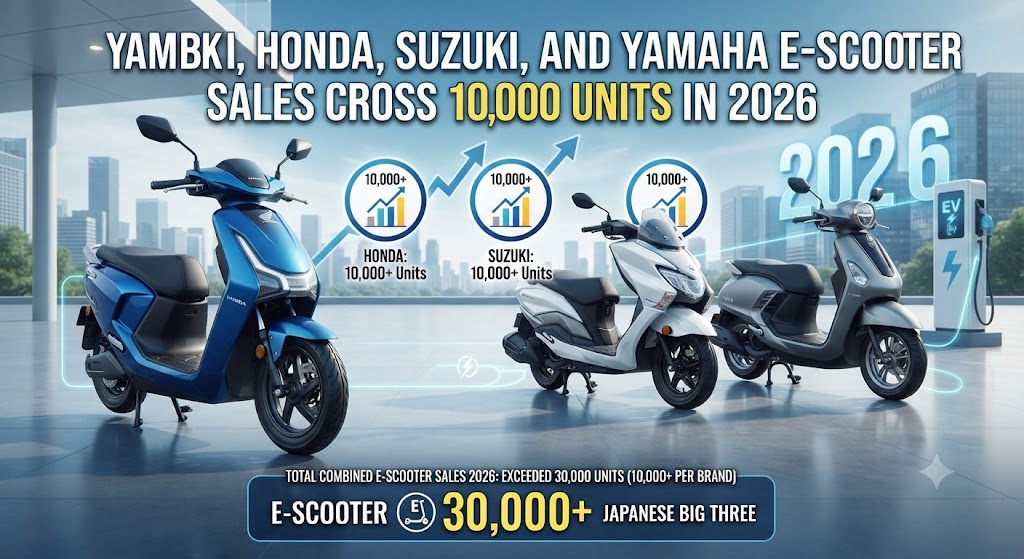
India’s electric two-wheeler market is attracting established Japanese manufacturers as Honda, Suzuki and Yamaha continue to expand their presence in the segment. Their electric scooters include the Honda Activa e: and QC1, Suzuki e-Access and Yamaha EC-06.
The three brands entered India’s electric scooter market later than several domestic competitors. Their progress is being closely watched as traditional two-wheeler manufacturers introduce electric models alongside their established petrol-powered line-ups.
A note on the sales figure: Published reports have shown different totals depending on the period and whether they count factory dispatches or customer registrations. For example, retail data for FY2026 recorded fewer than 5,000 combined units for the three Japanese brands. The 10,000-unit figure in the headline should therefore be verified against the specific reporting period before publication.
Honda, Suzuki and Yamaha Electric Scooters: Key Details
|
Brand
|
Electric scooter
|
Key detail
|
|
Honda
|
Activa e: and QC1
|
Two electric models for the Indian market
|
|
Suzuki
|
e-Access
|
Suzuki's electric scooter offering
|
|
Yamaha
|
EC-06
|
Electric scooter introduced in selected markets
|
Suzuki e-Access Leads Among the Three Japanese Brands
Suzuki bikes has gained an early lead among the three Japanese manufacturers in India's electric scooter segment. Its e-Access combines a familiar scooter format with an electric powertrain, targeting buyers who want a practical vehicle for daily commuting.
During January–April 2026, Suzuki recorded 2,261 wholesale dispatches and 1,161 retail registrations for the e-Access, according to published industry figures. These numbers placed Suzuki ahead of Honda and Yamaha over that period.
The e-Access is an important part of Suzuki's electrification strategy in India. Its longer-term performance will depend on pricing, dealership reach, charging convenience and customer confidence in battery-powered scooters.
Honda Expands Its Electric Scooter Line-Up
Honda bikes entered India's electric scooter market with the Activa e: and QC1. The company is leveraging its established presence in the conventional scooter segment while developing a separate electric offering.
Honda recorded 1,284 wholesale dispatches and 1,039 retail registrations for the Activa e: and QC1 combined between January and April 2026. Its retail performance subsequently improved, with the company recording more than 800 deliveries in June 2026 for the first time, according to industry reporting.
Honda's established brand recognition and extensive two-wheeler customer base could support future electric scooter growth. However, competition from established EV manufacturers means that pricing, real-world range, battery ownership costs and availability will remain important factors.
Yamaha EC-06 Targets the Electric Scooter Market
Yamaha bikes joined India's electric scooter segment with the EC-06, adding an electric model to its existing motorcycle and scooter portfolio.
Between February and April 2026, Yamaha recorded 426 wholesale dispatches and 140 retail deliveries, according to published figures. The model was initially available in selected cities, limiting its early reach compared with brands offering broader distribution.
Expanding availability and improving customer awareness will be important if Yamaha wants to increase its electric scooter sales in India. The EC-06 also gives the company an opportunity to understand local demand before expanding its electric portfolio further.
Competition From Indian Electric Scooter Brands
Honda, Suzuki and Yamaha face strong competition from Indian manufacturers and EV-focused companies. TVS, Bajaj, Ather and Hero's Vida brand have built significant positions in India's electric two-wheeler market.
For established Japanese manufacturers, the challenge is not simply to introduce electric scooters but to scale sales in a segment where customers closely compare upfront prices, range, charging times, battery warranties and after-sales support.
Their experience in petrol-powered scooters could help them attract buyers who already trust their brands. However, success in electric mobility will depend on how effectively they adapt their products and distribution networks to EV ownership.
Honda, Suzuki and Yamaha E-Scooter Sales Cross 10,000 Units in 2026
The three manufacturers have the potential to expand their electric scooter sales as awareness and acceptance of electric mobility increase. Their future performance will depend on product updates, pricing, dealership coverage and the availability of convenient charging options.
Suzuki's early lead among the trio gives it a useful starting position, while Honda's established scooter customer base and Yamaha's entry into the segment create opportunities for further growth.
The reported 10,000-unit milestone should be assessed using a clearly defined period and sales measure, as wholesale dispatches and retail registrations can produce different totals.
 Khyati Sharma 2026-10-09