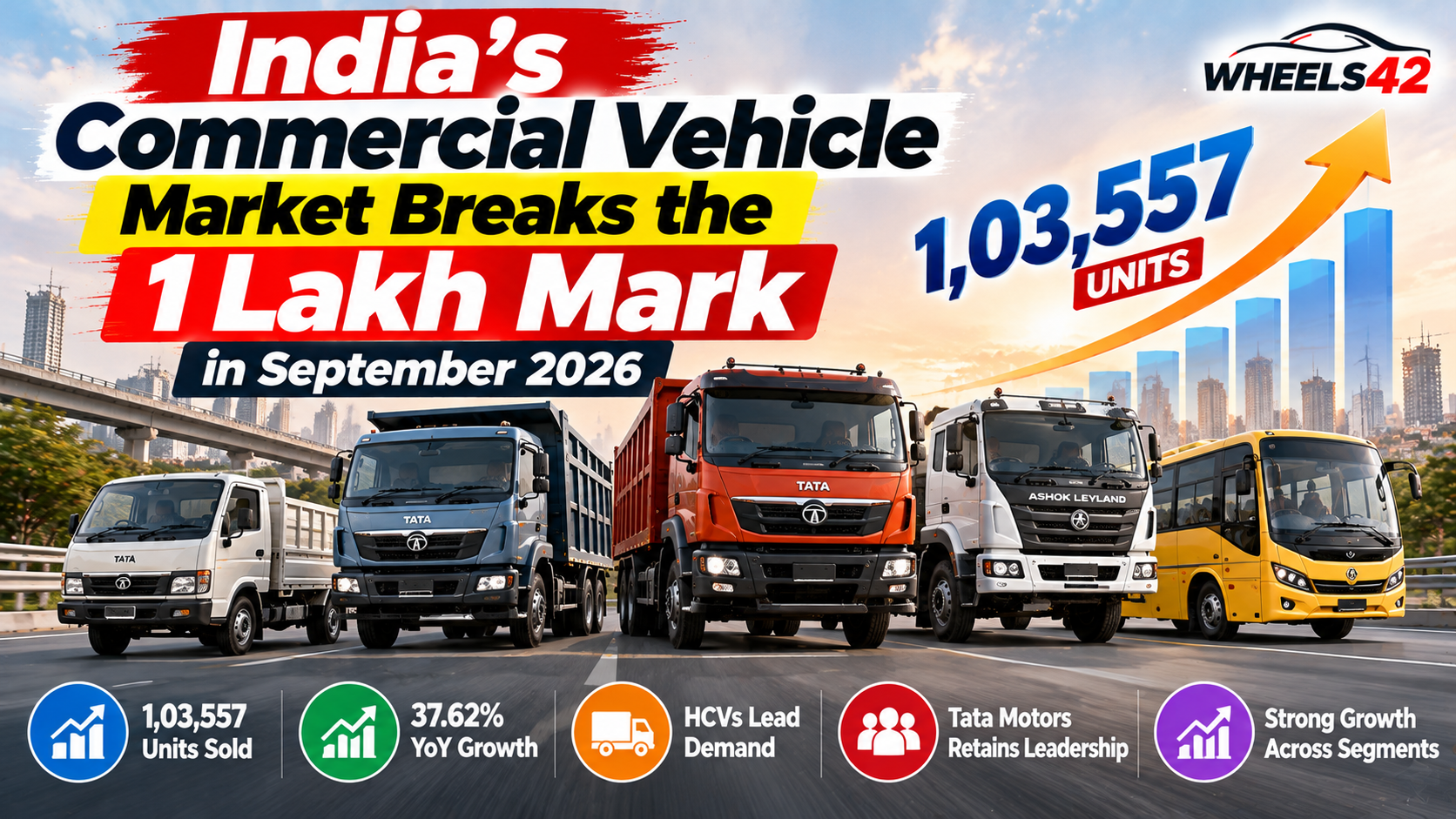
India’s commercial vehicle market recorded a major milestone in September 2026, with retail sales crossing the one-lakh-unit mark for the first time in the month of September.
According to the latest retail data from the Federation of Automobile Dealers Associations (FADA), commercial vehicle registrations stood at 1,03,557 units in September 2026. This represents a 37.62% year-on-year increase over September 2025 and a 14.09% month-on-month growth compared with August 2026.
The strong performance was supported by demand across light, medium and heavy commercial vehicles, with heavy commercial vehicles recording the fastest growth during the month.
Commercial Vehicle Retail Sales September 2026
|
Category
|
46266
|
46235
|
45901
|
YoY Growth
|
MoM Growth
|
|
Total Commercial Vehicles
|
1,03,557
|
90769
|
75246
|
0.3762
|
0.1409
|
|
LCV
|
62398
|
55972
|
46519
|
0.3413
|
0.1148
|
|
MCV
|
8789
|
8092
|
6561
|
0.3396
|
0.0861
|
|
HCV
|
32310
|
26640
|
22097
|
0.4622
|
0.2128
|
|
Others
|
60
|
65
|
69
|
-0.1304
|
-0.0769
|
The LCV segment remained the biggest contributor, accounting for 62,398 units during the month. However, the strongest growth came from HCVs, which increased 46.22% compared with the same period last year.
HCV Demand Leads the Growth
Heavy commercial vehicles emerged as the strongest-performing major CV category in September.
HCV retail sales reached 32,310 units, compared with 22,097 units in September 2025. This translates into 46.22% YoY growth. On a monthly basis, HCV sales increased by 21.28% from August 2026.
The strong performance points towards healthy demand for trucks and other heavy-duty vehicles used in freight movement, infrastructure projects, mining and industrial transportation.
LCVs Continue to Dominate Volumes
Light commercial vehicles continued to account for the largest share of India's commercial vehicle retail market.
LCV registrations stood at 62,398 units in September 2026, up from 46,519 units in the same month last year. The segment recorded 34.13% YoY growth and 11.48% MoM growth.
LCVs are widely used for last-mile deliveries, urban distribution, e-commerce logistics, small businesses and goods transportation, making them an important indicator of activity across India's logistics ecosystem.
Tata Motors Retains Market Leadership
Tata Motors remained the largest commercial vehicle brand in India's retail market during September 2026.
The company recorded 35,931 retail sales, giving it a 34.70% market share. Its sales were higher than the 24,449 units registered in September 2025.
Rural Demand Also Supports CV Growth
Commercial vehicle demand grew strongly in both rural and urban markets.
Rural CV retail sales increased 40.44% YoY, compared with 35.15% growth in urban markets. On a month-on-month basis, rural sales increased 14.25%, while urban sales rose 13.94%.
The stronger rural performance suggests that demand is not limited to large cities and is also being supported by activity in smaller towns and rural markets.
What Is Driving Commercial Vehicle Demand?
Several factors contributed to the strong September performance.
The industry saw continued replacement demand, while infrastructure and mining activity supported demand for heavy vehicles. Fleet purchases for transporting materials such as steel and cement also contributed to the growth.
Higher rural incomes and purchases ahead of expected vehicle price increases in October provided additional support. The half-year-end buying cycle also encouraged some fleet operators and businesses to complete purchases during September.
Commercial Vehicle Retail Sales in FY2026-27
The strong September performance also helped improve the overall commercial vehicle performance during the first half of FY2026-27.
Between April and September 2026, commercial vehicle retail sales reached 5,85,217 units, representing a 21.48% increase over the corresponding period of the previous financial year.
This indicates that the commercial vehicle market has maintained healthy momentum beyond a single month's performance.
Diesel Still Dominates the CV Market
Despite increasing electrification, diesel remained the dominant fuel type in India's commercial vehicle retail market during September.
Diesel-powered vehicles accounted for around 80.76% of CV retail sales. CNG/LPG vehicles contributed 12.07%, while electric commercial vehicles accounted for 4.04%. Petrol and ethanol-powered vehicles made up 3.11%.
The EV share was lower than August but remained above the level recorded in September 2025.
What to Expect in the Coming Months?
The commercial vehicle market is entering an important period as the festive season gathers momentum.
Demand from logistics, infrastructure, construction, mining and freight operators could continue supporting CV sales. At the same time, October price increases, vehicle availability and changing weather conditions could influence purchasing decisions.
The September numbers provide a strong starting point for the festive quarter, although the industry will need to maintain this momentum after the impact of seasonal buying and the favourable year-on-year comparison begins to normalise.
 Khyati Sharma 2026-10-08