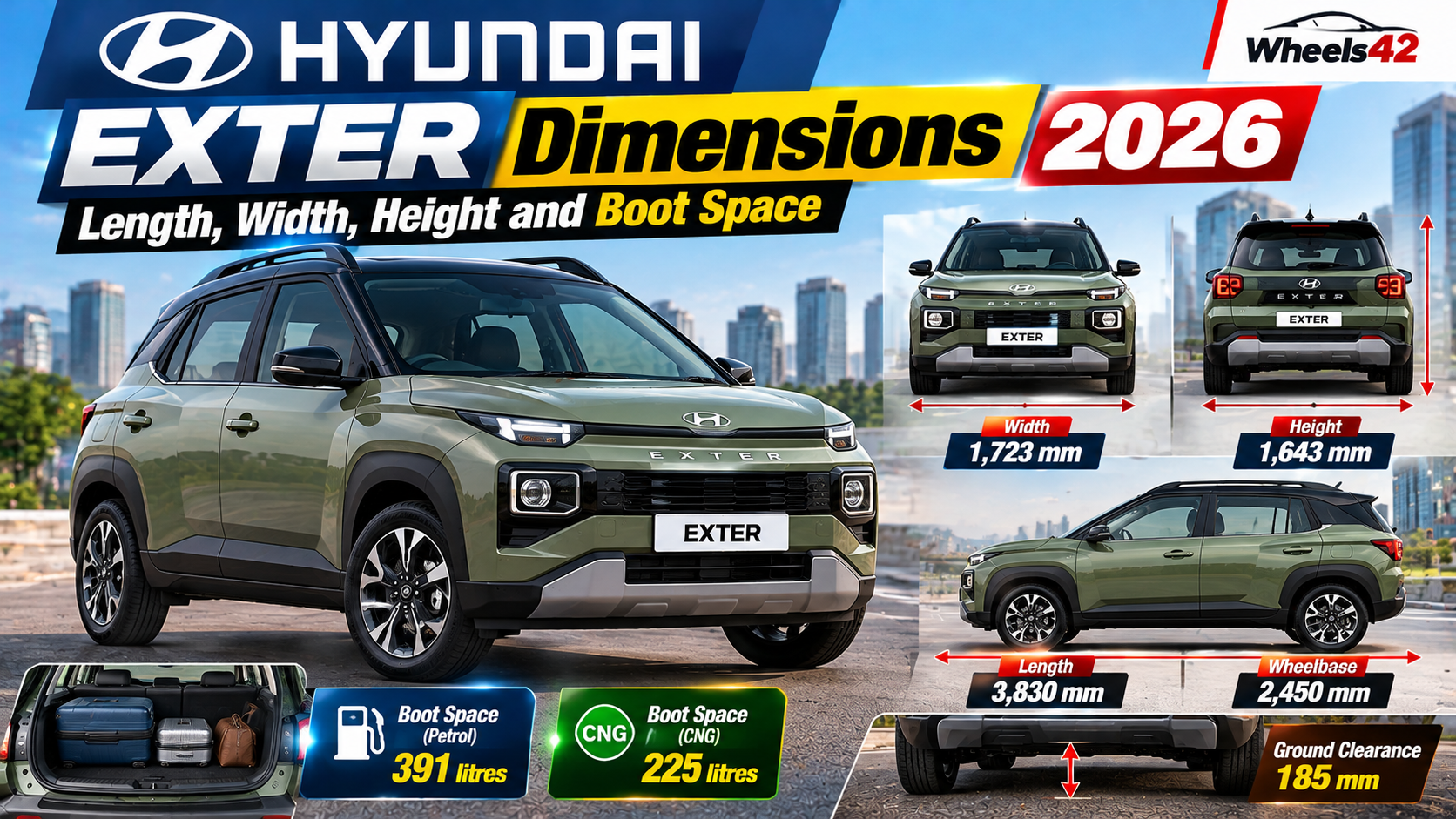
The Hyundai Exter 2026 is a compact SUV designed for buyers who want SUV-inspired styling, practical cabin space and easy manoeuvrability for everyday driving. The updated model brings revised exterior details and interior enhancements while retaining its compact footprint.
For buyers comparing small SUVs, dimensions are important because they influence parking convenience, cabin comfort, road presence and luggage capacity. Here is a detailed look at the Hyundai Exter’s length, width, height, wheelbase, ground clearance and boot space.
Hyundai Exter Dimensions 2026: At a Glance
|
Specification
|
Hyundai Exter 2026
|
|
Length
|
3,830 mm
|
|
Width
|
1,723 mm
|
|
Height
|
1,643 mm (with roof rails)
|
|
Wheelbase
|
2,450 mm
|
|
Ground clearance
|
185 mm
|
|
Boot space – Petrol
|
391 litres
|
|
Boot space – CNG
|
225 litres
|
|
Seating capacity
|
5 passengers
|
|
Body style
|
Compact SUV / micro SUV
|
Hyundai Exter Length: 3,830 mm
The Hyundai Exter measures 3,830 mm in length. Its compact overall length makes it suitable for city driving, tight streets and parking spaces where larger SUVs can be difficult to manoeuvre.
Despite its small footprint, the Exter has an upright body shape and SUV-inspired exterior design. These elements help give it a substantial road presence without making it as long as a midsize SUV.
For buyers who regularly drive through congested urban areas, the Exter’s length offers a practical balance between exterior size and everyday usability.
Hyundai Exter Width: 1,723 mm
The Exter has an overall width of 1,723 mm. Width plays an important role in determining cabin shoulder room and how easily a vehicle can move through narrow roads.
The Exter’s dimensions are intended to provide a comfortable cabin for everyday family travel while maintaining a manageable size for urban use. Its five-seat layout makes it suitable for small families and daily commuting.
Actual comfort will also depend on seat design, passenger size and how many people are travelling in the vehicle.

Hyundai Exter Height: 1,643 mm
The Hyundai Exter stands 1,643 mm tall with roof rails. Its relatively tall body contributes to its upright SUV appearance and helps provide a higher seating position than many conventional hatchbacks.
A taller body can also help with headroom and ease of entry and exit. Hyundai’s 2026 update continues to emphasise the Exter’s SUV stance, with revised bumpers, a redesigned grille and additional exterior detailing.
The overall height figure includes roof rails, so buyers comparing it with another vehicle should check whether that model’s published height includes roof-mounted equipment.
Hyundai Exter Wheelbase: 2,450 mm
The Exter has a 2,450 mm wheelbase, measured between the centres of the front and rear wheels.
Wheelbase is an important dimension because it affects cabin packaging, legroom potential and the vehicle’s proportions. The Exter’s wheelbase helps Hyundai accommodate a five-seat cabin within a compact exterior footprint.
However, wheelbase alone does not determine rear-seat comfort. Seat cushioning, seatback angle and the space available around passengers also affect comfort on longer journeys.
Hyundai Exter Boot Space: 391 Litres
The Hyundai Exter offers 391 litres of boot space in petrol variants, giving it room for everyday shopping, backpacks and luggage for shorter trips.
This capacity can be useful for small families that need a vehicle for commuting during the week and occasional weekend travel. The practical space available will depend on the size and shape of the luggage being carried.
Hyundai Exter Petrol vs CNG Boot Space
|
Specification
|
Petrol
|
CNG
|
|
Claimed boot space
|
391 litres
|
225 litres
|
|
Fuel configuration
|
Petrol
|
Petrol + CNG
|
|
CNG storage system
|
Not applicable
|
Dual-cylinder setup
|
|
Best suited for
|
Buyers prioritising luggage capacity
|
Buyers considering CNG running costs
|
The CNG version offers less luggage capacity because the fuel-storage arrangement takes up space. Hyundai’s dual-cylinder CNG layout is designed to preserve more usable boot space than some conventional CNG installations, but its quoted 225 litres remains lower than the petrol version’s 391 litres.
Buyers who regularly carry large suitcases, strollers or bulky equipment should compare the boot layouts in person before choosing a fuel type.
Hyundai Exter Ground Clearance
The Hyundai Exter has a quoted ground clearance of 185 mm. Ground clearance refers to the distance between the road surface and the vehicle’s lowest relevant underside point under the specified measurement conditions.
This clearance can be helpful when negotiating ordinary speed breakers, uneven urban roads and some rough patches. However, drivers should still approach tall speed breakers and deep potholes carefully, as the actual risk of underbody contact depends on the obstacle, vehicle load and approach angle.
Ground clearance should not be confused with overall height: the former relates to the space underneath the vehicle, while the latter measures the vehicle’s external height.
How Practical Are the Hyundai Exter’s Dimensions?
The Exter’s dimensions make it a practical option for buyers who want a compact vehicle with SUV styling and useful luggage capacity.
-
For city driving: Its 3,830 mm length helps keep the overall footprint manageable.
-
For cabin packaging: The 2,450 mm wheelbase supports a five-seat layout.
-
For luggage: The petrol model’s 391-litre boot provides more cargo capacity than the CNG version.
-
For uneven roads: The quoted 185 mm ground clearance offers useful clearance for typical road conditions, although careful driving remains important.
-
For parking: Its compact length can make it easier to fit into urban parking spaces than a larger SUV.
These figures provide a useful starting point, but buyers should consider their usual passenger count, luggage requirements and parking conditions before making a decision.

 Khyati Sharma 2026-10-10