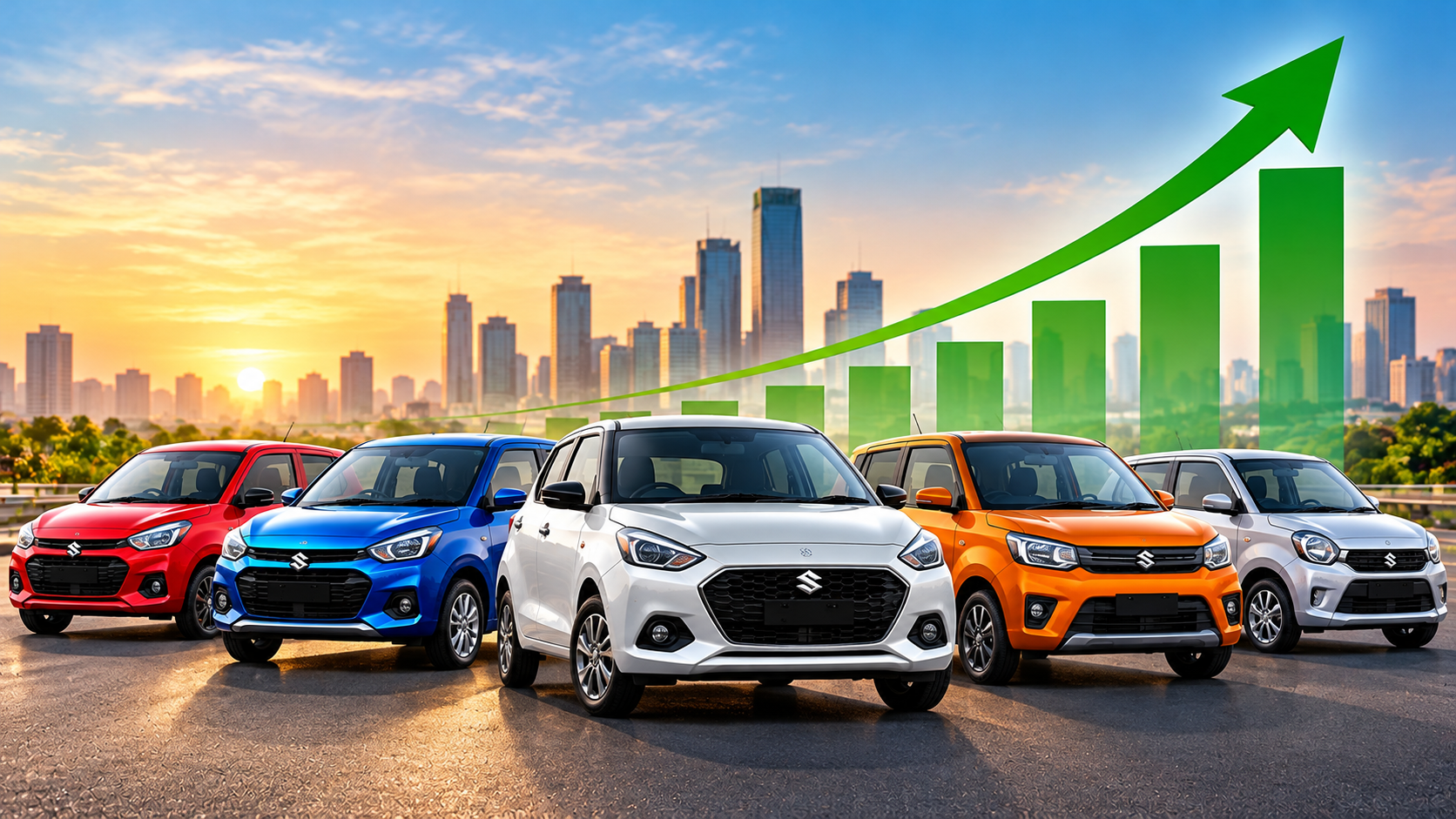
India's entry-level passenger car segment is showing signs of recovery, with mini car sales reportedly climbing 86% in the first half of FY2026–27. The sharp increase points towards renewed interest in affordable cars as buyers continue to consider purchase prices, fuel efficiency, maintenance costs and everyday practicality when choosing their next vehicle.
The development is significant for India's automotive industry, where small hatchbacks have traditionally served as an important entry point for first-time car buyers and budget-conscious families. After a period of pressure on the entry-level segment, the reported growth could signal a change in demand patterns.
However, the increase in sales needs to be viewed in context. The percentage growth alone does not establish whether the segment has returned to its previous peak, and a comparison with the corresponding period last year is essential to understand the full picture.
Mini Car Sales Rise 86% in H1 FY2027
The reported 86% increase in mini car sales during the first half of FY2026–27 covers April to September 2026. The figures point to a strong improvement in the segment compared with the same period in the previous financial year.
Mini cars occupy the more affordable end of India's passenger vehicle market. They generally appeal to buyers seeking compact dimensions, easy manoeuvrability, relatively low running costs and accessible pricing.
The segment has faced challenges as many buyers have increasingly preferred compact SUVs and larger hatchbacks. Higher vehicle prices and the growing availability of feature-rich alternatives have also influenced purchasing decisions.
The reported recovery could indicate that affordable cars are regaining attention among consumers who prioritise value for money over vehicle size and additional features.

Alto and S-Presso Lead India's Mini Car Segment
The mini-car category under the Society of Indian Automobile Manufacturers (SIAM) classification includes the Maruti Suzuki Alto and S-Presso. These models are positioned towards customers looking for relatively affordable, compact petrol-powered cars.
According to data reported by Business Standard, domestic wholesale sales of mini cars increased from 40,405 units in April–September 2025 to 75,269 units during April–September 2026. In September alone, sales reached 10,079 units, up 39.8% from 7,208 units in September 2025.
The numbers indicate that the improvement was not limited to the final month of the period. Sales growth across the six-month period suggests that demand for entry-level vehicles has strengthened compared with the previous year.
Mini Car Sales in India: Key Figures
|
Sales indicator
|
H1 FY2025–26
|
H1 FY2026–27
|
Growth
|
|
Mini car wholesales
|
40,405 units
|
75,269 units
|
0.863
|
|
September mini car sales
|
7,208 units
|
10,079 units
|
0.398
|
|
Broader compact car segment
|
553,595 units
|
668,788 units
|
0.208
|
|
Overall passenger car wholesales
|
—
|
766,200 units
|
0.231
|
The broader compact car category also recorded growth, with wholesale volumes increasing 20.8% to 668,788 units in H1 FY2026–27. Meanwhile, overall passenger car wholesales rose 23.1% to 766,200 units during the same period.
These figures suggest that the recovery extends beyond the smallest cars, although demand remains uneven across different vehicle categories.
Why Is Demand for Affordable Cars Improving?
Several factors may be contributing to the renewed interest in entry-level cars.
1. Improved affordability
The GST rate changes introduced in September 2025 have been cited by the industry as a factor supporting demand for smaller vehicles. Lower tax burdens on eligible vehicles can improve affordability, although the actual benefit depends on the model and its pricing.
2. Demand from first-time buyers
Entry-level hatchbacks remain relevant for customers buying their first car. Their compact dimensions make them suitable for city driving, parking in tight spaces and daily commuting.
3. Focus on running costs
For budget-conscious households, fuel economy, maintenance expenses, insurance and financing costs can be as important as the initial purchase price. Smaller cars can be attractive when buyers want to manage the total cost of ownership.
4. Wider recovery in the passenger vehicle market
India's passenger vehicle industry also recorded strong wholesale growth in the first half of FY2026–27. That broader improvement provides a favourable backdrop for the mini-car segment, even as SUVs continue to account for a large share of passenger vehicle sales.
SUVs Still Dominate, but Small Cars Are Showing Signs of Recovery
India's growing preference for SUVs has changed the passenger vehicle market over recent years. Buyers are increasingly looking for higher ground clearance, spacious cabins, modern features and a commanding driving position.
However, the latest mini-car sales figures suggest that affordable hatchbacks continue to have a role in the market. For buyers who primarily need a vehicle for commuting, shopping and short family journeys, a smaller car can offer a practical alternative to a larger SUV cars.
The 86.3% increase is particularly notable because it follows a period of weak demand in the entry-level segment. However, the growth also comes from a relatively low comparison base, so it should not automatically be interpreted as a complete recovery.
What Does the Sales Recovery Mean for Car Buyers?
The improvement in mini-car sales could encourage manufacturers to pay greater attention to the entry-level market. Competitive pricing, improved safety equipment, better fuel efficiency and attractive financing options may help the segment maintain momentum.
For customers, stronger competition could mean more choices and better-value offers. Buyers should nevertheless compare the actual on-road price, standard safety features, warranty coverage, service costs and fuel efficiency before selecting a vehicle.
The next few months will be important in determining whether the recovery continues through the festive season and into the second half of FY2026–27.
Outlook for India's Entry-Level Car Market
The latest figures provide encouraging signs for India's small-car market. Mini car wholesale sales rose 86.3% in H1 FY2026–27, while September volumes increased 39.8% year-on-year. The wider compact car category also recorded healthy growth.
Still, the long-term outlook will depend on purchasing power, vehicle prices, financing availability and consumers' changing preferences. SUVs are likely to remain important to the market, but affordable hatchbacks could regain some ground if manufacturers continue to meet the needs of price-sensitive buyers.
For now, the figures suggest that India's entry-level car segment is showing meaningful signs of recovery rather than disappearing under the pressure of the SUV boom.

 Khyati Sharma 2026-10-15