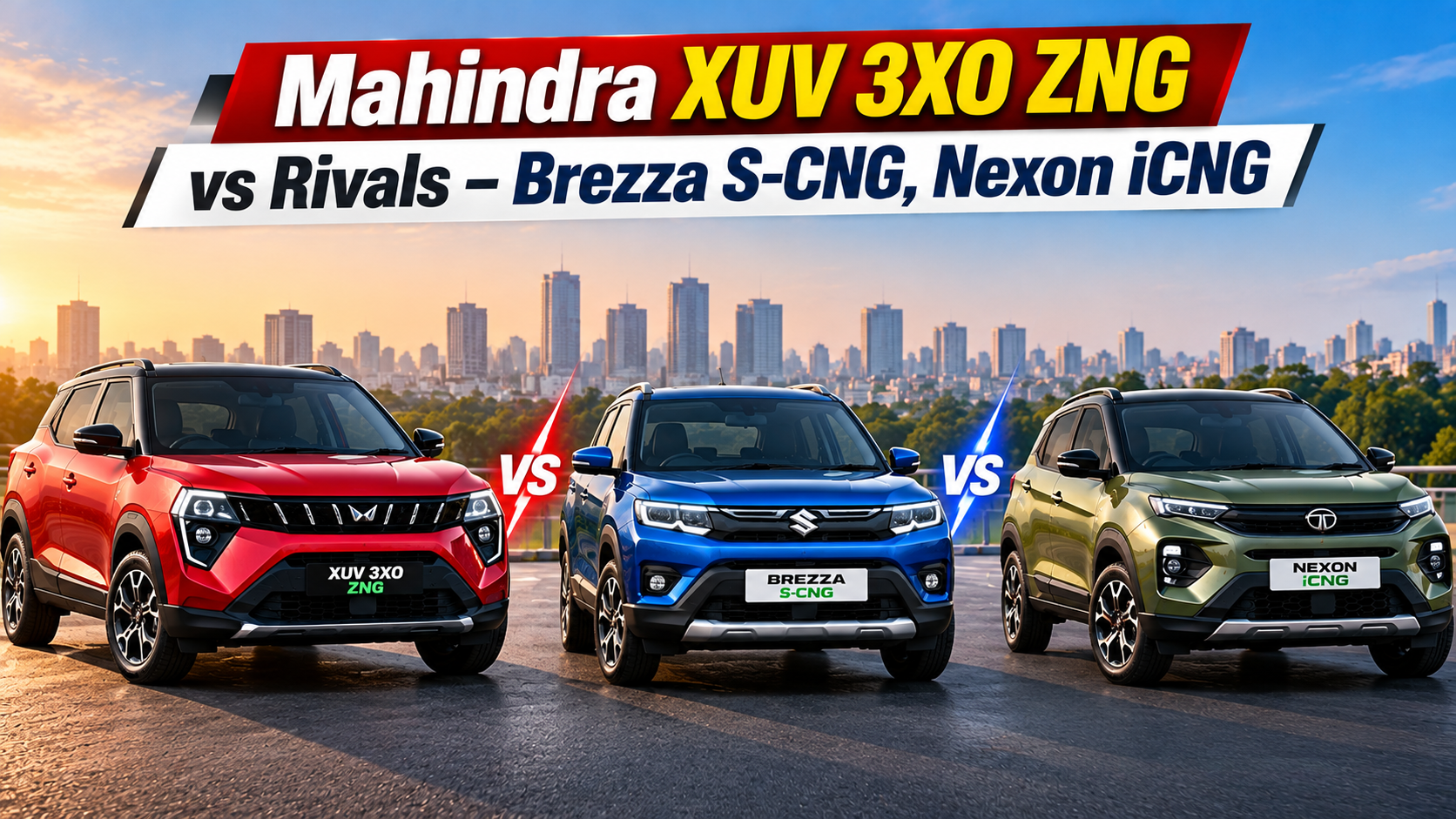
Mahindra car has expanded its compact SUV lineup with the launch of the XUV 3XO ZNG, its first mainstream passenger vehicle to receive a factory-fitted CNG powertrain. Priced from ₹9.99 lakh (ex-showroom), the new model brings turbocharged performance to the CNG SUV segment and takes on the Maruti Suzuki Brezza S-CNG and Tata Nexon iCNG.
The XUV 3XO ZNG stands out with its claimed mileage of 24.7 km/kg, 200 Nm of torque in both petrol and CNG modes, and a feature-rich cabin. However, the Brezza offers better claimed fuel efficiency, while the Nexon provides another turbocharged CNG option with a competitive entry price.
Here is a detailed comparison of the Mahindra XUV 3XO ZNG, Maruti Suzuki Brezza S-CNG and Tata Nexon iCNG, covering their prices, engines, mileage, features and practicality.
Mahindra XUV 3XO ZNG vs Rivals: Price Comparison
|
Model
|
Ex-showroom Price Range
|
Claimed CNG Efficiency
|
|
Mahindra XUV 3XO ZNG
|
₹9.99–12.27 lakh
|
24.7 km/kg
|
|
Maruti Suzuki Brezza S-CNG
|
₹9.35–11.71 lakh
|
26.9 km/kg
|
|
Tata Nexon iCNG
|
₹8.35–13.42 lakh
|
24.0 km/kg
|
The Tata Nexon iCNG is the most affordable option at the entry level in this comparison. The Brezza S-CNG sits between the Nexon and XUV 3XO ZNG on starting price, while the Mahindra commands a higher entry price than both.
However, the final buying decision should also consider engine performance, equipment, boot space and the features available in similarly priced variants.
Mahindra XUV 3XO ZNG: Turbocharged CNG Performance
The biggest highlight of the XUV 3XO ZNG is its 1.2-litre turbocharged petrol engine adapted to run on CNG. Mahindra says the powertrain produces 82 kW of power and 200 Nm of torque in both petrol and CNG modes.
The SUV cars uses optimised turbocharger calibration and engine control mapping to maintain the same headline output in either fuel mode. This is a significant distinction from conventional CNG vehicles, which often deliver lower output when operating on CNG.
Mahindra claims a fuel efficiency of 24.7 km/kg. The company also states that the SUV can accelerate from 0 to 60 km/h in 4.9 seconds in CNG mode.
The XUV 3XO ZNG uses a six-speed manual transmission and features twin CNG cylinders positioned to preserve usable luggage space. The combination of turbocharged performance, a factory-fitted system and modern equipment could appeal to buyers who want lower fuel costs without choosing a basic utility vehicle.
The model is offered in four variants: MX Edge, REVX Edge (O), AX5 and REVX A. Prices range from ₹9.99 lakh to ₹12.27 lakh, ex-showroom. Bookings and deliveries are scheduled to begin on October 20, 2026.
Maruti Suzuki Brezza S-CNG: Better Claimed Mileage
The Maruti Suzuki Brezza S-CNG focuses on fuel efficiency and everyday practicality. It uses a 1.5-litre naturally aspirated petrol engine paired with a factory-fitted CNG system and a six-speed manual gearbox.
In CNG mode, the engine produces around 88 PS and 121.5 Nm of torque. Its claimed efficiency of 26.9 km/kg is the highest among the three SUVs compared here.
The Brezza also benefits from an underbody CNG tank arrangement, which helps it retain a larger luggage compartment. Its reported boot capacity is approximately 328 litres, making it an appealing choice for families that regularly carry bags and other luggage.
Compared with the turbocharged Mahindra and Tata models, the Brezza delivers lower torque in CNG mode. Buyers prioritising acceleration and stronger pulling performance may therefore prefer one of the turbocharged alternatives.
Nevertheless, the Brezza S-CNG is a strong option for drivers who cover long distances, commute frequently or place fuel economy and luggage space above outright performance.
Tata Nexon iCNG: A Turbocharged Alternative
The Tata Nexon iCNG offers another approach to combining compact SUV practicality with lower running costs. It uses a 1.2-litre turbocharged petrol engine with a factory-fitted CNG system and a six-speed manual transmission.
The powertrain produces approximately 100 PS and 170 Nm of torque in CNG mode, according to published specifications. Tata claims a fuel efficiency of around 24 km/kg.
The Nexon iCNG also uses a twin-cylinder arrangement to make more effective use of the boot than a conventional large CNG cylinder might allow. Its reported luggage capacity is approximately 321 litres.
The Nexon's broad variant range gives buyers multiple price and equipment combinations. Depending on the selected version, features can include a touchscreen infotainment system, connected-car functions, a sunroof and other comfort and convenience equipment.
Its lower starting price makes it worth considering for buyers who want a turbocharged CNG SUV but are working with a tighter budget. However, buyers should compare the equipment available in each variant rather than choosing solely on the headline price.
Features and Practicality: Which SUV Stands Out?
The XUV 3XO ZNG offers a strong equipment package, even in its entry-level configuration. Mahindra highlights a 26.03 cm HD touchscreen, cruise control, rear AC vents and a 60:40 split rear seat. The range also includes six airbags, electronic stability control and ISOFIX child-seat mounts as standard, according to the manufacturer.
Higher variants offer additional convenience and technology features, depending on the trim.
The Brezza S-CNG focuses on family usability, with its underbody tank arrangement helping it retain more boot space. Its established position in the compact SUV segment may also appeal to buyers who prioritise everyday practicality and a broad service network.
The Nexon iCNG combines a turbocharged engine with a twin-cylinder CNG setup and a broad selection of variants. Its equipment and safety features vary by trim, so buyers should verify the specifications of the exact version they intend to purchase.
For luggage capacity, the Brezza has the advantage based on the reported figures. The Nexon follows, while the XUV 3XO ZNG has the smallest reported boot in this comparison.
Which CNG SUV Should You Buy?
Each of these SUVs serves a slightly different type of buyer.
Choose the Mahindra XUV 3XO ZNG if you want turbocharged performance, strong torque, modern equipment and the flexibility of petrol and CNG operation. Its identical headline power and torque figures in both fuel modes are a major selling point.
Choose the Maruti Suzuki Brezza S-CNG if fuel efficiency and luggage capacity are your main priorities. Its claimed 26.9 km/kg efficiency gives it the advantage for buyers who cover substantial distances.
Choose the Tata Nexon iCNG if you want a turbocharged CNG SUV with a lower entry price and a broad range of variants. It offers a middle ground between performance and affordability.
Before making a purchase, compare on-road prices, insurance, local CNG availability, waiting periods and the features included in the exact variant. Real-world mileage will also depend on traffic, driving style, passenger load and road conditions.
Final Verdict
The Mahindra XUV 3XO ZNG brings a distinctive proposition to India's CNG SUV market. Its turbocharged engine, 200 Nm torque output and claimed 24.7 km/kg efficiency make it an interesting alternative to the established Brezza S-CNG and Nexon iCNG.
The Brezza remains the efficiency-focused choice, while the Nexon provides a lower entry point into turbocharged CNG SUV ownership. The XUV 3XO ZNG, meanwhile, is aimed at buyers who want a stronger performance-oriented experience without giving up the potential running-cost benefits of CNG.

 Khyati Sharma 2026-10-19