Nissan and Honda Announce Joint Software and ECU Development
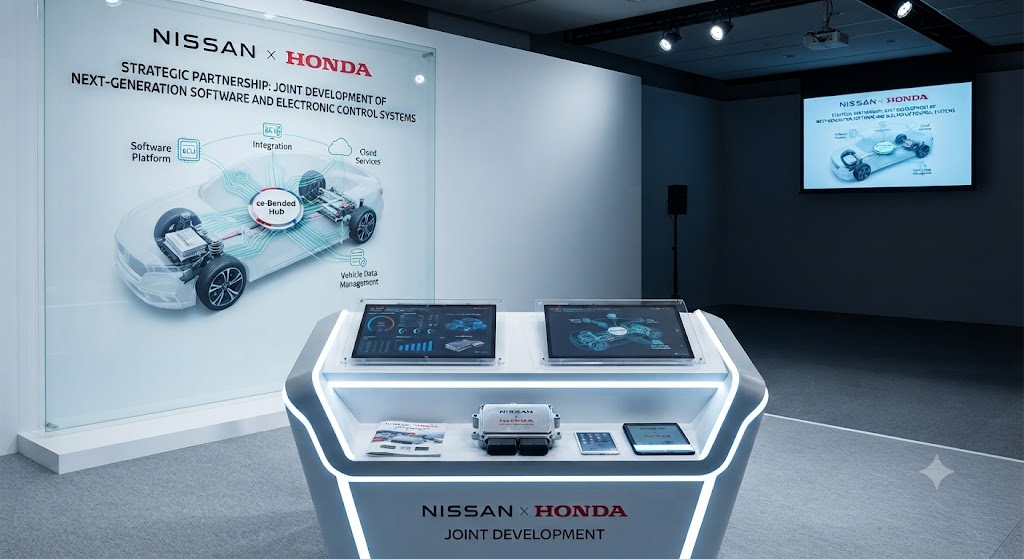
Nissan Motor and Honda Motor have entered into a joint development agreement to standardise key electronic control units (ECUs) and software for their next-generation software-defined vehicles (SDVs). The companies plan to use the jointly developed electrical and electronic architecture in their future SDVs from fiscal year 2029 onward.
The move marks a deeper technology collaboration between the two Japanese automakers as software becomes increasingly important in modern vehicles. Advanced software is playing a growing role in connected features, vehicle control, driver-assistance systems and the overall digital experience.
Common ECU Architecture for Future Vehicles
Under the agreement, Nissan and Honda will work on common specifications for multiple core ECUs that form an important part of the electrical/electronic architecture of their future vehicles.
The collaboration will cover high-performance main ECUs, including computing units based on system-on-chip technology, as well as zone ECUs that manage different areas of a vehicle.
Along with ECU hardware, the companies will jointly develop and standardise the in-vehicle operating system, key middleware components and vehicle-control software running on these systems.
Key Collaboration Details
| Area |
Details |
| Companies |
Nissan and Honda |
| Main Focus |
ECUs, operating systems and vehicle software |
| Vehicle Technology |
Software-Defined Vehicles (SDVs) |
| ECU Development |
Common specifications for key ECUs |
| Software Development |
Common operating system, middleware and vehicle-control software |
| Planned Deployment |
From fiscal year 2029 onward |
Focus on Software-Defined Vehicles
Software-defined vehicles are designed around increasingly centralised computing and software, allowing manufacturers to deliver more advanced functions and potentially update vehicle capabilities over time.
For Nissan and Honda, developing a common software foundation is expected to help simplify engineering work and improve development efficiency. The companies believe that sharing foundational technologies can help them make better use of their engineering resources while reducing duplicated development efforts.
Nissan Monthly Car Sales Figures
| Model | Jul '26 | Jun '26 | May '26 |
|---|
| Nissan Tekton | 1,670 | - | - |
| Nissan Magnite | 1,462 | 1,313 | 1,665 |
| Nissan Gravite | 1,386 | 1,839 | 1,283 |
| Nissan X-Trail | - | 2 | 3 |
| Monthly Total | 4,518 | 3,154 | 2,951 |
Planned From Fiscal 2029
The jointly developed electrical and electronic architecture is planned for use in next-generation SDVs from both companies starting in fiscal year 2029. Specific Nissan and Honda models that will receive the new architecture have not yet been announced.
The two automakers said the standardisation could help shorten development cycles, improve investment efficiency and reduce development costs. Greater economies of scale could also make it easier for both companies to invest in future vehicle technologies.
Why This Partnership Matters
The automotive industry is rapidly shifting toward vehicles that combine electrification, connectivity and software-driven features. This is increasing the complexity and cost of vehicle development.
By working together on core technology, Nissan and Honda can combine engineering expertise and development resources while continuing to maintain their individual vehicle brands and product strategies.
The partnership also reflects the growing importance of software capabilities in the global automotive market, where manufacturers are competing to offer more connected, intelligent and technology-focused vehicles.
Honda Monthly Car Sales Figures
| Model | Jul '26 | Jun '26 | May '26 |
|---|
| Honda Amaze | 3,436 | 2,937 | 2,660 |
| Honda Elevate | 1,949 | 1,635 | 1,461 |
| Honda City | 571 | 709 | 491 |
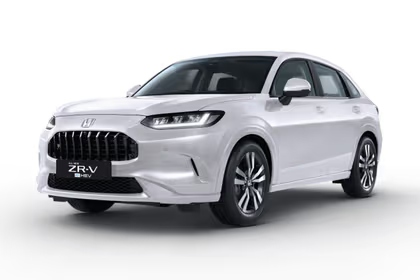
| Honda ZR-V | 58 | - | - |
| Honda City Facelift | - | - | 1,227 |
| Monthly Total | 6,014 | 5,281 | 5,839 |
More Collaboration Could Follow
Nissan and Honda have indicated that they will continue exploring additional areas of cooperation. Their broader strategic partnership includes ambitions related to carbon neutrality and vehicle safety, while the two companies continue to look for areas where joint development could create benefits for customers and improve development efficiency.
For now, the ECU and software agreement represents a significant step toward a shared technology foundation. If the programme progresses as planned, Nissan and Honda's next-generation vehicles from fiscal 2029 could feature more closely aligned underlying electronic and software architecture while retaining their distinct brand identities.

 Khyati Sharma 2026-09-01