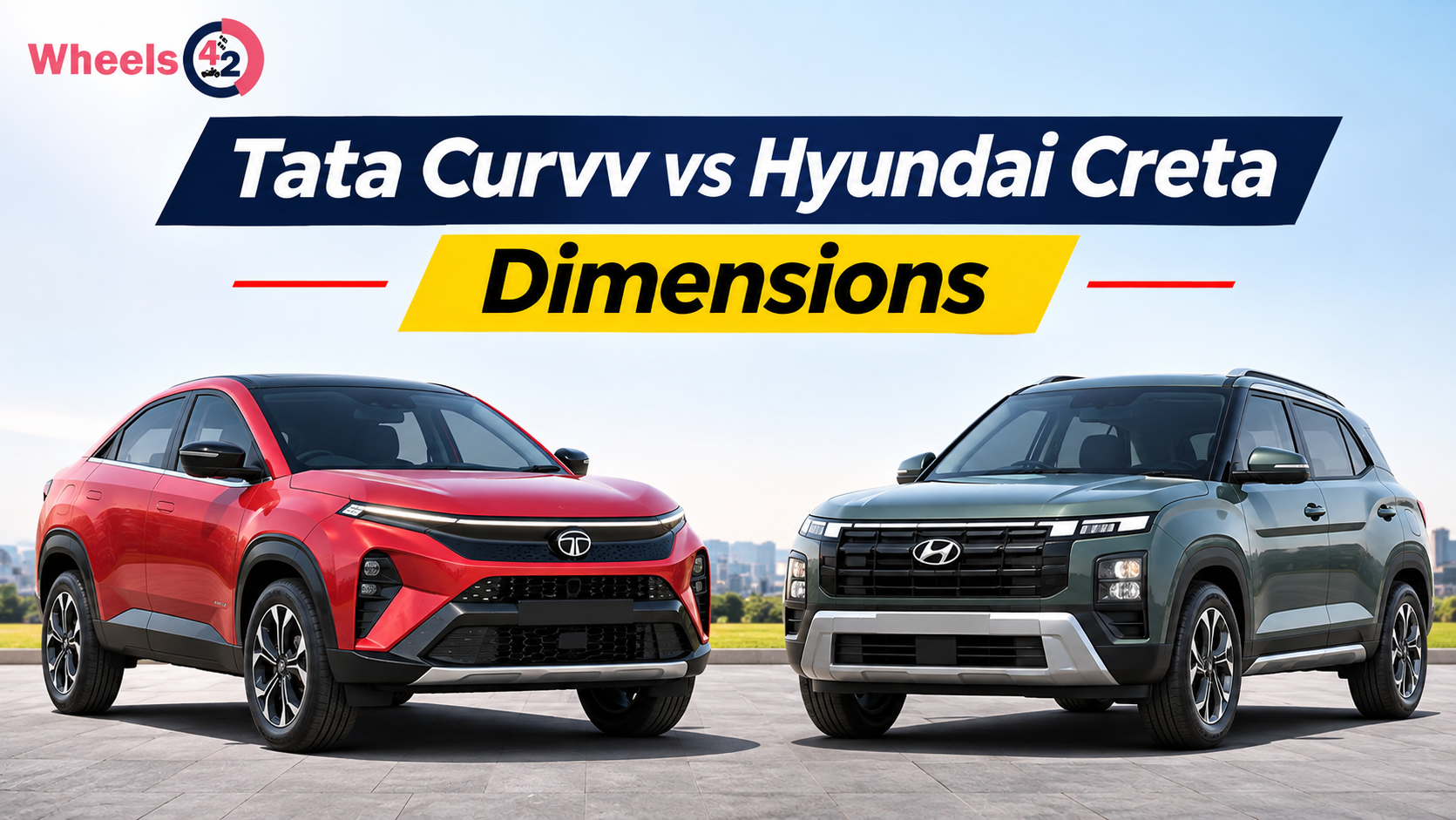
The Tata Curvv and Hyundai Creta are two popular choices in India's midsize SUV cars segment, offering different exterior designs and practical features. While the Hyundai Creta follows a traditional SUV design, the Tata Curvv stands out with its coupe-inspired roofline and sporty styling.
Both models target buyers looking for a five-seater SUV with a comfortable cabin, modern features and sufficient luggage capacity. However, their dimensions reveal some interesting differences that could influence a buyer's decision.
The Tata Curvv is wider and offers a larger boot, while the Hyundai Creta is slightly longer, taller and has a longer wheelbase. These differences can affect exterior proportions, cabin packaging and everyday usability.
In this comparison, we look at the Tata Curvv vs Hyundai Creta dimensions, including length, width, height, wheelbase, ground clearance and boot space, to understand which SUV offers better overall practicality.
Tata Curvv vs Hyundai Creta: Dimensions Comparison
The Tata Curvv measures 4,308 mm in length, 1,810 mm in width and 1,630 mm in height. It comes with a wheelbase of 2,560 mm and offers 500 litres of boot space.
On the other hand, the Hyundai Creta measures 4,330 mm in length, 1,790 mm in width and 1,635 mm in height. It has a longer wheelbase of 2,610 mm and provides 433 litres of luggage capacity.
The difference in measurements shows that both SUVs have their own advantages. The Curvv has a wider body and larger luggage compartment, while the Creta offers a longer wheelbase and slightly greater overall length.
1. Tata Curvv vs Hyundai Creta: Length
Length is an important measurement when comparing SUVs because it influences exterior proportions, parking convenience and the space available for cabin packaging.
The Hyundai Creta measures 4,330 mm in length, making it 22 mm longer than the Tata Curvv, which measures 4,308 mm.
Although the difference is relatively small, the Creta has a slight advantage in overall length.
The Curvv, however, uses its shorter body length with a coupe-inspired design. Its sloping roofline gives it a sportier appearance compared with the more conventional SUV proportions of the Creta.
For buyers concerned about parking in tight urban spaces, the difference is unlikely to be significant. Both vehicles remain similar in overall length and are designed for everyday city and highway usage.
Winner: Hyundai Creta, with a 22 mm advantage in overall length.
2. Tata Curvv vs Hyundai Creta: Width
Width plays an important role in determining the exterior stance of an SUV. It can also influence available shoulder room, although actual cabin comfort depends on interior design and seat dimensions.
The Tata Curvv measures 1,810 mm in width, whereas the Hyundai Creta measures 1,790 mm.
This gives the Curvv a 20 mm advantage over the Creta.
The wider body gives the Tata Curvv a more substantial road presence, while its coupe-style design further enhances its sporty appearance.
The Hyundai Creta has a slightly narrower body, which may offer a small advantage when navigating particularly tight spaces.
However, the actual ease of driving and parking also depends on visibility, turning radius, camera systems and the driver's familiarity with the vehicle.
Winner: Tata Curvv, with a 20 mm advantage in width.
3. Tata Curvv vs Hyundai Creta: Height
Height is another important factor, especially for buyers who prefer an upright seating position and a conventional SUV appearance.
The Hyundai Creta measures 1,635 mm in height, while the Tata Curvv measures 1,630 mm.
The Creta is therefore 5 mm taller than the Curvv.
The difference is very small, but the two SUVs have noticeably different roofline designs.
The Creta features a more traditional SUV roof, while the Curvv uses a sloping coupe-inspired roofline towards the rear.
The Curvv's styling gives it a sportier appearance, whereas the Creta's conventional roof design may appeal to buyers who prefer a familiar SUV silhouette.
However, exterior height alone does not determine headroom. Seat positioning, roof design and interior packaging also influence passenger comfort.
Winner: Hyundai Creta, with a 5 mm advantage in height.
4. Tata Curvv vs Hyundai Creta: Wheelbase
Wheelbase refers to the distance between the centre of the front and rear wheels. It is an important measurement because it influences vehicle proportions, stability and cabin packaging.
The Tata Curvv has a wheelbase of 2,560 mm, while the Hyundai Creta offers 2,610 mm.
This means the Creta has a 50 mm longer wheelbase than the Curvv.
A longer wheelbase can provide additional opportunities for cabin packaging and passenger space. However, actual rear-seat comfort also depends on seat design, legroom, floor layout and available interior space.
The Curvv has a comparatively shorter wheelbase despite being wider than the Creta.
For buyers who regularly travel with family members in the rear seats, it is worth comparing actual rear-seat comfort rather than relying only on wheelbase figures.
Winner: Hyundai Creta, with a 50 mm advantage in wheelbase.
5. Tata Curvv vs Hyundai Creta: Ground Clearance
Ground clearance is particularly important for Indian road conditions, where speed breakers, uneven surfaces, potholes and rough patches are common.
The Tata Curvv offers a ground clearance of 208 mm, while the Hyundai Creta offers approximately 190 mm.
This gives the Curvv an 18 mm advantage over the Creta.
The higher published ground clearance of the Curvv can be useful when driving over uneven roads and larger speed breakers.
However, actual underbody clearance can vary depending on vehicle loading, tyre pressure and suspension movement.
Drivers should also consider the approach and departure angles, wheelbase and underbody protection when evaluating a vehicle's ability to handle rough roads.
For buyers who frequently encounter poorly maintained roads, the Curvv's higher ground clearance is an important advantage.
Winner: Tata Curvv, with an 18 mm advantage in ground clearance.
6. Tata Curvv vs Hyundai Creta: Boot Space
Boot capacity is an important consideration for buyers who regularly travel with family or carry luggage during weekend trips.
The Tata Curvv offers 500 litres of boot space, while the Hyundai Creta provides 433 litres.
This means the Curvv offers 67 litres more luggage capacity than the Creta.
The larger boot gives the Tata Curvv an advantage for carrying suitcases, shopping bags and travel essentials.
The Hyundai Creta also provides a practical luggage compartment suitable for everyday usage and family journeys.
However, boot capacity figures do not always tell the complete story. The shape of the luggage area, loading height, rear seat arrangement and usable width can also affect how easily luggage fits inside.
The Curvv's larger claimed boot capacity makes it the stronger option on paper for buyers who prioritise luggage space.
Winner: Tata Curvv, with 67 litres more boot capacity.
7. Which SUV Offers Better Road Presence?
The Tata Curvv and Hyundai Creta follow different styling approaches.
The Tata Curvv features a coupe-inspired roofline, giving it a more distinctive and sporty appearance. Its wider body and sloping rear design make it stand out among conventional midsize SUVs.
The Hyundai Creta follows a traditional SUV design with an upright roofline and familiar proportions. Its slightly longer body and taller height give it a balanced SUV appearance.
The choice between these two models largely depends on personal preference.
Buyers who prefer a sportier coupe-SUV design may find the Curvv more attractive, while those who prefer conventional SUV proportions may favour the Creta.
8. Tata Curvv vs Hyundai Creta: Which Is More Practical?
Both SUVs offer five-seat configurations, but their dimensional differences make them suitable for slightly different priorities.
The Tata Curvv has a wider body, higher ground clearance and larger boot capacity. These specifications make it attractive to buyers who prioritise luggage space and a more substantial exterior stance.
The Hyundai Creta offers a longer body, taller roof and longer wheelbase. These measurements give it an advantage in overall length and wheelbase, although actual passenger comfort must be assessed through a cabin comparison.
The coupe-inspired roofline of the Curvv is another important consideration. Buyers should check rear headroom and rear-seat comfort during a test drive, particularly if adults frequently occupy the second row.
For family usage, both SUVs deserve consideration. The better option depends on whether the buyer prioritises luggage capacity, exterior design, passenger comfort or ease of everyday driving.
Conclusion: Tata Curvv vs Hyundai Creta Dimensions 2026
The Tata Curvv and Hyundai Creta offer different advantages in terms of dimensions and practicality.
The Hyundai Creta is longer by 22 mm, taller by 5 mm and has a 50 mm longer wheelbase. These measurements give it an advantage in overall length, height and wheelbase.
The Tata Curvv, meanwhile, is wider by 20 mm, offers 18 mm more ground clearance and provides 67 litres of additional boot space.
For buyers looking for a wider SUV with a larger luggage compartment and higher ground clearance, the Tata Curvv has several advantages on paper.
Those who prefer a slightly longer SUV with a longer wheelbase and traditional styling may find the Hyundai Creta more appealing.
Ultimately, both SUVs offer competitive dimensions in the midsize SUV category. Buyers should also compare rear-seat comfort, visibility, driving experience and parking convenience before making their final decision.

 Khyati Sharma 2026-11-16








_11zon.jpg)