BYD Denza Z9 GT
156.8 Lakh*

 Khyati Sharma 2026-11-17

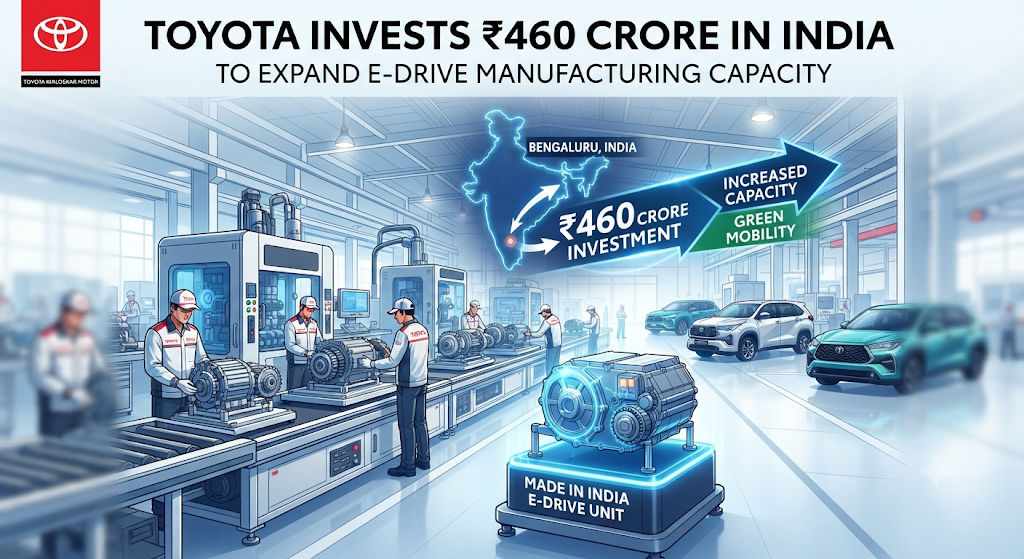
Toyota cars is strengthening its presence in India's automotive manufacturing sector with an investment of approximately Rs 460 crore in a new E-Drive manufacturing line at its Bidadi facility in Karnataka. The new production line has been inaugurated by Toyota Kirloskar Auto Parts (TKAP) and is expected to support the growing demand for hybrid electric vehicle technology.
The latest investment adds an annual manufacturing capacity of 2 lakh E-Drive units, taking To
yota Kirloskar Auto Parts' total E-Drive production capacity to 3.6 lakh units per year. The expansion is an important step towards increasing the localisation of advanced hybrid powertrain components and reducing dependence on imported technologies.
The new manufacturing line will produce next-generation E-Drive products recognised under the Government of India's Advanced Automotive Technology (AAT) category of the Production Linked Incentive (PLI) scheme for automobiles and auto components.
The development also highlights Toyota's continued focus on hybrid technology and its long-term manufacturing plans in India.
Toyota Kirloskar Auto Parts has inaugurated its new E-Drive manufacturing line at its Bidadi facility near Bengaluru, Karnataka.
The facility has been developed with an investment of approximately Rs 460 crore and will operate alongside the company's existing fourth-generation E-Drive production line, which was commissioned in 2022.
The new production line is expected to add 2,00,000 units of annual manufacturing capacity. With this expansion, TKAP's total E-Drive production capacity will increase to 3,60,000 units annually.
The inauguration was attended by S. Selvakumar, Principal Secretary, Commerce and Industries Department, Government of Karnataka, along with Manasi Tata, Vice Chairperson of Toyota Kirloskar Motor, and Tabrez Ahmed, Managing Director of Toyota Kirloskar Auto Parts.
The expansion is expected to strengthen India's capabilities in manufacturing advanced automotive components and support the development of a stronger domestic supply chain.
The new facility will significantly increase Toyota's local production capabilities for electrified powertrain components.
|
Particulars |
Details |
|
Company |
Toyota Kirloskar Auto Parts |
|
Investment |
Rs 460 crore |
|
Manufacturing Location |
Bidadi, Karnataka |
|
New Annual Capacity |
2 lakh units |
|
Total Annual Capacity |
3.6 lakh units |
|
Existing Production Line |
Fourth-Generation E-Drive |
|
Existing Line Commissioned |
2022 |
|
New Technology |
Next-Generation E-Drive |
|
Government Scheme |
AAT under PLI Scheme |
E-Drive is an important component of Toyota's hybrid electric vehicle technology. It forms part of the electrified powertrain system that helps manage the interaction between the petrol engine and electric motor.
Toyota's hybrid systems combine an internal combustion engine with electric motor technology to improve driving efficiency and reduce fuel consumption.
Unlike a conventional battery electric vehicle, Toyota's self-charging hybrid electric vehicles do not require an external charging connection. Their battery receives energy through the vehicle's hybrid system, including regenerative braking.
By manufacturing more E-Drive components locally, Toyota aims to strengthen its domestic supply chain and support the wider adoption of hybrid technology.
The new production line will manufacture next-generation products registered under the government's Advanced Automotive Technology category of the PLI scheme.
The Rs 460 crore E-Drive manufacturing investment is part of a larger Rs 4,800 crore Memorandum of Understanding signed between Toyota Group companies and the Karnataka government.
The agreement focuses on developing advanced manufacturing facilities, increasing localisation, generating employment opportunities and supporting green mobility technologies in the state.
Through this investment, Toyota aims to strengthen Karnataka's position as an important automotive manufacturing hub.
The expansion also supports the Government of India's Make in India initiative by encouraging domestic production of advanced automotive technologies instead of relying heavily on imported components.
The new manufacturing line is expected to strengthen the local supplier network and create opportunities for developing a skilled workforce in advanced automotive manufacturing.
Toyota has been following a multi-pathway approach towards vehicle electrification, focusing on hybrid electric vehicles, battery electric vehicles and other alternative technologies.
In India, the company has developed a strong presence in the self-charging hybrid segment. Its hybrid technology combines a petrol engine with an electric motor to improve fuel efficiency and reduce emissions.
Toyota has also highlighted the importance of making electrified vehicle technologies more affordable through local manufacturing.
The company has sold more than 36.8 million hybrid vehicles globally, according to its reported figures.
With increased local E-Drive production, Toyota aims to support the growing demand for hybrid vehicles while improving the availability of locally manufactured components.
Some of Toyota's hybrid-powered models available in India include:
Toyota Innova Hycross
Toyota Urban Cruiser Hyryder
Toyota Camry
Toyota Vellfire
The expanded manufacturing capacity could help support Toyota's long-term hybrid technology strategy in the Indian market.
The new manufacturing line is expected to provide several benefits to India's automotive industry.
1. Increased Local Manufacturing
The additional production capacity will allow Toyota to manufacture more advanced E-Drive components within India, strengthening domestic manufacturing capabilities.
2. Reduced Import Dependence
Local production could reduce the need to import certain hybrid powertrain components and improve supply-chain reliability.
3. Stronger Supplier Network
The investment is expected to support local suppliers and encourage the development of specialised automotive manufacturing capabilities.
4. Support for Hybrid Vehicle Growth
As demand for fuel-efficient vehicles increases, greater domestic production of hybrid components could help manufacturers expand their electrified vehicle portfolios.
5. Skilled Employment Opportunities
Advanced manufacturing processes, automation and quality-control requirements are expected to support the development of a skilled workforce.
Toyota's latest investment indicates that the company intends to continue strengthening its manufacturing operations in India.
The increased E-Drive capacity will support its existing hybrid technology business and provide a stronger manufacturing base for future electrified powertrain products.
The company is also expected to continue expanding its domestic supplier ecosystem and investing in advanced automotive technologies.
With the Indian market gradually adopting different forms of vehicle electrification, Toyota's focus on locally manufactured hybrid components could become an important part of its long-term growth strategy.
Toyota's Rs 460 crore investment in a new E-Drive manufacturing line is an important development for India's automobile industry. The expansion increases Toyota Kirloskar Auto Parts' annual E-Drive production capacity to 3.6 lakh units, strengthening its ability to manufacture advanced hybrid powertrain components locally.
The investment also supports India's Make in India initiative, reduces import dependence and strengthens the domestic automotive supply chain.
Rather than focusing only on new vehicle launches, Toyota is also investing in the technology and manufacturing infrastructure needed to support the future of hybrid mobility in India.