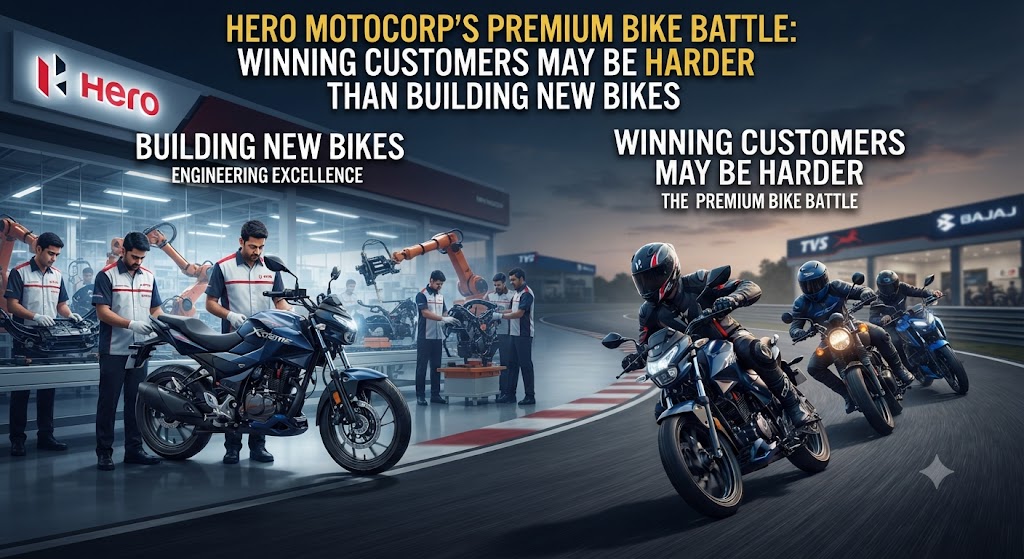
Hero MotoCorp’s Premium Bike Battle: Winning Customers May Be Harder Than Building New Bikes
Hero MotoCorp has been making a serious push beyond its traditional commuter motorcycle territory. Over the past few years, the company has expanded its premium portfolio with motorcycles such as the Xtreme range, Xpulse, Karizma XMR and Mavrick 440, while its partnership with Harley-Davidson has also given it a stronger presence in the higher-capacity motorcycle space.
The products are increasingly capable, feature-rich and performance-focused. However, the bigger challenge for Hero may not be developing more premium motorcycles. It could be convincing buyers to see Hero as a genuine premium motorcycle brand.
Hero Has More Premium Products Than Before
Hero MotoCorp's current premium portfolio is considerably broader than it was in the past. Its Premia retail and service experience now covers motorcycles and scooters including the Xtreme 250R, Xpulse 210, Xoom 160, Karizma XMR, Mavrick 440 and Harley-Davidson X440 models.
This shows that Hero is no longer relying only on commuter motorcycles to drive its business. The company is targeting customers across several premium categories, including street motorcycles, adventure bikes, performance motorcycles and larger-capacity machines.
The challenge is that a strong product portfolio alone does not automatically create a premium image.
The Perception Problem
For decades, Hero MotoCorp has been closely associated with practical and affordable motorcycles. Models such as the Splendor and HF Deluxe have built the company's reputation around reliability, accessibility, fuel efficiency and everyday commuting.
That reputation has been extremely valuable for Hero. At the same time, it creates a difficult transition when the company wants customers to associate the same badge with premium motorcycles.
A customer shopping for a 200cc, 250cc or 400cc motorcycle may look beyond specifications. Brand image, showroom experience, design appeal, ownership experience, exclusivity and the emotional connection with the motorcycle can all influence the final purchase decision.
This is where Hero's premium strategy needs to go beyond simply launching new models.
Harley-Davidson Partnership Gives Hero an Advantage
Hero's partnership with Harley-Davidson has been an important part of its premium motorcycle strategy.
The Harley-Davidson X440 is manufactured by Hero MotoCorp, while the partnership has also resulted in the expansion of Harley-Davidson's retail presence in India. In March 2026, the two companies announced new full-line Harley-Davidson dealerships in Kochi and Bengaluru, taking the brand's full-line dealership network in India to 22 outlets.
The X440 has also helped bring more customers into the Harley-Davidson ecosystem in India. The partnership gives Hero access to premium motorcycle expertise, technology and an established international motorcycle brand.
However, there is an important distinction between selling a premium motorcycle under a globally recognised badge and convincing customers that Hero itself belongs in the same premium conversation.
Mavrick 440 Is an Important Test
The Mavrick 440 represents one of Hero's clearest attempts to establish its own identity in the premium motorcycle space.
Instead of depending entirely on a partner brand, Hero needs products such as the Mavrick to create an emotional connection directly with the Hero name.
The motorcycle uses a 440cc engine and sits in a segment where buyers have several established options. For Hero, success here is about more than engine output or equipment. The motorcycle needs to create a strong identity and make buyers consider Hero as a desirable choice rather than simply a value-oriented alternative.
Xtreme and Xpulse Are Building the Foundation
Hero's Xtreme and Xpulse families are also important to this transition.
The Xtreme range gives Hero a presence in the sporty street motorcycle category, while the Xpulse has helped the company establish itself in the adventure motorcycle space.
The latest Xtreme 250R uses a 250cc liquid-cooled engine, while the Xpulse 210 uses a 210cc liquid-cooled engine. Both are positioned within Hero's premium portfolio.
These motorcycles can help Hero gradually change consumer perception because they allow the company to build credibility across multiple premium categories rather than relying on a single model.
Premium Is Also About the Ownership Experience
One of the biggest factors in moving upmarket is the experience surrounding the product.
Hero has introduced Premia as a dedicated retail and service experience for its premium range. The network includes products from Hero's premium portfolio along with Harley-Davidson and VIDA models.
This is an important step because premium customers generally expect a different buying and ownership experience.
The showroom environment, sales staff, service quality, availability of spare parts, accessories, merchandise, customer events and community-building activities all contribute to how a premium brand is perceived.
Hero therefore has to make sure that the premium experience is consistent across its network.
The EV Push Adds Another Dimension
Hero's premium strategy is not limited to petrol motorcycles. The company is also developing its electric mobility business through VIDA.
Its current premium ecosystem includes VIDA electric scooters, while the company has also been working with strategic partners on electric and premium motorcycle development.
The electric two-wheeler market gives Hero another opportunity to build a more technology-focused image. However, here too, customer experience and brand positioning will be as important as specifications.
Hero Has Momentum, But Brand Building Takes Time
Hero's recent financial performance indicates that the company is benefiting from stronger volumes and an improved product mix. In its latest quarter, the company also saw growth in average selling prices, while analysts highlighted the importance of its premium motorcycle and scooter expansion.
That gives Hero a solid foundation for its premium ambitions.
But changing consumer perception cannot happen with one or two launches. It requires a sustained product strategy, distinctive designs, strong technology, premium retail infrastructure and consistently good ownership experiences.
What Hero Needs to Do Next
Hero does not necessarily need to flood the market with premium motorcycles. Instead, the company needs to make each new product more memorable.
A premium Hero motorcycle needs a clear identity, strong road presence, engaging performance and an ownership experience that justifies its positioning.
The company also needs to create stronger emotional connections with younger buyers. Premium motorcycles are often purchased as lifestyle products rather than simply transportation, making brand image particularly important.
If Hero can successfully combine its strengths in manufacturing, distribution and reliability with a stronger aspirational image, its premium portfolio could become a much bigger contributor to the business.
Final Take
Hero MotoCorp has already taken several important steps towards becoming a stronger player in India's premium motorcycle market. Its growing range, the Mavrick 440, Xtreme and Xpulse families, Premia outlets and Harley-Davidson partnership show that the company is serious about moving upmarket.
The bigger battle, however, is likely to be in the minds of buyers.
Hero knows how to build motorcycles for the mass market. Now it needs to convince customers that the Hero badge can also stand for performance, aspiration, lifestyle and premium ownership.
In other words, the next stage of Hero's premium journey may depend less on how many new motorcycles it launches and more on how successfully it changes the way customers see the brand.
 Khyati Sharma 2026-08-24