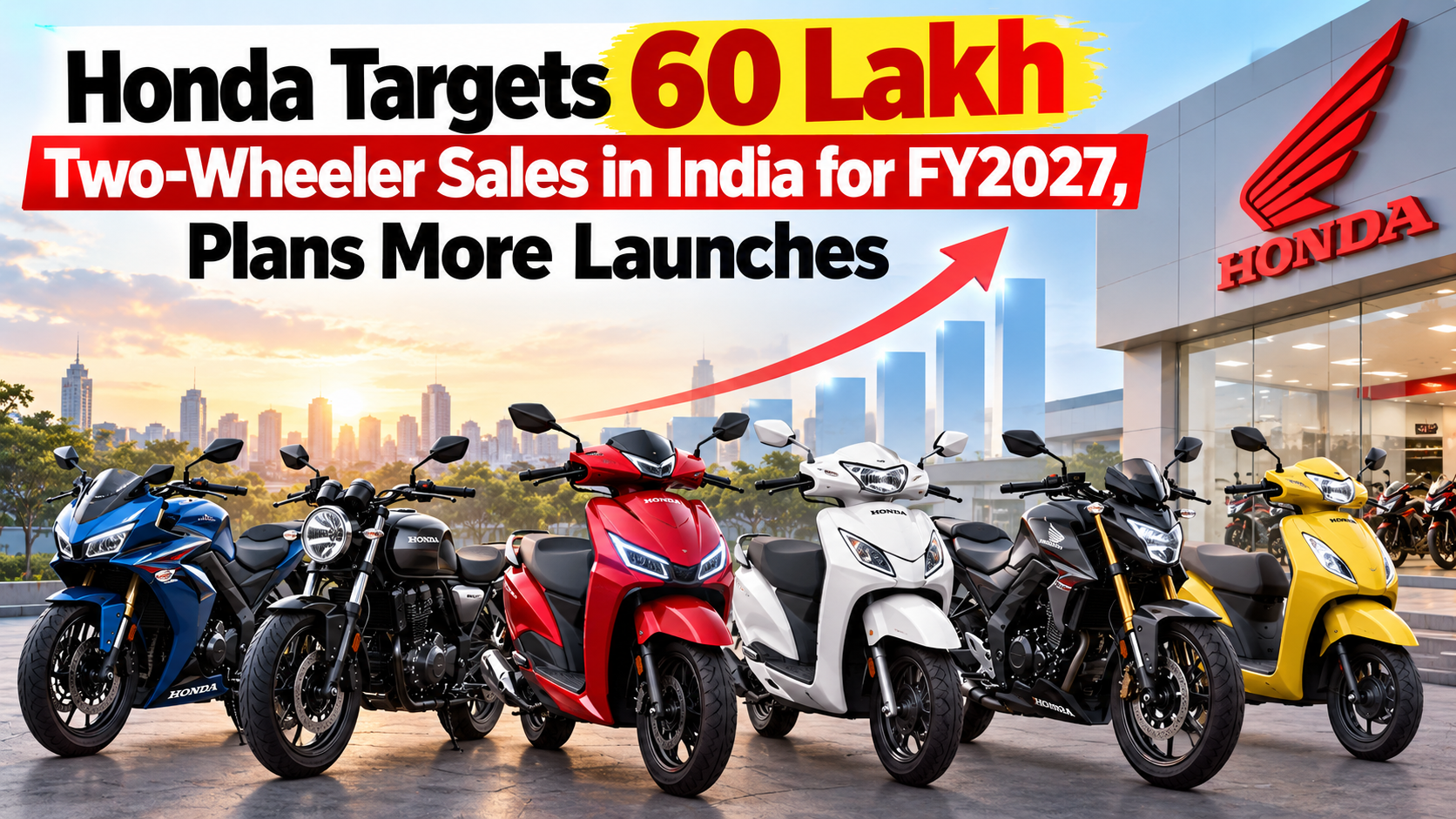
Honda Motorcycle & Scooter India (HMSI) is aiming to sell around 60 lakh (6 million) motorcycles and scooters in India during FY2026–27, reflecting the company's confidence in the country's two-wheeler market. The target comes amid strong domestic demand, growing scooter sales and plans to expand manufacturing capacity over the next two years.
The company's President and CEO, Tsutsumu Otani, has indicated that Honda expects both motorcycles and scooters to contribute to growth. The company also plans to maintain its existing sales mix, with scooters accounting for approximately 60% of its domestic volume and motorcycles making up the remaining 40%.
Honda is preparing to expand its product portfolio with additional launches in 2027. Alongside new products, the company is working to increase its annual production capacity from approximately 62.5 lakh units to 80 lakh units by 2028.
Honda Expects 60 Lakh Domestic Sales in FY2027
Honda's sales outlook for the financial year ending March 2027 represents an increase over its domestic dispatches of 57.5 lakh units in FY2025–26.
The company is targeting approximately 4.3% year-on-year growth in domestic sales. The outlook reflects the performance of the Indian two-wheeler market and the demand Honda has experienced during the current financial year.
According to reports, Honda's domestic two-wheeler dispatches increased by 13.5% year-on-year to approximately 30.4 lakh units during the first half of FY2026–27, covering April to September 2026.
The wider Indian two-wheeler industry also recorded growth during the same period. This provides an encouraging backdrop for manufacturers looking to increase sales, introduce new models and expand production.
However, the 60-lakh figure remains Honda's sales expectation for the full financial year rather than a confirmed final result.
Scooters to Contribute 60% of Honda's Sales
Scooters are expected to remain the largest contributor to Honda's domestic two-wheeler business. The company intends to maintain an approximate 60:40 ratio between scooters and motorcycles.
At a total volume of six million units, that mix would translate into approximately 36 lakh scooters and 24 lakh motorcycles. These are indicative calculations based on Honda's stated sales mix, not separate official volume targets for the two categories.
Honda has a strong presence in the Indian scooter market, particularly through the Activa range. Its scooter portfolio serves customers looking for convenient daily transportation, while its motorcycle lineup caters to commuters and riders seeking larger-capacity products.
The company expects both segments to contribute to future growth rather than relying on one category alone.
Honda Plans More Motorcycle and Scooter Launches in 2027
Honda is also preparing to expand its product lineup in India. The company has confirmed plans for additional two-wheeler launches in 2027, beyond the ten models showcased earlier in 2026.
The company has not disclosed the complete launch schedule or confirmed the number of new products planned for next year. Further details are expected to be communicated as its product plans progress.
Honda's broader portfolio strategy includes entry-level products, premium motorcycles, scooters and electric two-wheelers. This approach allows the company to address different customer requirements, from affordable everyday commuting to leisure riding and premium mobility.
The ten models showcased earlier in 2026 included products such as the ADV160, QC3 electric scooter, Rebel 300, XR L300, XR300 Rally and CB500 roadster, along with models from the CB350 range. The availability and launch timing of individual products can differ, so these showcases should not be treated as confirmation that every model will be launched in India in 2027.
Honda to Expand Production Capacity to 80 Lakh Units
To support rising demand, Honda plans to increase its annual manufacturing capacity in India from approximately 62.5 lakh units to eight million units by 2028.
The expansion involves additional production lines at its existing manufacturing facilities, including Tapukara in Rajasthan and Vithalapur in Gujarat.
The planned capacity increase is intended to support both domestic sales and exports. Honda is also positioning India as an important manufacturing base for supplying two-wheelers to overseas markets.
Greater production capacity could help the company respond more effectively to demand across different vehicle categories. However, actual sales growth will depend on market conditions, product availability, competition and customer preferences.
Honda's First-Half Performance Supports Its Growth Outlook
Honda's domestic dispatches grew during the first half of FY2026–27, giving the company a stronger starting point for the remainder of the financial year.
|
Business Metric
|
Reported Figure
|
|
FY2026–27 domestic sales outlook
|
60 lakh units
|
|
Domestic dispatches in FY2025–26
|
57.5 lakh units
|
|
Targeted year-on-year domestic growth
|
Approximately 4.3%
|
|
Domestic dispatches in April–September 2026
|
30.4 lakh units
|
|
First-half domestic dispatch growth
|
0.135
|
|
Approximate scooter share
|
0.6
|
|
Approximate motorcycle share
|
0.4
|
|
Planned annual production capacity by 2028
|
80 lakh units
|
Honda Is Considering Multiple Powertrain Technologies
Honda's strategy for India is not limited to conventional petrol-powered motorcycles and scooters. The company is evaluating a range of technologies, including petrol, flex-fuel and electric powertrains.
The direction of the market will depend on factors such as charging infrastructure, fuel availability, government policies, affordability and consumer preferences.
Electric scooters remain an important part of the company's future portfolio. Honda entered India's electric two-wheeler market with electric scooter offerings in 2025, while the broader market continues to attract competition from established manufacturers and newer electric-vehicle brands.
Flex-fuel technology is another area of interest as India develops its ethanol-blending ecosystem. Rather than relying exclusively on one powertrain technology, Honda intends to adapt its product strategy to the infrastructure and requirements of different markets.
The success of this approach will depend on the availability, pricing and performance of individual models as well as how quickly consumer preferences evolve.
What Honda's Sales Target Means for Indian Buyers
Honda's target of 60 lakh domestic two-wheeler sales reflects its expectation that demand will remain strong during FY2026–27. For customers, the company's plans could mean a wider choice of motorcycles and scooters over time.
Additional product launches may expand the options available to commuters, families and premium-bike buyers. Production-capacity expansion could also help Honda serve a growing market and support its export ambitions.
However, the sales target does not guarantee immediate price reductions, discounts or shorter waiting periods. These factors will depend on individual models, dealer inventory and local market conditions.
Customers considering a new Honda two-wheeler should compare the available models based on price, mileage, performance, features, maintenance costs and intended usage rather than relying solely on the company's overall sales outlook.

 Khyati Sharma 2026-10-22