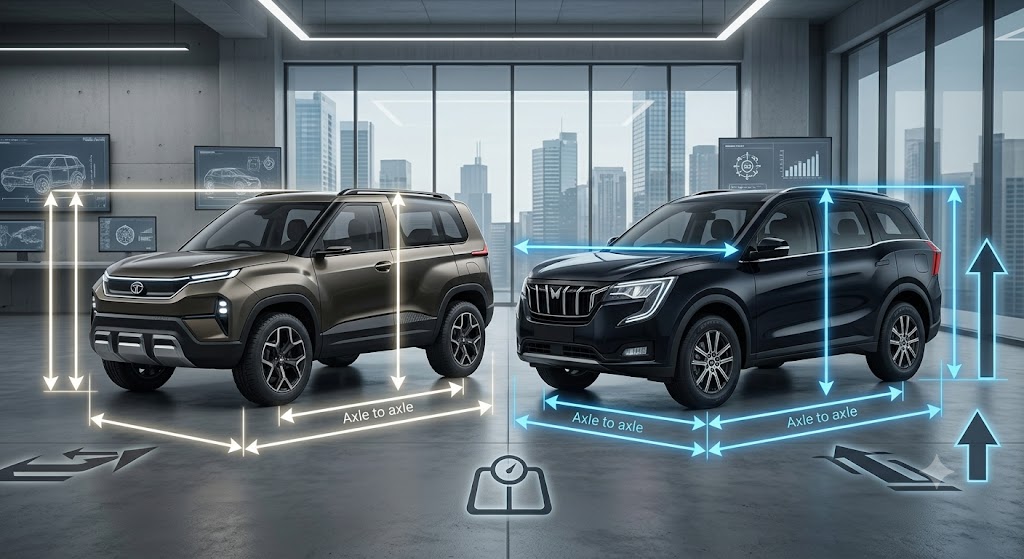
The Tata Sierra and Mahindra XUV700 represent two different approaches to SUV cars design. The Tata Sierra combines a modern exterior with a distinctive upright stance and a focus on passenger comfort, while the Mahindra XUV700 offers a larger body, a longer wheelbase and the option of three-row seating.
For buyers comparing these SUVs, dimensions are important because they influence road presence, cabin packaging, parking convenience, passenger comfort and luggage capacity.
In this Tata Sierra vs Mahindra XUV700 dimensions comparison, we look at their length, width, height, wheelbase, ground clearance and boot space to understand how the two SUVs differ.
Tata Sierra vs Mahindra XUV700 Dimensions: At a Glance
The Mahindra XUV700 is larger in overall length and width, while the Tata Sierra has a relatively tall body for its size and a substantial wheelbase for a mid-size SUV.
The Sierra measures 4,340 mm long, 1,841 mm wide and 1,715 mm tall, with a 2,730 mm wheelbase. The XUV700 measures 4,695 mm long, 1,890 mm wide and 1,755 mm tall, with a 2,750 mm wheelbase.
These figures show that the XUV700 has a larger overall footprint. However, exterior dimensions alone do not determine which SUV has the more comfortable cabin or the more practical interior.
Tata Sierra vs Mahindra XUV700 Dimensions Comparison Table
|
Dimensions
|
Tata Sierra
|
Mahindra XUV700
|
|
Length
|
4,340 mm
|
4,695 mm
|
|
Width
|
1,841 mm
|
1,890 mm
|
|
Height
|
1,715 mm
|
1,755 mm
|
|
Wheelbase
|
2,730 mm
|
2,750 mm
|
|
Ground clearance
|
205 mm
|
Check variant-specific specification
|
|
Seating capacity
|
5 passengers
|
5 or 7 passengers, depending on variant
|
|
Boot space
|
622 litres
|
Depends on seating configuration and measurement method
|
1. Length: Mahindra XUV700 Is Longer
The Mahindra XUV700 measures 4,695 mm in length, while the Tata Sierra measures 4,340 mm.
This gives the XUV700 a length advantage of 355 mm, or 35.5 cm.
The extra length contributes to the XUV700's larger overall proportions and allows for a three-row seating configuration in applicable variants. This can make it a suitable option for families that regularly travel with more passengers.
The Sierra's shorter body may be more convenient for drivers who frequently navigate narrow streets, congested residential areas and tight parking spaces. A shorter vehicle can be easier to position in restricted spaces, although turning radius and visibility also affect manoeuvrability.
For buyers prioritising a larger SUV footprint and the flexibility of additional seating, the XUV700 has the advantage in this category.

2. Width: XUV700 Offers a Wider Body
The Tata Sierra is 1,841 mm wide, compared with 1,890 mm for the Mahindra XUV700.
The difference is 49 mm, or approximately 4.9 cm, in favour of the XUV700.
A wider body can provide more scope for shoulder room and a broader cabin layout. However, actual passenger comfort depends on interior design, seat dimensions, door trims and the placement of other components.
The XUV700's additional width may also make it feel larger when driving through narrow roads or entering compact parking spaces. Drivers should consider the width of their parking area and the space available around the vehicle.
The Sierra is narrower on paper, which may be helpful for buyers looking for a substantial SUV without moving to the larger body dimensions of the XUV700.
3. Height: XUV700 Is Taller
The Mahindra XUV700 stands 1,755 mm tall, while the Tata Sierra measures 1,715 mm.
The XUV700 is therefore 40 mm taller.
Vehicle height can influence headroom, the seating position and the overall road presence. Nevertheless, a taller exterior does not automatically guarantee more interior headroom, as roof structure, floor height and seat mounting also matter.
The Sierra's upright design gives it a distinctive SUV appearance, while the XUV700's larger height complements its broader and longer proportions.
Buyers should ideally sit in both vehicles to assess the ease of entry and exit, visibility, seating position and headroom, particularly when carrying adults in the rear seats.

4. Wheelbase: The XUV700 Has a Small Advantage
Wheelbase refers to the distance between the centres of a vehicle's front and rear wheels. It can influence cabin packaging, ride characteristics and the amount of space available between the axles.
The Tata Sierra has a wheelbase of 2,730 mm, while the Mahindra XUV700 has a wheelbase of 2,750 mm.
The difference is just 20 mm.
Although the XUV700 has the longer wheelbase, the gap is relatively small compared with the difference in their overall lengths. The Sierra's 2,730 mm wheelbase is substantial for its body size.
A longer wheelbase can help provide more room for passenger accommodation, but it does not independently determine legroom or ride comfort. Suspension tuning, seat design and cabin layout are also important.
For this comparison, the XUV700 leads in wheelbase, although the difference is unlikely to tell the complete story about real-world comfort.
5. Ground Clearance: What Buyers Should Know
Ground clearance is the distance between the road surface and the lowest relevant point underneath a vehicle. It is particularly important when driving over speed breakers, uneven roads, steep ramps and broken surfaces.
The Tata Sierra has a published ground-clearance figure of 205 mm.
A directly comparable, verified ground-clearance figure for the specific XUV700 variant should be checked against its official specification before making a numerical comparison. Ground clearance can also depend on the measurement method, vehicle load and equipment fitted.
The Sierra's 205 mm figure provides a useful reference for buyers who frequently travel on rough or uneven roads. However, ground clearance alone does not determine off-road ability. Tyres, approach and departure angles, underbody protection, drivetrain and suspension capability also play important roles.
For regular city use, both vehicle selection and driving style matter when crossing steep ramps and large speed breakers.
6. Boot Space and Practicality
The Tata Sierra has a published boot capacity of 622 litres, making luggage accommodation an important part of its practicality proposition.
The Mahindra XUV700's luggage capacity varies with its seating configuration. In a three-row SUV, the space available behind the third row can be considerably different from the capacity available when the third row is folded.
This is why buyers should not compare boot-space numbers without checking how they were measured and which seats were in use.
For a family that regularly travels with five passengers and luggage, the Sierra's stated boot capacity may be attractive. For larger families that need to carry six or seven occupants, an applicable XUV700 variant offers the flexibility of an additional row, although luggage space will depend on whether that row is occupied.
Before deciding, check the boot with your usual luggage, pushchairs or other everyday items. A physical inspection can reveal practical differences that specifications alone cannot show.

 Khyati Sharma 2026-10-22