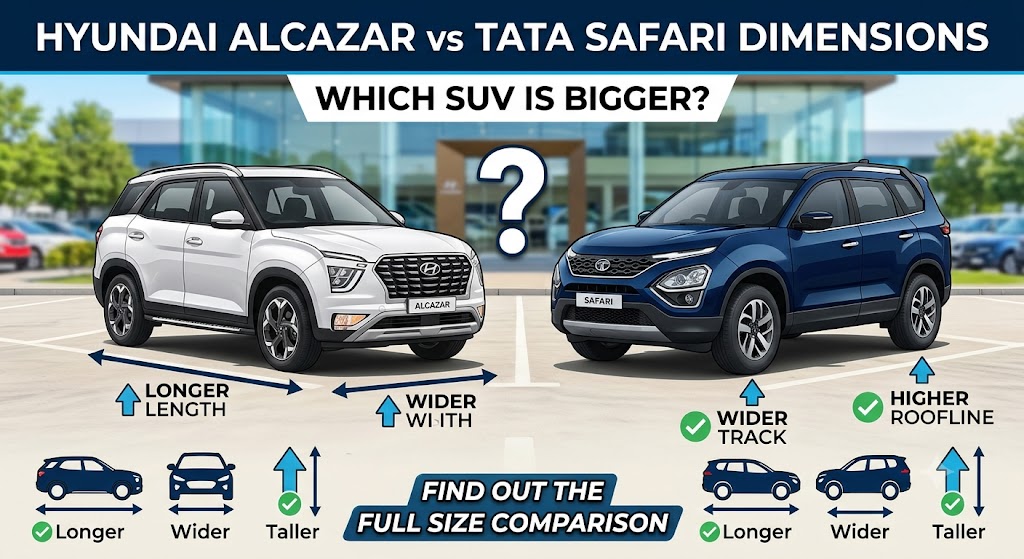
Hyundai Alcazar vs Tata Safari Dimensions: The Hyundai Alcazar and Tata Safari are popular three-row SUVs in India, but they differ in exterior size, road presence and space requirements. While the Alcazar focuses on a relatively compact footprint with family-friendly practicality, the Safari offers a wider and taller body designed to provide a more substantial SUV stance.
For buyers comparing these vehicles, dimensions matter because they influence parking convenience, cabin packaging, passenger comfort and luggage capacity. In this guide, we compare the length, width, height, wheelbase, ground clearance and boot space of both SUVs to help you understand which one better suits your needs.
Hyundai Alcazar vs Tata Safari: Dimensions Comparison
The Hyundai Alcazar measures 4,560 mm in length, 1,800 mm in width and 1,710 mm in height. The Tata Safari is larger in all three exterior measurements, measuring 4,668 mm long, 1,922 mm wide and 1,795 mm tall. The figures show that the Safari has a bigger overall footprint, particularly in width and height.
|
Dimension
|
Hyundai Alcazar
|
Tata Safari
|
|
Length
|
4,560 mm
|
4,668 mm
|
|
Width
|
1,800 mm
|
1,922 mm
|
|
Height
|
1,710 mm
|
1,795 mm
|
|
Wheelbase
|
2,760 mm
|
2,741 mm
|
|
Ground clearance
|
Approx. 200 mm
|
Approx. 205 mm
|
|
Boot space
|
Approx. 180 litres with all seats up
|
Approx. 420 litres (published specification)
|
|
Seating capacity
|
6 or 7 seats
|
6 or 7 seats
|
1. Hyundai Alcazar vs Tata Safari Length
The Hyundai Alcazar is 4,560 mm long, while the Tata Safari measures 4,668 mm. This makes the Safari 108 mm longer than the Alcazar.
The additional length gives the Safari a larger exterior profile and may provide more flexibility in its overall cabin and luggage packaging. It also contributes to the SUV's substantial appearance on the road.
The Alcazar's shorter length can be useful for buyers who frequently drive in congested cities, use tight parking spaces or navigate narrow residential roads. Although the difference is relatively small in everyday terms, it can matter when parking in a compact garage or manoeuvring through crowded streets.
For buyers prioritising a larger SUV cars body, the Tata Safari has the advantage. Those who prefer a slightly more manageable exterior size may find the Hyundai Alcazar more convenient.

2. Hyundai Alcazar vs Tata Safari Width
Width is one of the biggest differences between these SUVs. The Alcazar measures 1,800 mm wide, whereas the Safari is 1,922 mm wide.
The Tata Safari is therefore 122 mm wider than the Hyundai Alcazar.
A wider body can help provide more room for passengers across the cabin, although actual shoulder room and seating comfort also depend on interior design, seat shape and door-panel construction.
The Safari's wider body gives it a more imposing stance and may appeal to families who want a large SUV for long-distance journeys. However, the extra width can make driving through tight lanes, entering narrow parking spaces and judging clearance around obstacles more challenging.
The Alcazar is narrower and may feel easier to place on crowded urban roads. Buyers should still test both vehicles in the kind of parking spaces and streets they use regularly.

3. Hyundai Alcazar vs Tata Safari Height
The Hyundai Alcazar stands 1,710 mm tall, while the Tata Safari measures 1,795 mm.
The Safari is 85 mm taller than the Alcazar, giving it a higher overall body profile.
A taller SUV can offer a commanding visual presence and may allow a more upright cabin design. However, exterior height alone does not determine headroom, seating comfort or ease of entry. Roof design, seat height and interior packaging also play important roles.
The Alcazar's lower overall height gives it a somewhat less bulky appearance. This may appeal to buyers looking for a family SUV that combines three-row seating with relatively compact exterior proportions.
If you prefer a taller, more substantial-looking SUV, the Tata Safari has the advantage on paper.
4. Wheelbase Comparison
Wheelbase is the distance between the front and rear axles. It plays an important role in cabin packaging, straight-line stability and the way a vehicle accommodates its seating layout.
The Hyundai Alcazar has a wheelbase of 2,760 mm, compared with 2,741 mm for the Tata Safari. Surprisingly, the Alcazar's wheelbase is 19 mm longer despite its shorter overall length.
This shows why exterior length alone cannot determine interior room. Manufacturers use different platform layouts and packaging strategies to balance passenger space, luggage capacity and vehicle proportions.
The Alcazar's longer wheelbase may help its cabin layout, but it does not automatically mean that it offers more room in every seating row. Seat dimensions, legroom measurements and the placement of the third row must also be considered.
The Safari's shorter wheelbase, combined with its greater width and height, gives it a different set of proportions. Buyers should compare actual seating comfort rather than relying only on one measurement.
5. Ground Clearance and Indian Road Conditions
Ground clearance is important for drivers who regularly encounter speed breakers, uneven roads, steep ramps and damaged road surfaces.
Published specifications commonly list approximately 200 mm of ground clearance for the Hyundai Alcazar and around 205 mm for the Tata Safari. The Safari therefore has a small nominal advantage, although exact figures and measurement methods should be checked for the selected variant.
A difference of around 5 mm is relatively small and should not be the deciding factor by itself. Tyre condition, vehicle load, suspension movement and the shape of an obstacle can all affect underbody clearance in real-world driving.
Both SUVs are designed for everyday road use, including typical Indian urban and highway conditions. Neither should be treated as a substitute for a dedicated off-road vehicle simply because it has SUV styling and elevated ground clearance.
6. Boot Space and Luggage Capacity
Boot space becomes especially important when travelling with a full family. Both vehicles offer three-row seating, but luggage capacity depends heavily on whether the third row is in use.
Published figures list approximately 180 litres of boot space for the Alcazar with all seats in place, while the Safari is commonly listed with around 420 litres. These figures should be checked against the specific measurement method and seating configuration, as boot-capacity claims are not always directly comparable across manufacturers.
With all seats occupied, luggage room in a three-row SUV can be limited. Families carrying several large suitcases may need to fold seats when fewer passengers are travelling or consider roof-storage solutions approved for the vehicle.
When comparing these SUVs, inspect the boot with the third row upright and folded. Try placing your usual travel bags inside, particularly if you frequently take long road trips with six or seven occupants.
7. Which SUV Is Easier to Drive and Park?
The Hyundai Alcazar's smaller overall length and narrower body may make it easier to manoeuvre in tight urban spaces. Drivers who regularly park in apartment basements, crowded markets or narrow driveways may appreciate its more compact dimensions.
The Tata Safari's larger width and height provide a stronger road presence but require more attention when judging side clearance and entering tight parking spaces.
Parking sensors, a reversing camera, surround-view camera systems where equipped, and good visibility can help make both vehicles easier to manage. Equipment varies by variant, so buyers should verify the features included in the trim they are considering.
8. Which SUV Offers Better Space for Families?
Both SUVs are available with six- or seven-seat configurations, depending on the variant. The best choice depends on how frequently you use the third row and how much luggage you carry.
The Alcazar may suit families looking for a three-row SUV with a more compact exterior footprint. Its wheelbase is slightly longer than the Safari's, but this does not guarantee greater passenger space in every row.
The Safari's wider and taller body may appeal to buyers who prefer a larger SUV and want to evaluate its cabin packaging for family trips. However, a bigger exterior does not automatically guarantee more comfortable third-row seating.
Before making a decision, sit in all three rows, check access to the rear seats and assess whether the boot can accommodate your luggage with every seat occupied.
Hyundai Alcazar vs Tata Safari Dimensions: Final Verdict
The Tata Safari is larger than the Hyundai Alcazar in overall length, width and height. It is 108 mm longer, 122 mm wider and 85 mm taller, giving it a more substantial exterior footprint.
The Alcazar, however, has a wheelbase that is 19 mm longer. This highlights the importance of looking beyond exterior dimensions when evaluating passenger comfort and cabin design.
Choose the Hyundai Alcazar if you prefer a relatively compact three-row SUV that may be easier to manoeuvre in urban environments.
Consider the Tata Safari if you prefer a wider, taller and longer SUV with a more imposing road presence.
Ultimately, the better option depends on your parking conditions, seating requirements, luggage needs and comfort preferences. A test drive and a practical check of all three rows will help you make the right choice

 Khyati Sharma 2026-10-22