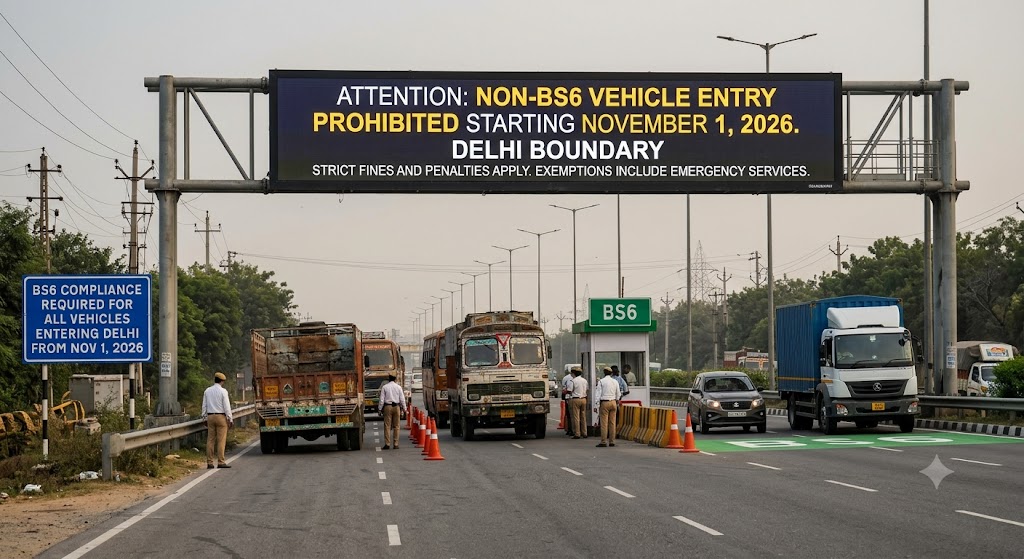
Delhi is preparing to introduce stricter vehicle-entry restrictions from November 1, 2026, as part of its winter pollution-control measures. Under the new rules, vehicles registered outside the National Capital Territory of Delhi that do not meet BS-VI emission standards will not be permitted to enter the capital from November 1, 2026, to January 31, 2027.
The restriction is part of the Delhi government's wider Winter Pollution Action Plan, which aims to reduce vehicular emissions and tackle deteriorating air quality during the winter months. The plan also includes measures relating to Pollution Under Control Certificates (PUCC), parking charges, office attendance, traffic management and construction dust.
For motorists travelling to Delhi from neighbouring states, understanding the new rules will be important before planning their journeys.
How to Compare Car Variants: Base vs Mid vs Top Trim
Delhi Non-BS6 Vehicle Entry Ban: What Is the New Rule?
According to the announced policy, vehicles registered outside Delhi that comply with emission standards below BS-VI will face an entry restriction during the specified period.
The rule is intended to reduce emissions from older vehicles entering the capital, particularly during winter, when air pollution can become a serious public-health concern.
The restriction does not mean that every vehicle manufactured before 2020 is automatically banned. A vehicle's applicable emission standard and registration details are important. Owners should check their vehicle's actual BS emission classification rather than relying only on its manufacturing year.
The announced entry restriction runs from November 1, 2026, through January 31, 2027. The broader winter pollution-control plan will remain in force until February 28, 2027, with different measures applying for different periods.
Which Vehicles Will Be Affected?
The entry restriction specifically targets motor vehicles registered outside Delhi that do not meet BS-VI emission standards.
This is particularly relevant for motorists travelling from neighbouring areas of Haryana, Uttar Pradesh, Rajasthan and other states. Depending on their vehicle's registration and emission classification, some drivers may need to use an alternative vehicle or another mode of transport when entering Delhi during the restriction period.
Owners should verify their vehicle's emission category through their registration documents or the relevant official vehicle records before travelling.
The rule should not be confused with separate restrictions that may apply under the Graded Response Action Plan (GRAP), end-of-life vehicle regulations or other pollution-control orders. Those measures can have different conditions and enforcement requirements.
Delhi Non-BS6 Vehicle Ban: Important Dates and Rules
|
Rule or measure
|
Details
|
|
Entry restriction begins
|
46327
|
|
Entry restriction ends
|
31-Jan-27
|
|
Vehicles affected
|
Vehicles registered outside Delhi that are below BS-VI emission standards
|
|
CNG and electric vehicles
|
Exempt from this specific entry restriction
|
|
Emergency vehicles
|
Ambulances, fire tenders and police vehicles are among the stated exemptions
|
|
Broader winter pollution plan
|
November 1, 2026, to February 28, 2027
|
|
Valid PUCC requirement
|
Fuel restrictions for vehicles without a valid certificate are a separate measure
|
Which Vehicles Are Exempt From the Entry Ban?
The announced rules provide exemptions for certain categories of vehicles.
CNG vehicles: Vehicles operating on compressed natural gas are exempt from this specific entry restriction.
Electric vehicles: Electric vehicles are also exempt from the non-BS-VI entry restriction.
Emergency and essential-duty vehicles: Ambulances, fire tenders and police vehicles are among the categories identified for exemption. Other vehicle categories may be exempted if specifically authorised by the Delhi Environment Department.
However, motorists should not assume that every alternative-fuel vehicle or commercial vehicle is automatically exempt from all pollution-related rules. The exemption applies to the particular entry restriction described here; other applicable requirements may remain in force.
How to Set a Realistic Car Buying Budget (On-Road Price Explained)
No PUCC, No Fuel: Another Important Rule for Motorists
Alongside the entry restriction, Delhi's winter pollution-control framework includes a requirement for vehicles to have a valid Pollution Under Control Certificate.
A PUCC confirms that a vehicle has undergone the applicable emissions test and meets the prescribed pollution limits at the time of testing.
Under the notified directions, fuel outlets in Delhi are required to dispense fuel only to vehicles presenting a valid PUCC. This requirement is separate from the restriction on non-BS-VI vehicles registered outside Delhi.
Therefore, even motorists whose vehicles are permitted to enter the capital should check that their pollution certificate is valid. Having a BS-VI-compliant vehicle does not remove the separate PUCC requirement.
Vehicle owners should check the certificate's validity before travelling and arrange an emissions test if renewal is required.
Other Measures Under Delhi's Winter Pollution Action Plan
The vehicle-entry restriction is only one part of the government's wider effort to control winter pollution.
1. Higher Parking Charges
Parking charges at authorised parking facilities are scheduled to double from November 1, 2026, to February 28, 2027. Parking facilities owned and managed by the Delhi Metro Rail Corporation are exempt from this increase under the notified directions.
The measure is intended to discourage unnecessary private vehicle use and encourage commuters to consider public transport.
2. Work-From-Home Arrangements
The plan includes measures to reduce the number of employees physically attending offices. Government and private offices are required to limit physical attendance under the notified arrangements, with the remaining workforce working from home, subject to applicable provisions and exemptions.
Reducing daily commuting is intended to help ease traffic congestion and limit vehicle emissions during the winter pollution period.
3. Staggered Office Timings
Different working hours have also been prescribed for certain government offices to help reduce peak-hour traffic.
Offices under the Municipal Corporation of Delhi are scheduled to operate from 8:30 am to 5 pm, while offices under the Government of the National Capital Territory of Delhi are scheduled to operate from 10 am to 6:30 pm.
4. Construction Dust Control
Construction and demolition activities are another focus of the winter pollution plan. Dust-generating work, construction-site monitoring and the movement of construction materials are subject to additional restrictions under the applicable directions.
These measures are intended to address several sources of pollution rather than relying exclusively on vehicle restrictions.
Car Waiting Period: How to Get Your New Car Faster
How Can Vehicle Owners Prepare Before November 1?
Motorists who regularly travel to Delhi should take a few precautions before the restriction comes into effect.
First, check the vehicle's emission standard and registration details. Do not assume that the vehicle's age alone determines whether it is affected.
Second, check whether the vehicle falls within an exemption category. CNG and electric vehicles are exempt from the specific entry restriction, but other rules may still apply.
Third, ensure that the vehicle has a valid PUCC. This is a separate requirement and should not be overlooked even if the vehicle meets BS-VI standards.
Finally, consider alternatives such as the Delhi Metro, public buses, carpooling or an eligible vehicle if your vehicle is covered by the restriction.
Drivers should also check official Delhi government and transport department updates before travelling, as enforcement details and other pollution-control measures may be clarified or updated.
Why Is Delhi Introducing These Restrictions?
Delhi frequently experiences deteriorating air quality during the winter months. Weather conditions, traffic emissions, dust and other pollution sources can combine to make pollution levels worse.
The government's approach is to introduce preventive measures before the most difficult part of the winter pollution season rather than relying only on emergency restrictions after air quality has deteriorated.
Restricting the entry of older, higher-emitting vehicles registered outside Delhi is one component of this strategy. Measures involving fuel compliance, parking, commuting and construction aim to address other contributors to pollution.
The actual impact will depend on enforcement, compliance and the contribution of these measures alongside wider regional pollution-control efforts.
Final Takeaway
Delhi's non-BS6 vehicle-entry restriction is scheduled to begin on November 1, 2026, and continue until January 31, 2027. It applies to vehicles registered outside Delhi that do not meet BS-VI emission standards, with stated exemptions including CNG vehicles, electric vehicles and specified emergency vehicles.
The wider Winter Pollution Action Plan continues through February 28, 2027, and includes separate measures concerning valid PUCCs, parking charges, office attendance and construction dust.
For motorists, the most important steps are to verify the vehicle's emission category, keep the PUCC valid and check the latest official instructions before entering Delhi. Understanding the exact scope of the restriction can help drivers avoid unnecessary disruption while supporting the wider effort to reduce winter air pollution.

 Khyati Sharma 2026-10-22