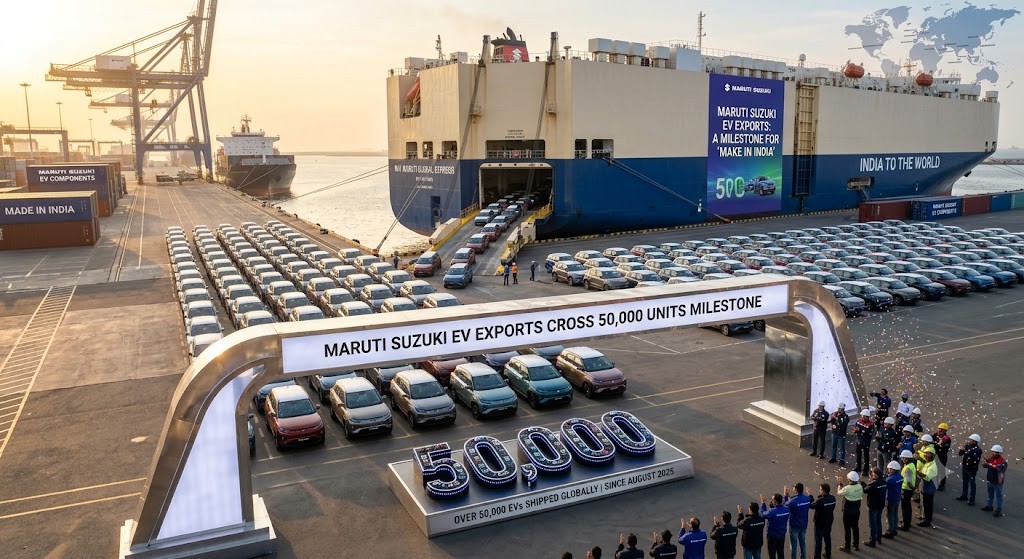
Maruti Suzuki cars has crossed 50,000 cumulative exports of its India-made electric vehicle since August 2025. The company says it accounted for nearly 93% of India’s electric passenger vehicle exports between April and September 2026, with Europe remaining its largest overseas market.
Maruti Suzuki India Limited has achieved a significant milestone in its electric vehicle export journey, with cumulative shipments of its Made-in-India EV crossing 50,000 units. The company announced the achievement on October 29, 2026, marking a little over a year since it began international EV shipments in August 2025.
The milestone strengthens Maruti Suzuki’s position in India’s electric passenger vehicle export market and highlights the growing role of Indian manufacturing facilities in supplying vehicles to international markets.
The company’s first global battery-electric vehicle, the Maruti Suzuki e VITARA, is manufactured at its Hansalpur facility in Gujarat. The electric SUV is exported to nearly 50 countries, including the United Kingdom, Norway, Germany, Japan and Switzerland.
Key Highlights
-
Maruti Suzuki’s cumulative EV exports have crossed 50,000 units.
-
Global shipments began in August 2025.
-
The company exports its India-made EV to nearly 50 countries.
-
Europe remains the largest export destination.
-
Maruti Suzuki accounted for nearly 93% of India’s electric passenger vehicle exports between April and September 2026, according to the company.
-
The Hansalpur manufacturing facility in Gujarat is the exclusive production base for Suzuki’s first global battery-electric vehicle.
Maruti Suzuki e VITARA Drives the Export Milestone
The e VITARA is central to Maruti Suzuki’s international electric vehicle strategy. Developed for global markets, the electric SUV is manufactured in India and shipped to customers across several regions.
Maruti Suzuki began global EV shipments in August 2025, when production of the e VITARA commenced at its Hansalpur facility. Europe was the first export market to receive the vehicle and continues to be the company’s largest destination for EV shipments.
The model’s availability across multiple international markets reflects Maruti Suzuki’s plan to use India not only as a domestic production base but also as a manufacturing and export hub for electric mobility.
The company has stated that the vehicle was intended for sale in more than 100 countries. Its current EV exports reach nearly 50 countries, representing a growing international footprint for the automaker’s electric vehicle operations.
Maruti Suzuki Accounts for Nearly 93% of India’s Electric PV Exports
One of the most notable figures in the announcement is Maruti Suzuki’s reported share of India’s electric passenger vehicle exports.
According to the company, it accounted for nearly 93% of India’s electric passenger vehicle exports during April–September 2026, based on data from the Society of Indian Automobile Manufacturers (SIAM).
Maruti Suzuki also said it was India’s largest EV exporter in the 2025–26 financial year and retained that position during the first half of FY2026–27.
These figures underline the importance of the e VITARA export programme to the company’s electric vehicle business. They also demonstrate how a single India-made EV can play a substantial role in the country’s passenger vehicle export performance.
The reported 93% figure applies specifically to electric passenger vehicle exports during the stated six-month period. It should not be interpreted as Maruti Suzuki’s share of all electric vehicles sold in India or of the entire domestic EV market.
Europe Remains the Largest Export Market
Europe continues to be the largest destination for Maruti Suzuki’s exported electric vehicle. Markets such as the UK, Norway and Germany are among the countries receiving the India-made EV.
Japan and Switzerland are also included among the company’s export destinations. Reaching nearly 50 countries gives Maruti Suzuki access to a range of international markets with different customer requirements and electric mobility policies.
For the company, international exports offer a way to expand the reach of its electric vehicle beyond India. Export demand can also support production scale at its dedicated manufacturing facility.
Maruti Suzuki’s broader overseas business extends beyond electric vehicles. The automaker currently exports 16 models to nearly 120 countries, according to its announcement. The e VITARA adds an electric option to this established export portfolio.
Hansalpur Plant Plays a Key Role
The Hansalpur facility in Gujarat is the exclusive manufacturing base for Suzuki’s first global battery-electric vehicle. It is a key part of Maruti Suzuki’s strategy to produce vehicles in India for international markets.
The company recently expanded the facility’s annual production capacity to one million vehicles, making it the first Suzuki manufacturing facility globally to reach that annual capacity at a single location.
Maruti Suzuki has reported cumulative investment of approximately ₹25,288.7 crore in the Hansalpur facility. The plant is also an important export hub: it accounted for nearly half of the company’s overall overseas shipments in FY2025–26.
The facility’s scale is significant because EV exports require production planning, quality control and logistics capable of serving multiple international markets. A large manufacturing base can help the company support export volumes while continuing to serve its wider vehicle business.
A Boost for the ‘Make in India’ Initiative
Maruti Suzuki’s EV export milestone also highlights the role of Indian manufacturing in the global automotive supply chain.
Managing Director and CEO Hisashi Takeuchi said the company’s EV export journey began in August 2025 with the start of e VITARA production at Hansalpur. He linked the milestone to India’s manufacturing capabilities and its increasing competitiveness in international markets.
Maruti Suzuki has been India’s largest passenger vehicle exporter for five consecutive financial years, from FY2021–22 through FY2025–26, according to SIAM data cited by the company. It also reported a share of more than 50% of India’s passenger vehicle exports during April–September 2026.
The EV milestone adds another dimension to that export performance. While the company’s wider export portfolio includes several types of vehicles, the e VITARA represents its move into battery-electric vehicle exports from India.
What This Means for Maruti Suzuki’s EV Strategy
Crossing 50,000 exported EVs is an important early milestone, but future performance will depend on demand in international markets, production planning, competition and the pace of electric vehicle adoption.
Europe’s continued position as the largest export destination gives the company an established overseas base for the e VITARA. Expanding shipments across additional markets could further strengthen the model’s global reach.
The Hansalpur plant’s expanded capacity provides manufacturing scale, although total plant capacity should not be confused with EV-only production capacity. The facility supports Maruti Suzuki’s wider manufacturing operations, while the e VITARA serves as the dedicated global battery-electric vehicle produced there.
For India’s automotive sector, the announcement is another example of a domestic manufacturing operation supplying vehicles to overseas customers. The longer-term significance will depend on whether export volumes continue to grow and how successfully Indian-made EVs compete in different markets.
Conclusion
Maruti Suzuki has crossed 50,000 cumulative EV exports since starting global shipments in August 2025. The e VITARA, manufactured at the Hansalpur facility in Gujarat, is being exported to nearly 50 countries, with Europe remaining its largest market.
The company’s reported 93% share of India’s electric passenger vehicle exports during April–September 2026 highlights the importance of its EV export programme. With the Hansalpur facility expanding to an annual capacity of one million vehicles, Maruti Suzuki is positioning India as an important base for its global vehicle operations.

 Khyati Sharma 2026-10-29