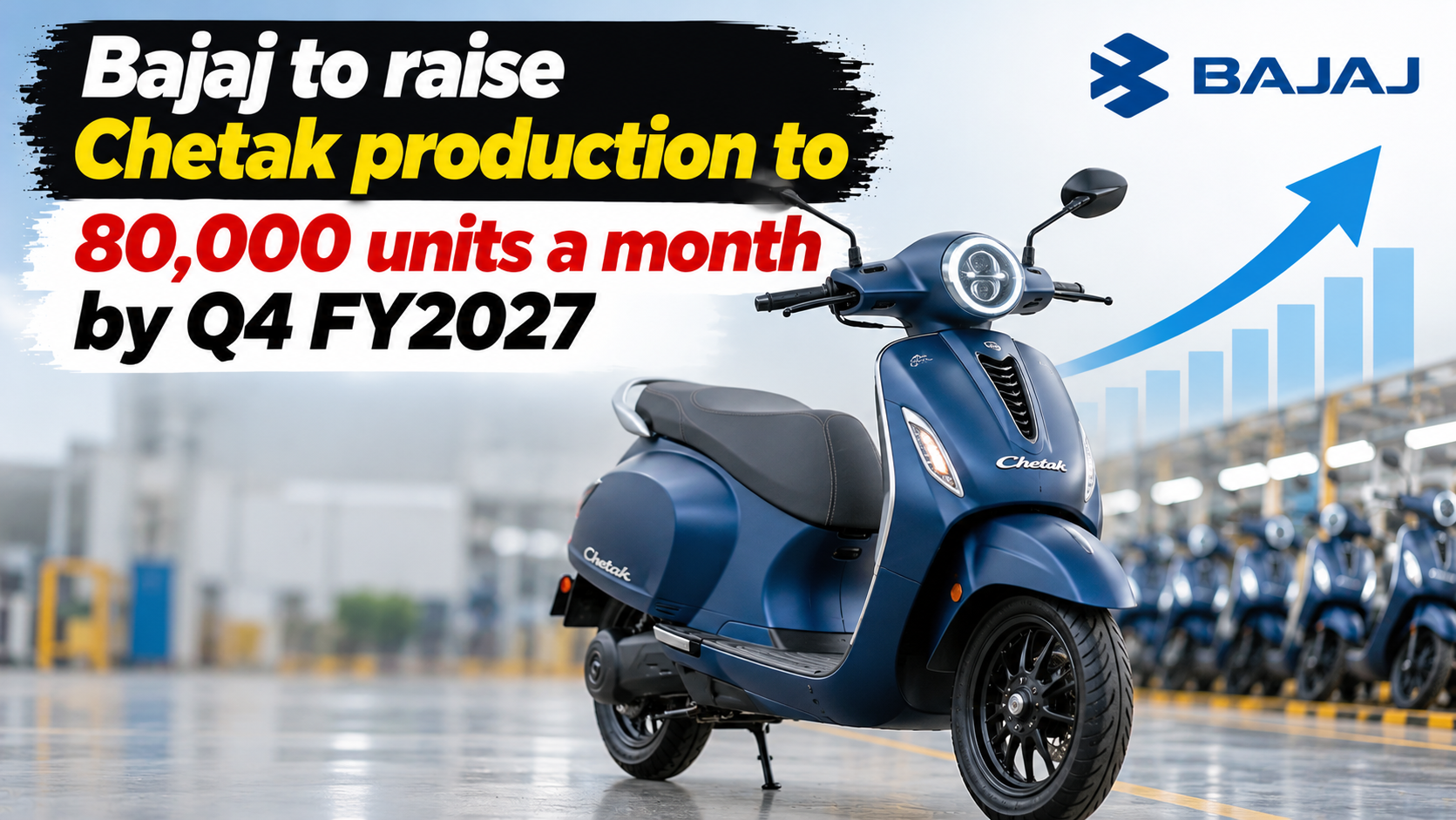
Bajaj Auto is preparing to significantly increase production of its Chetak electric scooter as demand continues to outpace manufacturing capacity. The company aims to raise monthly Chetak production to approximately 80,000 units by the fourth quarter of FY2027, covering January to March 2027.
The production expansion comes as India's electric two-wheeler market becomes increasingly competitive, with manufacturers investing in higher output to reduce waiting periods and meet growing customer demand. Bajaj Auto has restored Chetak production to its existing capacity following earlier supply-chain disruptions, but the company says further improvements are necessary to meet current requirements.
The announcement was made following Bajaj Auto's second-quarter FY2027 financial results. The company is also evaluating locations for a potential sixth manufacturing plant to support rising demand across its electric scooters and premium motorcycle businesses.
Bajaj Chetak Production Target: 80,000 Units Per Month
Bajaj Auto currently has the capacity to produce around 60,000 Chetak electric scooters per month, with recent reports placing actual output at approximately 62,000–64,000 units as production recovered. The company wants to increase monthly output to around 80,000 units by the January–March 2027 quarter.
This would represent an increase of roughly 25–33% compared with the reported current monthly output, depending on the baseline used.
Earlier, supply-chain disruptions had restricted production to around 40,000 units a month despite installed capacity of approximately 60,000 units. The company has since restored production, but demand remains higher than the number of scooters it can currently manufacture.
Bajaj Auto Joint Managing Director Rakesh Sharma said the company expects to complete further production improvements, commonly referred to as debottlenecking, during Q4 FY2027.
Debottlenecking involves identifying and removing production constraints within an existing manufacturing setup. It can help a manufacturer increase output without immediately building an entirely new factory.
The target is intended to bring production closer to current demand, although actual output will continue to depend on component availability, manufacturing efficiency and market conditions.
Why Bajaj Auto Is Expanding Chetak Production
The Chetak has become an important part of Bajaj Auto's electric mobility strategy. Rising demand for electric scooters has increased pressure on manufacturers to supply dealerships more consistently, particularly during periods of strong retail demand.
When production cannot keep pace with orders, customers may face longer waiting periods or choose competing products that are available sooner. Increasing Chetak output could help Bajaj improve vehicle availability, support its dealership network and capture additional sales opportunities.
The expansion also follows a strong performance from Bajaj Auto's electric vehicle portfolio during the July–September 2026 quarter.
According to reports covering the company's Q2 FY2027 results, Chetak revenue exceeded ₹2,000 crore during the quarter, while scooter volumes more than doubled year on year. Bajaj's wider electric vehicle portfolio, which includes electric two-wheelers and three-wheelers, recorded approximately 2 lakh units during the quarter.
The electric portfolio has become a significant contributor to the company's domestic business, despite the production constraints.
Bajaj Is Evaluating a Sixth Manufacturing Plant
Apart from increasing Chetak output at its existing facilities, Bajaj Auto is evaluating potential locations for a sixth manufacturing plant.
The company has indicated that capacity constraints are not limited to electric scooters. Demand for premium motorcycles and internal-combustion-engine vehicles is also putting pressure on manufacturing operations.
A new plant could provide additional capacity to support several product categories as the company's business expands. However, Bajaj Auto has not announced the final location, investment amount, planned capacity or construction timeline for the proposed facility.
The company is assessing different locations and proposals before making a decision. Any new manufacturing investment would depend on its future requirements, operational considerations and the economics of expansion.
For now, the near-term priority is to improve output from the existing Chetak production system and move towards the target of 80,000 units per month by the end of FY2027.
Electric Scooters Could Account for a Larger Share of India's Market
Bajaj Auto expects India's electric scooter market to expand further over the next few years. Company management has indicated that electric scooters currently account for around one-quarter of scooter sales nationally, with the share potentially reaching 50% over the next three to five years.
Adoption differs considerably across states. Markets with stronger electric vehicle adoption can offer manufacturers significant opportunities, while other regions may require improvements in charging access, customer awareness and affordability.
Electric scooters are attracting buyers because of their potential for lower running costs, quiet operation and reduced routine powertrain maintenance. However, the overall ownership experience depends on purchase price, charging access, battery performance, service availability and individual usage patterns.
For Bajaj, increasing Chetak production is important because market growth alone does not guarantee higher sales. The company must also ensure that sufficient vehicles reach dealerships when customers are ready to buy.
Bajaj Auto's Financial Performance Supports Its EV Expansion
Bajaj Auto reported a strong financial performance for the July–September 2026 quarter. Its standalone revenue from operations rose 34.1% year on year to approximately ₹20,003 crore, while standalone net profit increased 35.2% to ₹3,353.76 crore.
The company also reported growth in its overall vehicle sales and exports. Its electric vehicle business has become an increasingly important contributor to domestic revenue, while the Chetak has established itself as a key product within its electric two-wheeler portfolio.
The improved performance provides a broader business context for Bajaj's capacity plans. However, higher production also requires reliable component supplies, efficient manufacturing processes and continued demand from customers.
The company will need to balance its expansion plans with changes in competition, input costs and the pace of electric vehicle adoption.
Bajaj Chetak Production: Key Details
|
Particular
|
Details
|
|
Electric scooter
|
Bajaj Chetak
|
|
Current monthly production capacity
|
Around 60,000 units
|
|
Reported current monthly output
|
Approximately 62,000–64,000 units during the recent recovery period
|
|
Earlier production during supply disruptions
|
Around 40,000 units per month
|
|
Target monthly production
|
Approximately 80,000 units
|
|
Target timeline
|
Q4 FY2027, January–March 2027
|
|
Main reason for expansion
|
Demand exceeding available production
|
|
Additional manufacturing plan
|
Sixth plant under evaluation
|
|
New plant location
|
Not announced
|
|
Chetak quarterly revenue
|
More than ₹2,000 crore in Q2 FY2027, according to reports
|
What This Means for Chetak Buyers
The planned production increase could improve the availability of Bajaj Chetak scooters and help reduce supply-related waiting periods if demand and component supplies remain favourable.
It may also allow Bajaj to serve more markets and support its dealer network more effectively. However, the production target does not automatically guarantee shorter delivery times in every city, as availability will depend on local demand, variant preferences and distribution.
Bajaj has also indicated plans to expand the Chetak range over the next six months, although it has not disclosed specific upcoming models or variants. A broader lineup could help the company address different customer requirements, but details remain unconfirmed.

 Khyati Sharma 2026-10-29