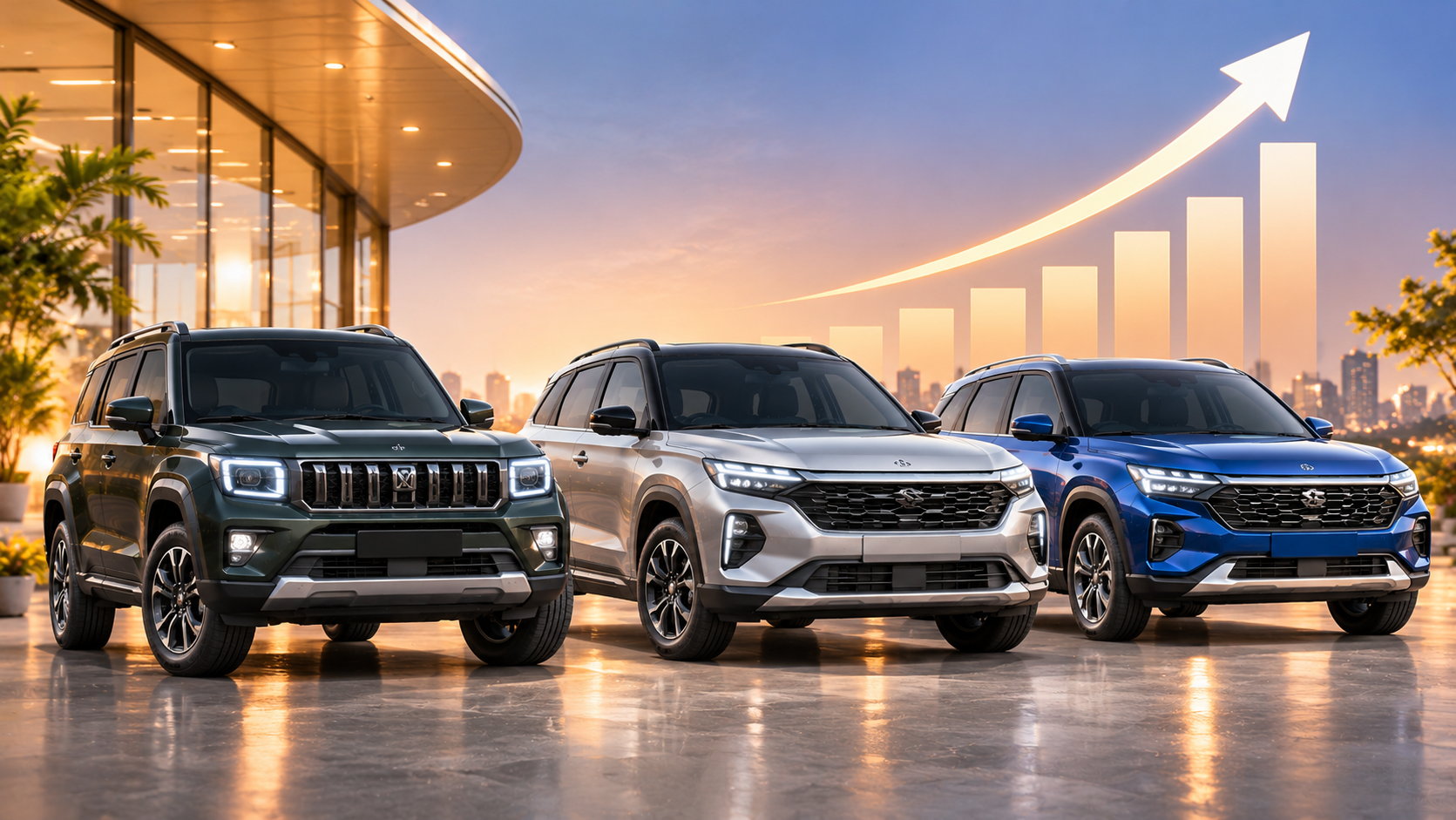
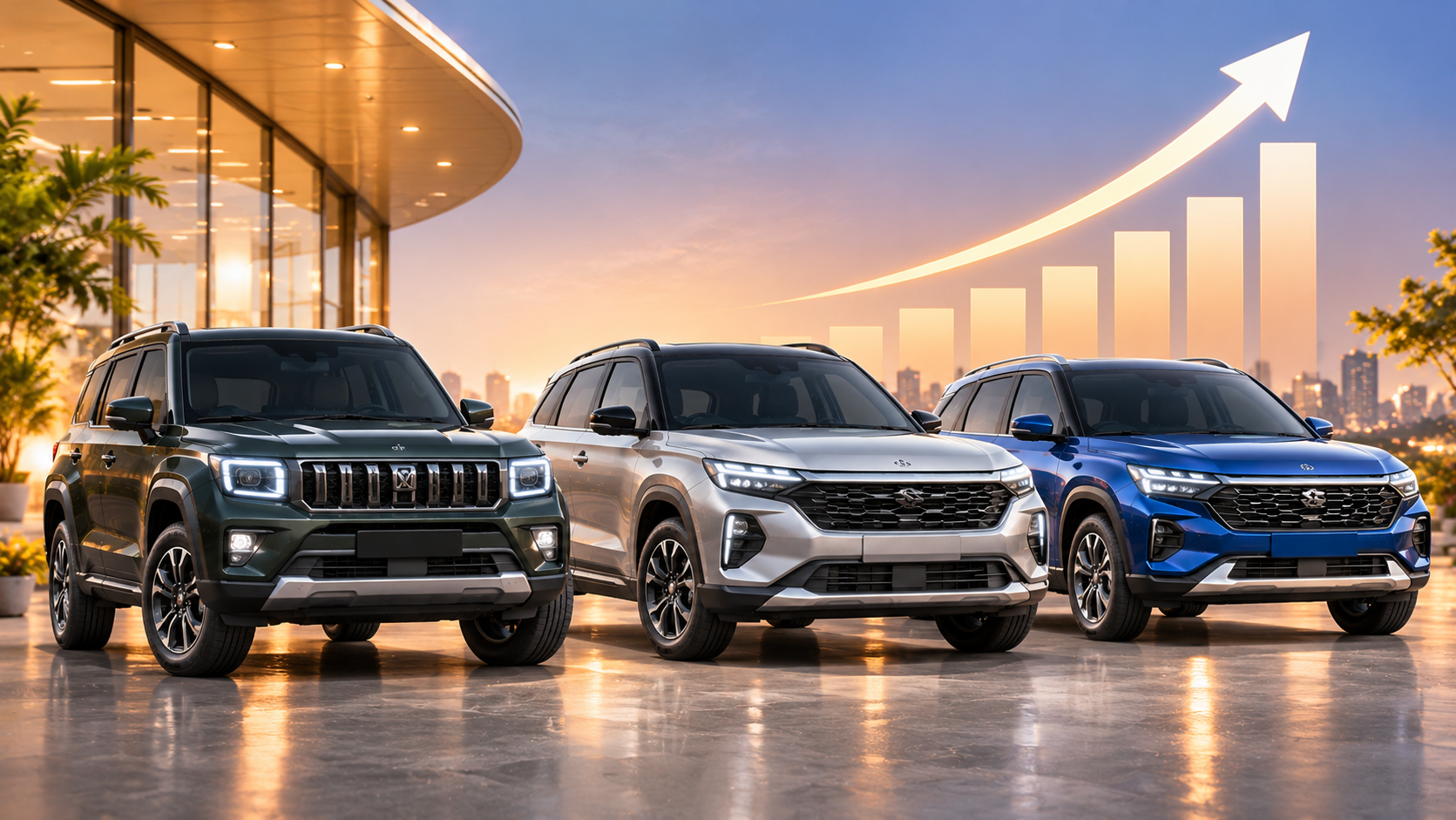
Maruti Suzuki car's strong-hybrid SUVs, the Victoris and Grand Vitara, are facing supply-related challenges as the company struggles to increase production in line with the growth of its overall SUV business. The automaker has revealed that imported strong-hybrid kits from Japan have a procurement lead time of approximately four to five months, making it difficult to quickly increase the availability of hybrid variants.
The supply situation comes at a time when both SUV cars are recording strong overall demand in India. However, the contribution of strong-hybrid powertrains to their combined registrations has declined, even though the actual number of hybrid registrations has increased.
According to registration data analysed by ElecTree, the combined strong-hybrid registrations of the Maruti Suzuki Victoris and Grand Vitara increased by approximately 15% to 13,172 units between January and September 2026. During the same period, registrations across all powertrain options of the two SUVs more than doubled to approximately 1.77 lakh units.
As a result, the strong-hybrid share declined to around 7%, compared with nearly 15% during the corresponding period last year.
Maruti Suzuki Highlights 4–5 Month Waiting Period for Hybrid Kits
The main challenge for Maruti Suzuki is the availability of imported strong-hybrid components. According to the company's management, the strong-hybrid kits are sourced from Japan and require approximately four to five months to arrive.
Partho Banerjee, Senior Executive Officer, Marketing and Sales at Maruti Suzuki India, highlighted the issue during the company's October 2026 sales briefing.
He explained that the company can increase production of petrol and CNG vehicles more quickly, while strong-hybrid production depends on the availability of imported kits.
This difference in supply flexibility affects the overall powertrain mix. When petrol and CNG production increases faster than hybrid production, the percentage contribution of hybrid vehicles can decline even if hybrid volumes continue to grow.
The company has not disclosed the exact number of hybrid kits imported every month or when the supply situation is expected to improve.
Strong-Hybrid Share Falls to 7% for Victoris and Grand Vitara
The declining hybrid share is one of the major developments in Maruti Suzuki's midsize SUV business.
Between January and September 2026, the Victoris and Grand Vitara together recorded 13,172 strong-hybrid registrations, compared with 11,439 units during the same period in 2025.
This represents an increase of approximately 15% in actual hybrid registrations.
However, combined registrations across all powertrain options increased much faster, reaching approximately 1.77 lakh units. This significantly reduced the proportion of strong-hybrid vehicles in the overall sales mix.
|
Particulars
|
January–September 2025
|
January–September 2026
|
|
Combined strong-hybrid registrations
|
11,439 units
|
13,172 units
|
|
Growth in hybrid registrations
|
—
|
Approximately 15%
|
|
Combined registrations across powertrains
|
77,007 units
|
1,76,987 units
|
|
Strong-hybrid share
|
Nearly 15%
|
Around 7%
|
The figures show that strong-hybrid registrations have increased, but their share has reduced because petrol and CNG variants have expanded at a much faster rate.
It is important to distinguish between a decline in market share and a decline in actual registrations. The available figures indicate that the hybrid share has fallen, not that combined hybrid registrations have declined.
Victoris and Grand Vitara Sales Continue to Grow
The Maruti Suzuki Victoris and Grand Vitara are important products in the company's midsize SUV portfolio, but they are sold through different dealership networks.
The Victoris is retailed through Maruti Suzuki's Arena network, while the Grand Vitara is available through the premium Nexa dealership channel.
Both models offer multiple powertrain options, including petrol, CNG and strong-hybrid configurations. This gives customers different choices depending on their driving requirements, budget and preference for fuel efficiency.
During October 2026, Maruti Suzuki reported approximately 17,000 Victoris sales and 11,000 Grand Vitara sales across their available powertrains.
These figures cover all variants and should not be confused with strong-hybrid sales alone.
The strong overall demand for both SUVs is also creating pressure on the company's production and supply chain. While the manufacturer can increase petrol and CNG output more quickly, the longer procurement cycle for hybrid kits makes it difficult to match the same pace with strong-hybrid variants.
Why CNG and Petrol Variants Are Gaining a Larger Share
Another important factor behind the changing powertrain mix is the popularity of petrol and CNG variants.
The Victoris offers a factory-fitted underbody CNG system, which helps preserve luggage space compared with conventional CNG installations. This practical feature may appeal to buyers who want lower running costs without sacrificing too much boot space.
Registration figures for January–September 2026 show that the Victoris recorded 1,05,476 registrations across its powertrain options. Of these, 58,808 were CNG variants, while 42,411 were petrol models and 4,257 were strong hybrids.
This means CNG accounted for approximately 56% of Victoris registrations during the period, while strong hybrids contributed around 4%.
The numbers indicate that customers are choosing different powertrains based on their priorities. While strong hybrids offer improved fuel efficiency and limited electric-only driving, CNG versions can provide an attractive alternative for buyers focused on running costs.
The growth of CNG and petrol variants has also increased the overall registration base, reducing the percentage contribution of strong hybrids.
Strong-Hybrid Technology and Its Cost Advantage
Strong-hybrid vehicles combine a conventional petrol engine with an electric motor and battery. Unlike mild-hybrid systems, strong hybrids can operate using electric power alone under suitable driving conditions.
The system can improve fuel efficiency, particularly in city traffic where frequent braking and acceleration allow the battery to recover energy through regenerative braking.
The Maruti Suzuki Grand Vitara and Victoris strong-hybrid variants use this technology to deliver better fuel efficiency than their conventional petrol counterparts.
However, strong-hybrid technology generally involves additional components, including a battery pack, electric motor, power electronics and specialised transmission hardware.
These components can increase manufacturing costs and make the supply chain more complex.
Maruti Suzuki management has also highlighted the taxation structure for strong hybrids. According to the company, strong hybrids are taxed at the same GST level as comparable naturally aspirated petrol vehicles, unlike battery-electric vehicles, which receive a different tax treatment.
This is another factor in the broader discussion around the pricing and adoption of hybrid technology in India.
Maruti Suzuki Expands SUV Production Amid Supply Pressure
The hybrid supply challenge comes at a time when Maruti Suzuki is working to increase its overall production capacity.
The company has been expanding manufacturing operations and improving production efficiency to meet growing demand across its vehicle portfolio.
During October 2026, Maruti Suzuki reported record total dispatches of approximately 2.76 lakh vehicles, representing growth of around 25% year-on-year.
The company also reported approximately 2.45 lakh pending bookings at the end of October, while dealer inventory stood at around 12 days.
Average daily production increased to approximately 10,100 units during October, compared with around 9,600 units in the second quarter of FY2027.
However, increasing overall vehicle production does not automatically solve the hybrid supply problem. The availability of imported hybrid kits remains a separate constraint.
The company will need to manage component procurement and production planning carefully to increase strong-hybrid output alongside its expanding petrol and CNG business.
What Does This Mean for Buyers?
For customers considering the Victoris or Grand Vitara strong-hybrid variants, the supply situation could affect vehicle availability and delivery estimates.
However, the reported four-to-five-month figure refers to the procurement lead time for hybrid kits from Japan. It should not be interpreted as a confirmed four-to-five-month waiting period for every customer.
Actual delivery timelines may vary depending on the dealership, variant, colour, available inventory and production allocation.
Customers planning to purchase either SUV should confirm the latest availability and estimated delivery date with their local Maruti Suzuki dealer.
Buyers should also compare the strong-hybrid, petrol and CNG versions based on their expected monthly running, fuel expenses, purchase budget and driving conditions.

 Khyati Sharma 2026-11-03











.avif)