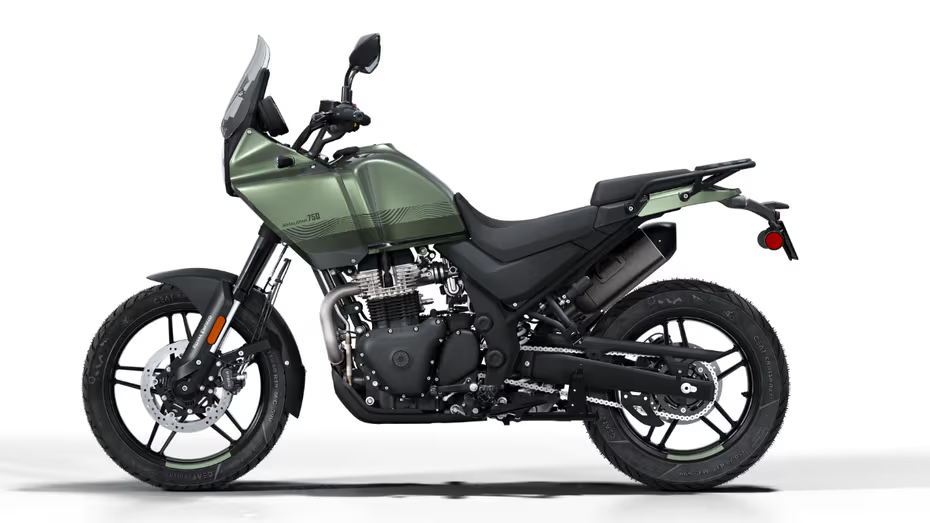
Royal Enfield bikes has officially unveiled the much-awaited Himalayan 750 at EICMA 2026 in Milan, Italy. The new adventure motorcycle marks an important expansion of the company's Himalayan lineup, bringing a larger twin-cylinder engine, upgraded suspension hardware and a comprehensive package of electronic rider aids.
The biggest highlight is its new 743cc, air-oil-cooled, parallel-twin engine, which produces 55 PS of maximum power at 7,000 rpm and 63 Nm of peak torque at 5,000 rpm. The motorcycle gets a six-speed gearbox and an assist-and-slipper clutch.
The Himalayan 750 also features adjustable Showa suspension, twin front disc brakes, cornering ABS, lean-sensitive traction control and cruise control. Other highlights include a 4-inch circular TFT instrument console, five riding modes and a 17.8-litre fuel tank.
With a kerb weight of 224kg for the India-spec version, the new motorcycle is positioned as a larger and more touring-focused alternative to the Himalayan 450.
Royal Enfield Himalayan 750: New 743cc Parallel-Twin Engine
The biggest change on the Himalayan 750 is its newly developed 743cc parallel-twin engine. This air-oil-cooled, inline twin-cylinder unit produces 55 PS at 7,000 rpm and 63 Nm of torque at 5,000 rpm.
Royal Enfield claims that approximately 90% of the engine's peak torque is available from 3,500 rpm. This should help deliver stronger low- and mid-range performance, particularly during highway cruising, overtaking and riding on steep mountain roads.
The engine uses an 83.5mm bore and 67.8mm stroke, with a compression ratio of 9.5:1. It is paired with a six-speed gearbox and a wet multi-plate clutch.
An assist-and-slipper clutch is also included to make clutch operation smoother and help manage rear-wheel behaviour during aggressive downshifts.
The new engine is a significant development for Royal Enfield because it introduces a larger-capacity twin-cylinder powertrain specifically for the Himalayan family.
Himalayan 750 Gets Premium Showa Suspension
Royal Enfield has equipped the Himalayan 750 with Showa suspension components to improve its touring and adventure capabilities.
At the front, the motorcycle gets a 43mm upside-down fork with preload, compression and rebound adjustment. It offers 190mm of wheel travel.
At the rear, there is a Showa monoshock with linkage, featuring adjustable preload and rebound settings. The rear suspension provides 175mm of wheel travel.
This setup is designed to offer a balance between highway stability, riding comfort and the ability to handle uneven surfaces.
The motorcycle uses a box-section spine frame with pressed-steel outriggers, with the engine serving as a stressed member. This chassis arrangement is intended to provide stability and predictable handling across different riding conditions.
19-Inch Front Wheel and Dual Disc Brakes
The Himalayan 750 gets a 19-inch front and 17-inch rear wheel combination. Royal Enfield will offer cast-alloy and tubeless spoked-wheel options, depending on the variant.
The front tyre measures 110/80 R19, while the rear tyre measures 150/70 R17.
Braking duties are handled by twin 280mm front discs with two-piston floating calipers. At the rear, the motorcycle gets a 255mm disc brake with a two-piston caliper.
The safety package includes dual-channel ABS, with the rear ABS being switchable. It also gets cornering ABS and lean-sensitive traction control, supported by a six-axis IMU.
A tyre pressure monitoring system (TPMS) is included as standard equipment.
Five Riding Modes and Cruise Control
Another major highlight of the Royal Enfield Himalayan 750 is its electronic rider-assistance package.
The motorcycle comes with five riding modes:
-
Road
-
Road Sport
-
Rain
-
Trail
-
Custom
These modes adjust engine mapping and electronic intervention according to riding conditions. The motorcycle also gets lean-sensitive traction control with selectable intervention levels.
Cruise control is included, making the Himalayan 750 more suitable for long-distance highway journeys. It can help reduce rider fatigue during extended periods of steady-speed riding.
The combination of riding modes, cornering ABS and traction control gives the new Himalayan a more advanced electronics package than previous models in the range.
4-Inch TFT Display and Connected Features
The Himalayan 750 gets a 4-inch circular TFT instrument display with Bluetooth and Wi-Fi connectivity.
The display supports Google Maps navigation, along with phone and music controls. It also works with Royal Enfield's connected vehicle technology.
Other equipment includes a new LED lighting system, self-cancelling turn indicators, an emergency brake lamp and two USB Type-C charging ports. One of the charging ports supports 27W fast charging.
These features should make the motorcycle more practical for riders who regularly use smartphones and navigation systems during touring trips.
Design, Colours and Touring Accessories
The new Himalayan 750 retains the familiar adventure motorcycle design associated with the Himalayan family. It features a round LED headlamp, tall windscreen, muscular fuel tank, upright handlebars, split seats and an upswept exhaust.
Royal Enfield has announced five colour options:
-
Antarctic Silver
-
Siberia White
-
Aztec Green
-
Viking Bronze
-
Tectonic Black
The company has also showcased touring accessories for the motorcycle. These include hard panniers, a top box, heated grips, handguards and an aluminium skid plate.
The accessory-equipped version is aimed at riders planning extended journeys and carrying additional luggage.
Royal Enfield Himalayan 750: Complete Specifications
|
Specification
|
Details
|
|
Engine
|
743cc parallel-twin
|
|
Cooling
|
Air-oil cooled
|
|
Maximum power
|
55 PS at 7,000 rpm
|
|
Maximum torque
|
63 Nm at 5,000 rpm
|
|
Bore x Stroke
|
83.5 x 67.8 mm
|
|
Compression ratio
|
9.5:1
|
|
Gearbox
|
6-speed
|
|
Clutch
|
Assist and slipper clutch
|
|
Front suspension
|
43mm Showa USD fork
|
|
Rear suspension
|
Showa monoshock with linkage
|
|
Front wheel travel
|
190mm
|
|
Rear wheel travel
|
175mm
|
|
Front brakes
|
Twin 280mm discs
|
|
Rear brake
|
255mm disc
|
|
Front wheel
|
19-inch
|
|
Rear wheel
|
17-inch
|
|
Seat height
|
815mm
|
|
Ground clearance
|
205mm
|
|
Fuel tank
|
17.8 litres
|
|
Kerb weight (India-spec)
|
224kg
|
|
Instrument console
|
4-inch circular TFT
|
|
Riding modes
|
5
|
|
Rider aids
|
Cruise control, cornering ABS, traction control and TPMS
|
Himalayan 750 vs Himalayan 450: What Has Changed?
The Himalayan 750 sits above the Himalayan 450 in Royal Enfield's adventure motorcycle lineup. The biggest difference is the engine configuration and overall performance.
The Himalayan 450 uses a 452cc liquid-cooled, single-cylinder engine producing 40.02 PS and 40 Nm. In comparison, the Himalayan 750 gets a 743cc air-oil-cooled parallel-twin engine producing 55 PS and 63 Nm.
The larger motorcycle also receives a 17.8-litre fuel tank, compared with the Himalayan 450's 17-litre capacity.
However, the Himalayan 750 is heavier. Its India-spec kerb weight is 224kg, compared with 196kg for the Himalayan 450. It also has 205mm of ground clearance, while the Himalayan 450 offers 230mm.
This means the two motorcycles serve somewhat different requirements. The Himalayan 450 focuses on lighter adventure riding and off-road versatility, while the Himalayan 750 adds more engine performance and touring-oriented equipment.
India Launch and Expected Price
Royal Enfield has unveiled the Himalayan 750 at EICMA 2026 and published its technical specifications on the official Indian website.
Bookings have opened in Europe, where the motorcycle's UK pricing starts at GBP 6,999 for the alloy-wheel version. However, this should not be treated as an indication of its final Indian price.
The company has not yet announced the official India showroom price. An India debut is expected around the Royal Enfield Motoverse event in November 2026, but the final retail launch and delivery schedule should be confirmed by the manufacturer.
Once launched, the Himalayan 750 will compete in the larger adventure touring motorcycle category against models such as the Kawasaki Versys 650 and Honda NX500.

 Khyati Sharma 2026-11-03