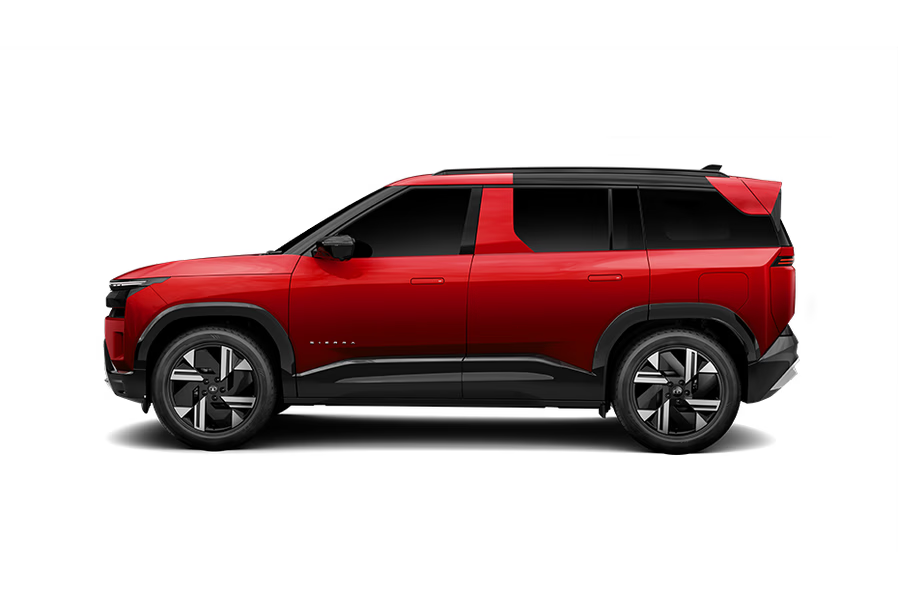
Tata Sierra.ev to Get Built-In 5G Connectivity Through Tata Partnership
New Delhi: Tata Communications and Tata Motors Passenger Vehicles (TMPV) have announced a new collaboration to bring built-in 5G cellular connectivity to the upcoming Tata Sierra.ev. The partnership is aimed at supporting the development and wider adoption of Software-Defined Vehicles (SDVs) in India, where connected technologies are becoming an increasingly important part of modern vehicles.
Under the collaboration, the Sierra.ev will be equipped with integrated 5G connectivity, allowing the electric SUV to support faster and more reliable communication between the vehicle and connected digital services. The technology is expected to create a foundation for advanced connected-car features and future software-led vehicle functions.
5G Technology for Tata Sierra.ev
The introduction of 5G connectivity is expected to strengthen the Sierra.ev's digital capabilities. Unlike conventional vehicles, Software-Defined Vehicles rely heavily on software to control, enhance and introduce new functions. High-speed connectivity can help such vehicles receive software updates and access connected services more efficiently.
The collaboration between the two Tata companies combines Tata Motors' vehicle-development capabilities with Tata Communications' telecommunications and connectivity expertise. This could help create a more connected driving experience as automotive technology moves beyond traditional mechanical features.
Key Details
|
Feature
|
Details
|
|
Vehicle
|
Tata Sierra.ev
|
|
Technology
|
Built-in 5G cellular connectivity
|
|
Automaker
|
Tata Motors Passenger Vehicles
|
|
Technology Partner
|
Tata Communications
|
|
Vehicle Architecture
|
Software-Defined Vehicle (SDV)
|
|
Powertrain
|
Electric
|
|
Primary Focus
|
Connected vehicle technology
|
What It Means for Future Tata EVs
The integration of 5G into the Sierra.ev represents a broader shift towards software-centric mobility. Connected vehicles can potentially support real-time data exchange, cloud-based services, remote functions and regular software enhancements.
Tata Monthly Car Sales Figures
| Model | Aug '26 | Jul '26 | Jun '26 |
|---|
| Tata Nexon | 14,004 | 17,471 | 18,335 |
| Tata Punch | 10,704 | 21,313 | 21,006 |
| Tata Tiago | 5,250 | 7,429 | 7,329 |
| Tata Altroz | 3,959 | 2,862 | 2,715 |
| Tata Harrier | 3,087 | 3,301 | 2,962 |
| Tata Curvv | 1,703 | 1,697 | 1,753 |
| Tata Safari | 1,489 | 1,453 | 1,192 |
| Tata Tigor | 805 | 758 | 602 |
| Tata Altroz Racer | - | - | 2,426 |
| Tata Curvv EV | - | - | 1,753 |
| TATA Harrier EV | - | - | 2,148 |
| TATA NEXON Dark Edition | - | - | 2,580 |
| Tata Nexon EV | - | - | 2,842 |
| Tata Punch EV | - | - | 3,314 |
| Tata Sierra 2026 | - | 6,327 | 6,392 |
| Tata Tiago EV | - | 448 | 1,096 |
| Tata Tigor EV | - | - | 412 |
| Tata Xpres | - | - | 1,236 |
| Tata Xpres T EV | - | - | 768 |
| Monthly Total | 41,001 | 63,059 | 80,861 |
For customers, stronger connectivity could make the vehicle more adaptable over its lifecycle. Software-based improvements may allow manufacturers to enhance certain functions without requiring extensive hardware changes, depending on the feature and vehicle architecture.
The Tata Sierra.ev is therefore positioned to combine an electric powertrain with a more advanced digital ecosystem. The latest partnership also highlights how connectivity and software are becoming key elements of India's evolving electric-vehicle market.
As the automotive industry moves towards increasingly connected and software-driven vehicles, the Sierra.ev could serve as an important example of how telecommunications technology is being integrated directly into passenger vehicles.

 Khyati Sharma 2026-08-27