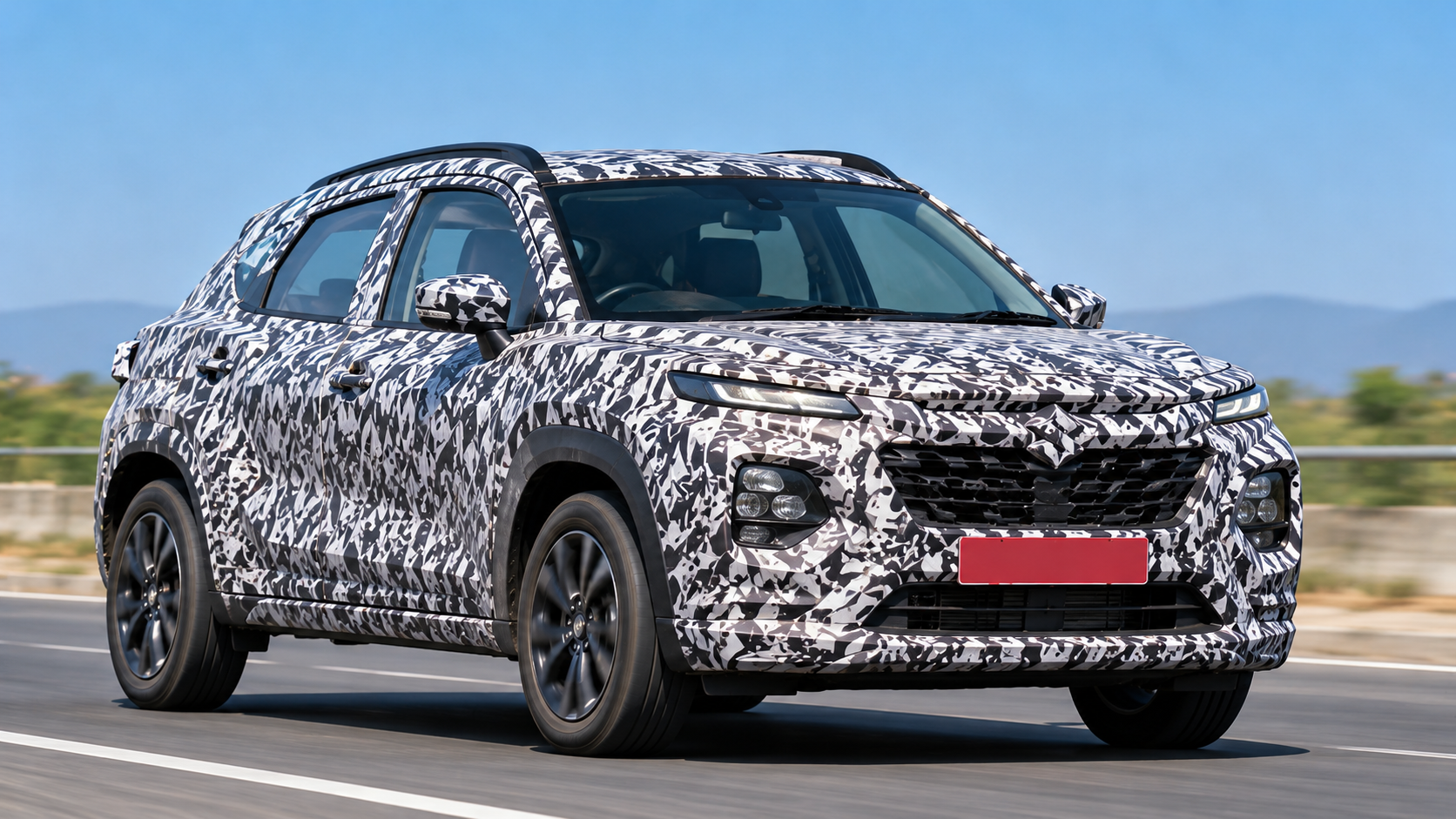
The upcoming Maruti Suzuki Fronx facelift has been spotted testing on Indian roads, indicating that the popular compact crossover is being prepared for a significant update. The refreshed model is expected to bring revised styling, additional safety technology and changes to its petrol powertrain.
The biggest talking points include the possible introduction of Level 2 Advanced Driver Assistance Systems (ADAS), a new 1.2-litre three-cylinder petrol engine and potential improvements to the braking hardware. A strong-hybrid powertrain is also being discussed, although Maruti Suzuki has not confirmed the final specifications or launch schedule.
The Fronx was introduced in India in 2023 and has established itself as an important model in the company's Nexa portfolio. The facelift could help it remain competitive against other compact SUVs and crossovers as buyers increasingly look for improved safety, technology and fuel efficiency.
1. Updated Exterior Design Expected
The upcoming Fronx is expected to retain its distinctive coupe-inspired roofline, raised stance and compact crossover proportions. However, spy images suggest that the front section could receive the most noticeable styling changes.
The updated model may feature a revised front grille, a redesigned bumper and changes to the faux skid plate. The existing split-headlamp arrangement and LED daytime running lights could continue, maintaining the familiar Fronx identity.
At the rear, the overall design is expected to remain largely familiar, although bumper revisions are possible. The connected LED tail-lamp treatment and sloping roofline are likely to remain key elements of the crossover's design.
The latest test vehicle is camouflaged, so the final production design cannot yet be confirmed. New alloy-wheel designs or minor trim updates could also be introduced, depending on the variant.
2. Level 2 ADAS Could Be a Major Addition
One of the most significant expected upgrades is Level 2 ADAS. Testing activity involving advanced driver-assistance hardware has previously been reported on Fronx prototypes, suggesting that Maruti Suzuki may be evaluating additional active-safety technology for the facelift.
If offered, the ADAS package could include features such as:
The final feature list will depend on the production model and variant. These functions are expected possibilities rather than a confirmed equipment list.
ADAS uses cameras, radar or other sensors to monitor the road and assist the driver in certain situations. For example, Automatic Emergency Braking can help reduce the risk or severity of a collision when the system detects an imminent impact. Adaptive Cruise Control can maintain a selected distance from a vehicle ahead, while Lane Keep Assist can provide steering support when appropriate.
These systems do not make a vehicle autonomous. Drivers must remain attentive, keep their hands on the steering wheel when required and be ready to take control.
If Maruti Suzuki introduces Level 2 ADAS on the Fronx, it could become a stronger option for buyers prioritising active safety in the compact crossover segment.
3. New 1.2-Litre Three-Cylinder Petrol Engine
Another reported change concerns the Fronx's naturally aspirated petrol engine. The facelift could replace the existing 1.2-litre four-cylinder unit with the newer Z-Series 1.2-litre three-cylinder petrol engine.
This engine family is already used in models such as the Swift, Dzire and Baleno. Its possible introduction in the Fronx could help Maruti Suzuki streamline its powertrain range and focus on efficiency.
The three-cylinder engine is expected to prioritise everyday drivability and fuel economy. However, the performance figures, transmission combinations and calibration for the updated Fronx have not been officially announced.
The current Fronx also offers a 1.0-litre Boosterjet turbo-petrol engine. Reports suggest that this turbocharged option could continue with the facelift, potentially preserving a more performance-oriented choice for customers.
Whether the naturally aspirated engine will be offered with a manual or AMT gearbox, and whether the turbo-petrol engine will retain its existing transmission options, remains to be confirmed.
4. Strong-Hybrid Technology Could Improve Fuel Efficiency
The possibility of a strong-hybrid version is another major talking point surrounding the updated Fronx. Maruti Suzuki's parent company, Suzuki, has discussed work on a series-hybrid system for compact vehicles, but the company has not confirmed that this technology will be introduced on the Fronx.
In a series-hybrid layout, an electric motor drives the wheels while a petrol engine operates primarily as a generator to supply electricity or recharge the battery. Unlike a conventional petrol car, the engine does not directly drive the wheels in the usual manner.
Such a setup could provide an electric-motor-driven experience without requiring drivers to plug the vehicle into an external charger. Regenerative braking could also recover some energy while slowing down.
Improved fuel efficiency would be a potential benefit, particularly in stop-and-go city traffic. Some reports have speculated about mileage figures of around 30–35 kmpl, but these numbers are not official claims and should not be treated as confirmed specifications.
The final efficiency figure, if a hybrid version reaches production, would depend on the battery, motor, engine calibration, vehicle weight and certification testing.
5. Will the 2027 Fronx Get Rear Disc Brakes?
Rear disc brakes are another feature of interest for the facelift. However, the latest reports available do not clearly confirm that the production-spec Fronx will receive them.
Disc brakes use a rotor and caliper to create friction and slow the vehicle. Depending on the vehicle's design, they can offer consistent braking performance and effective heat dissipation. The actual stopping distance, however, also depends on tyres, brake calibration, road conditions, vehicle load and electronic safety systems.
If rear disc brakes are introduced, the change could be part of a broader effort to improve the Fronx's hardware. Buyers should wait for official specifications before assuming that this equipment will be standard across the range.
6. Expected Features and Interior Changes
The cabin is expected to retain much of the current Fronx's layout, potentially with updates to selected materials, trim and equipment. The existing model offers features such as a touchscreen infotainment system, wireless smartphone connectivity, a head-up display, automatic climate control and a 360-degree camera on applicable variants.
The facelift could carry over many of these features while introducing additional technology on higher trims. Ventilated front seats or a revised instrument display have also been discussed as possibilities, but neither should be considered confirmed until Maruti Suzuki reveals the production model.
Safety equipment and feature availability may vary by variant. The final specification sheet will clarify which technologies are offered as standard and which are restricted to higher trims.
Expected Specifications: 2027 Maruti Fronx Facelift
|
Feature
|
Expected details
|
|
Body style
|
Compact crossover SUV
|
|
Exterior changes
|
Revised grille and bumper styling expected
|
|
Naturally aspirated engine
|
1.2-litre, three-cylinder Z-Series petrol, reported
|
|
Turbo-petrol engine
|
1.0-litre Boosterjet could continue
|
|
Hybrid powertrain
|
Possible future series-hybrid option
|
|
ADAS
|
Level 2 features expected, not officially confirmed
|
|
Rear disc brakes
|
Unconfirmed
|
|
Transmission options
|
Final combinations not announced
|
|
India launch
|
Official date not announced
|
|
Price
|
To be announced
|
7. Expected Launch and Price in India
Maruti Suzuki has not officially announced the launch date or prices of the Fronx facelift. Reports point towards a possible arrival around late 2026 or in 2027, but the timing could differ between the standard petrol and any future hybrid versions.
The updated model could command a price premium if it receives additional safety equipment, revised styling and powertrain upgrades. A hybrid variant, if introduced, would likely need separate pricing to account for its battery and electric-drive hardware.
Until an official announcement is made, any estimated price range should be treated cautiously. The final pricing will depend on the variants, equipment and powertrain options offered at launch.
8. Rivals in the Compact SUV Segment
The facelifted Fronx will continue to compete for buyers seeking a compact vehicle with SUV-inspired styling, practical dimensions and a choice of petrol powertrains. Depending on pricing and equipment, its alternatives include the Hyundai Venue, Kia Sonet, Tata Nexon and Mahindra XUV 3XO.
ADAS availability, real-world fuel economy, rear-seat comfort, boot space, ownership costs and after-sales support could all influence buying decisions. If the Fronx receives a hybrid powertrain and additional active-safety features, it could offer a different proposition from rivals that rely mainly on conventional petrol engines.
Conclusion
The 2027 Maruti Suzuki Fronx facelift is shaping up to be an important update for the compact crossover. Expected changes include refreshed exterior styling, a possible 1.2-litre three-cylinder petrol engine and the potential addition of Level 2 ADAS. A strong-hybrid powertrain could also be under consideration as Maruti Suzuki explores more efficient technologies for smaller cars.
Rear disc brakes remain unconfirmed, and the company has not announced final specifications, prices or a launch date. More details should emerge as testing progresses and Maruti Suzuki moves closer to unveiling the updated Fronx.

 Khyati Sharma 2026-10-28