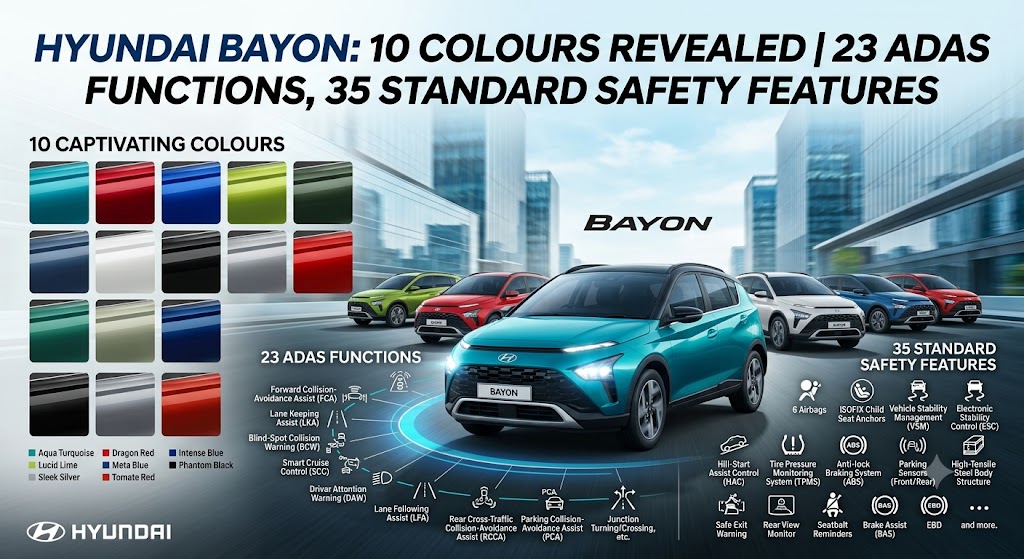
Hyundai car is preparing to expand the powertrain lineup of its newly launched Bayon SUV with a factory-fitted CNG option, expected to arrive in India in January 2027. One of the biggest talking points surrounding the upcoming model is its CNG tank packaging, which is expected to help preserve luggage space for everyday family use.
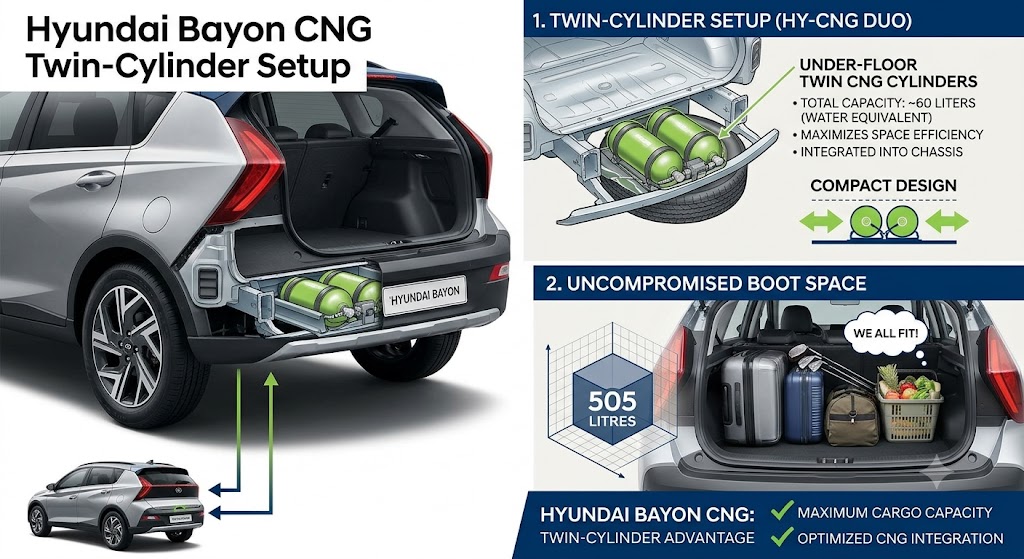
The headline suggests a twin-cylinder setup, but Hyundai has not yet officially confirmed whether the Bayon CNG will use twin cylinders or an underbody-mounted tank. Current reports indicate that an underbody arrangement is a possibility, allowing the SUV to retain more of its usable boot space than a conventional CNG vehicle with a large cylinder installed inside the luggage compartment.
The CNG version will target buyers who want the practicality of a midsize SUV cars while reducing their fuel expenses. Final details, including tank configuration, CNG mileage, power output, variants and pricing, are still awaited.
Hyundai Bayon CNG Launch Timeline
Hyundai has confirmed that the Bayon will receive a CNG powertrain in India in January 2027. The announcement follows the launch of the petrol-powered Bayon on October 26, 2026.
The CNG model is expected to broaden the SUV's appeal among customers who drive long distances regularly and want to reduce their running costs. It will also expand Hyundai India's factory-fitted CNG portfolio beyond its smaller models.
The company has not yet announced the exact launch date, booking schedule or delivery timeline for the Bayon CNG. More information about its variants and equipment is expected closer to the launch.
Twin-Cylinder Setup or Underbody CNG Tank?
Tank placement will be an important factor in determining how practical the Bayon CNG is for families. In many conventional CNG cars, the cylinder is positioned inside the boot, reducing the space available for suitcases, shopping bags and other luggage.
Hyundai could address this issue through a more space-efficient tank arrangement. An underbody-mounted tank has been reported as a possibility, while the use of twin cylinders remains unconfirmed.
A twin-cylinder system can divide the storage arrangement into two smaller units instead of one large cylinder. Depending on the design, this can improve packaging flexibility and make it easier to retain usable luggage space. However, a twin-cylinder setup does not automatically guarantee an unchanged boot capacity; the final result depends on the tanks' size, position and vehicle structure.
If Hyundai adopts an underbody arrangement, the Bayon CNG could offer a major practical advantage over models that place their CNG cylinders directly inside the luggage compartment. The final boot capacity and tank layout will need to be confirmed by the manufacturer.
Hyundai Bayon CNG Engine and Gearbox
The upcoming CNG version is expected to use the same 1.5-litre, four-cylinder, naturally aspirated petrol engine as the standard Bayon, with modifications for CNG operation.
In petrol form, the engine produces approximately 115 PS and 144 Nm of torque. Its CNG version is expected to deliver lower power and torque figures, although the official output figures have not been announced.
| Specification |
Hyundai Bayon CNG – Expected Details |
| Engine |
1.5-litre, four-cylinder, naturally aspirated petrol engine adapted for CNG |
| Fuel type |
Petrol and CNG |
| Petrol engine output |
115 PS and approximately 144 Nm |
| CNG power output |
Yet to be announced |
| Expected gearbox |
6-speed manual |
| Automatic option |
Not confirmed |
| CNG tank arrangement |
Underbody setup is a possibility; twin-cylinder configuration unconfirmed |
| Boot space |
Designed to minimise compromise; final capacity awaited |
| Expected launch |
January 2027 |
| Price |
Not announced |
Will the Hyundai Bayon CNG Retain Its Boot Space?
Boot space could become one of the most important selling points of the Bayon CNG. The petrol-powered Bayon has been reported with a claimed luggage capacity of around 505 litres, making storage practicality an important part of the SUV's appeal.
Installing a conventional CNG cylinder inside the boot could reduce that space significantly. For families travelling with several suitcases, this may be an inconvenience, particularly on long journeys.
An underbody tank arrangement could help Hyundai avoid this compromise by placing the CNG storage system beneath the vehicle, subject to safety requirements, ground clearance and packaging constraints. This could allow the luggage compartment to remain closer to the petrol model's configuration.
However, the company has not yet confirmed the CNG version's final boot capacity. Buyers should wait for official specifications before assuming that the entire 505-litre capacity will remain unchanged.
Expected Price of the Hyundai Bayon CNG
Hyundai has not announced the price of the Bayon CNG. The petrol-powered Bayon was launched at an introductory starting price of ₹9.99 lakh, ex-showroom.
The CNG version is expected to cost more than its equivalent petrol variant because of the additional fuel-system hardware and factory integration. The actual premium will depend on the variant, equipment and final tank arrangement.
The CNG model's value proposition will depend on how quickly buyers can recover the higher initial purchase cost through fuel savings. Customers with high monthly driving distances may benefit more than those who mainly use their vehicles for occasional short trips.
Running costs will also depend on local CNG prices, real-world fuel efficiency, maintenance expenses and the difference between the petrol and CNG variants' purchase prices. Hyundai has not announced an official CNG mileage figure, so a reliable cost-per-kilometre comparison is not yet possible.
Hyundai Bayon CNG Rivals in India
Once launched, the Bayon CNG is expected to compete with CNG-powered SUVs such as the Maruti Suzuki Victoris and Maruti Suzuki Grand Vitara, along with the Toyota Urban Cruiser Hyryder in relevant powertrain comparisons.
The competition will depend on pricing, variant availability, fuel efficiency, features and luggage space. Buyers will also need to consider the availability of CNG stations in their area and whether a factory-fitted CNG vehicle suits their driving patterns.
Hyundai's potential advantage will be its combination of a larger SUV body, a naturally aspirated 1.5-litre engine and a factory-fitted CNG option. If the final tank arrangement preserves useful boot space, it could make the Bayon more appealing to customers who regularly travel with family or carry luggage.
What Buyers Should Expect
The Hyundai Bayon CNG is shaping up to be an option for buyers who want lower fuel expenses without moving to a smaller vehicle. The expected January 2027 launch gives Hyundai an opportunity to offer an alternative to petrol-only versions of the SUV.
The most important details still to be confirmed are the CNG tank configuration, usable boot capacity, fuel efficiency, power and torque figures, gearbox options, variant lineup and price.
For now, the possibility of a space-saving tank arrangement is promising, but the twin-cylinder setup should not be treated as a confirmed feature. Hyundai's final specifications will determine whether the Bayon CNG can deliver both economical running costs and the same level of everyday practicality as the petrol model.

 Khyati Sharma 2026-10-28