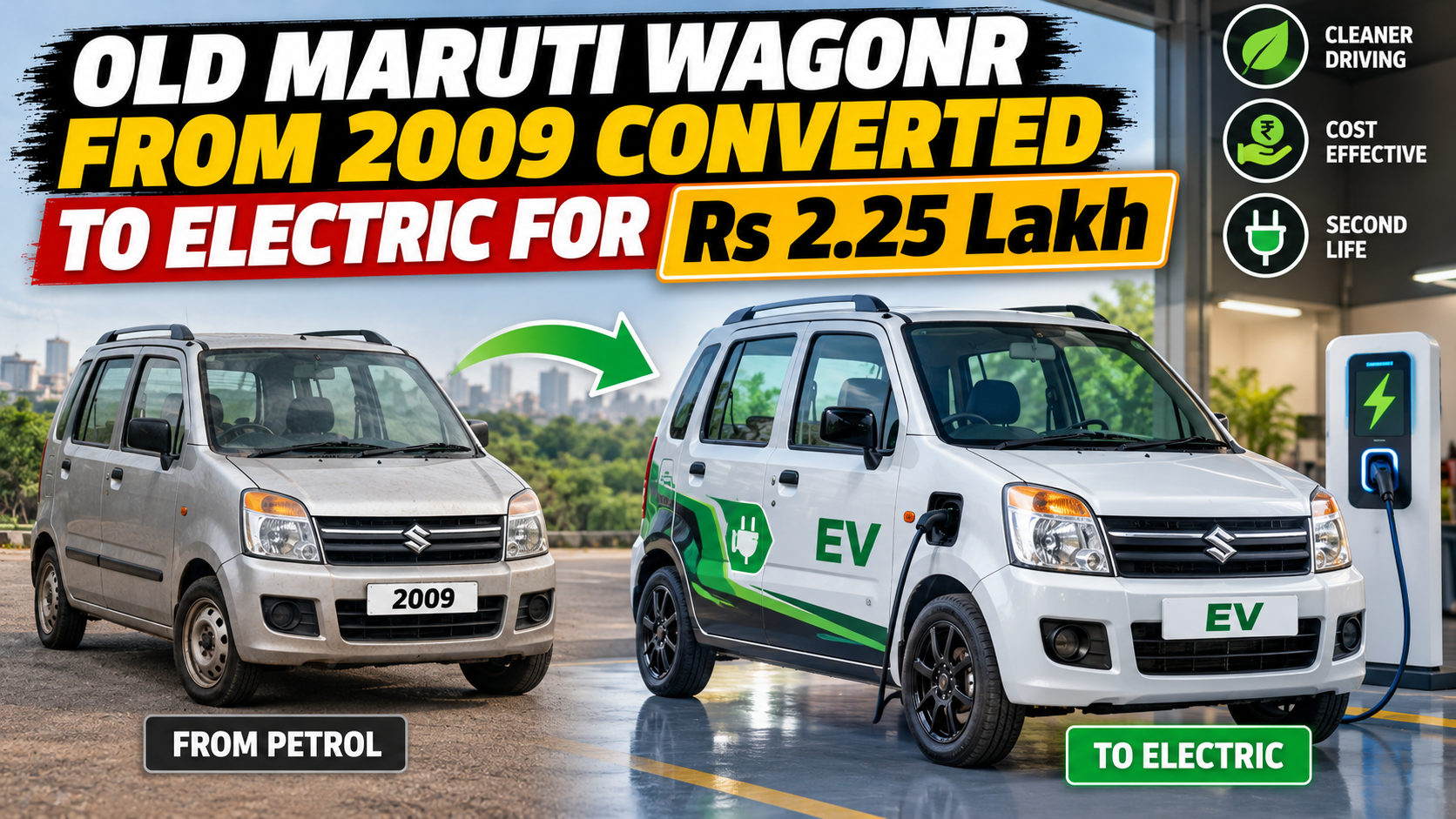
Converting an old petrol car into an electric vehicle can offer an alternative to buying a brand-new EV. A reported conversion of a 2009 Maruti Suzuki WagonR for ₹2.25 lakh has drawn attention to the possibility of giving older hatchbacks a second life through electric powertrain technology.
The idea is straightforward: remove the conventional petrol engine and associated components, install an electric motor and battery pack, and modify the vehicle's supporting systems to work with the new powertrain.
However, the specific details of the reported 2009 WagonR conversion—including the company responsible, battery capacity, driving range and final road-legal status—remain unverified. The ₹2.25 lakh figure should therefore be treated as a reported cost rather than a confirmed, universally available conversion package.
How Can an Old Maruti WagonR Be Converted Into an EV?
A petrol-powered WagonR uses an internal combustion engine to generate power. An electric conversion replaces the original propulsion system with an electric motor, battery pack and associated electronics.
The conversion process generally involves several major changes.
1. Removing the petrol engine and fuel system
The original engine, fuel tank and selected engine-related components are removed as required by the conversion design. Other mechanical components may also need modification to accommodate the electric powertrain.
2. Installing an electric motor
An electric motor provides propulsion using energy supplied by the battery. Depending on the conversion kit, it may drive the existing transmission or use a different arrangement.
3. Adding a battery pack
The battery stores the electricity required to operate the vehicle. Its capacity affects the potential driving range, weight, charging time and overall conversion cost.
4. Installing a motor controller
The controller regulates the motor's operation according to the driver's accelerator input and the system's operating requirements.
5. Integrating charging and safety systems
A complete conversion may require an onboard charger, battery management system, high-voltage wiring, protective equipment and modifications to supporting systems.
The installation must be engineered and tested carefully. An electric conversion is not simply a matter of fitting a battery and motor into the engine bay.
What Could a ₹2.25 Lakh Conversion Include?
|
Component or expense
|
What buyers should check
|
|
Electric motor
|
Power output, compatibility and warranty
|
|
Battery pack
|
Capacity, chemistry, safety and warranty
|
|
Motor controller
|
Compatibility with the motor and vehicle
|
|
Charging equipment
|
Charging speed and connector type
|
|
Installation
|
Labour, fabrication and electrical integration
|
|
Supporting modifications
|
Brakes, suspension, steering and auxiliary systems
|
|
Certification and paperwork
|
Required approvals and registration updates
|
|
After-sales support
|
Battery servicing, repairs and replacement costs
|
Expected Driving Range and Performance
The driving range of a converted WagonR depends mainly on the battery capacity, vehicle weight, motor efficiency and driving conditions.
A larger battery can generally store more energy, but it also adds weight and increases cost. City driving, frequent acceleration, air-conditioning use, road gradients and traffic conditions can all affect the distance travelled on a charge.
There is no independently verified battery specification or range figure available for the particular 2009 WagonR mentioned in the headline.
Earlier Indian EV-conversion projects provide some context. In 2018, Hyderabad-based E-Trio announced plans to convert Maruti Alto and WagonR models using electric retrofit kits. The company claimed a range of up to 150 km for its converted Alto and WagonR vehicles. Those historical claims relate to a different conversion programme and should not be attributed to the reported 2009 WagonR.
Before purchasing a conversion kit, owners should ask for verified range figures and, where possible, independent test results for the exact vehicle configuration.
Is Converting an Old WagonR Cheaper Than Buying a New EV?
The answer depends on the condition of the existing car, the conversion price and the owner's daily travel requirements.
A conversion could be attractive if the WagonR's body, suspension and other major components remain in good condition. It may allow the owner to retain a familiar vehicle while potentially reducing energy and routine powertrain maintenance costs.
However, the conversion price is only one part of the financial calculation.
Owners must also consider the age and condition of the original vehicle, battery replacement costs, insurance, certification, repairs and the availability of specialist service support.
A new electric car may offer a manufacturer-backed warranty, integrated safety systems and a purpose-built electric platform. An older converted vehicle may not provide the same level of integration or convenience.
The correct comparison should therefore include the complete cost of ownership rather than the conversion price alone.
Legal Requirements for Electric Car Conversion in India
Vehicle conversion regulations are an important consideration for anyone planning to transform a petrol-powered WagonR into an EV.
Under India's motor vehicle framework, changes to a vehicle's fuel or propulsion system may require compliance with applicable technical requirements, approved conversion components and updates to the vehicle's registration records.
Owners should consult their local Regional Transport Office (RTO) and a qualified retrofit provider before beginning the work. They should confirm that the specific vehicle and conversion kit are eligible, that the necessary approvals and testing can be completed, and that the revised vehicle details can be recorded legally.
The conversion should also meet applicable electrical safety and roadworthiness requirements. Insurance providers must be informed of material changes to the vehicle.
A conversion that has not received the required approvals should not be assumed to be legal for unrestricted public-road use.
Benefits of Converting an Old Petrol Car Into an EV
Converting an older vehicle can offer several potential advantages when the work is performed by a qualified provider.
-
Lower petrol consumption: Electric propulsion eliminates the need for petrol to power the converted vehicle.
-
Potentially lower routine maintenance: Electric motors have fewer moving parts than conventional combustion engines, although the converted car still requires maintenance.
-
Extended vehicle life: A structurally sound older car may remain useful instead of being replaced immediately.
-
Reduced tailpipe emissions: A fully electric vehicle has no exhaust emissions during driving.
-
Familiar practicality: Owners can retain the WagonR's compact dimensions and tall-boy body style.
These advantages depend on the conversion's quality, electricity source, battery durability and the condition of the original vehicle.
Challenges Buyers Should Consider
Despite its potential benefits, converting an older petrol car into an EV has limitations.
Battery packs can be expensive, and their performance can deteriorate over time. The added weight may also affect suspension behaviour, braking requirements and overall efficiency if the conversion is not properly engineered.
The availability of spare parts and qualified technicians is another concern. Unlike a factory-built EV, a retrofitted vehicle may use components sourced from different suppliers, making repairs more complicated.
Buyers should also investigate warranty coverage, battery replacement costs, charging compatibility and the availability of technical support.
Finally, the condition of the original car matters. A conversion may not be financially sensible if the vehicle already needs substantial bodywork, suspension repairs or other major maintenance.
Conclusion
The reported conversion of a 2009 Maruti Suzuki WagonR into an electric car for ₹2.25 lakh highlights an interesting possibility for extending the life of older vehicles. EV retrofitting can provide an alternative to buying a new car, particularly for owners who want to retain a familiar hatchback.
However, the exact ₹2.25 lakh project and its technical specifications remain unverified. The cost should not be interpreted as an official Maruti Suzuki offering or a confirmed market-wide price.
Anyone considering a similar conversion should first verify the provider, battery capacity, expected range, warranty, total installed cost and legal approvals.
A properly engineered and approved conversion could make an older WagonR useful for everyday travel, but its value ultimately depends on safety, reliability and long-term ownership costs.

 Khyati Sharma 2026-10-27