Audi India Enters Growth Mode with Three New Model Launches Planned by 2027
After spending several years focusing on consolidation, Audi India is now preparing for an aggressive product expansion strategy. The luxury carmaker is set to introduce three major new models within the next 12 months, marking one of the biggest product offensives in its India journey.
The upcoming launches will begin with the third-generation Audi Q3, followed by the new Audi A5 in February 2027 and the recently unveiled Audi Q9 flagship SUV in the second half of 2027. Confirming the aggressive roadmap, Balbir Singh Dhillon, Head of Audi India, stated that the brand will bring three new models in less than a year.
A key part of Audi’s strategy is local production. Instead of relying on expensive Completely Built-Up (CBU) imports, these new models will be assembled at the Skoda Auto Volkswagen Group manufacturing facility in Chhatrapati Sambhajinagar. Audi believes that localisation will remain central to its long-term success in India.
“Making in India will continue to be our core strategy,” said Dhillon, highlighting the importance of local manufacturing despite changing global trade policies.
New Audi Q3: First Launch in the Product Offensive
The third-generation Audi Q3 will be the first major launch under the company’s new strategy. Compared to the previous-generation model, the new Q3 brings significant improvements in design, technology and features.
Internationally, the SUV is offered with petrol, diesel and plug-in hybrid powertrains. However, the India-spec model is expected to arrive with a 2.0-litre turbo-petrol engine producing around 204hp, paired with a 7-speed dual-clutch automatic transmission.
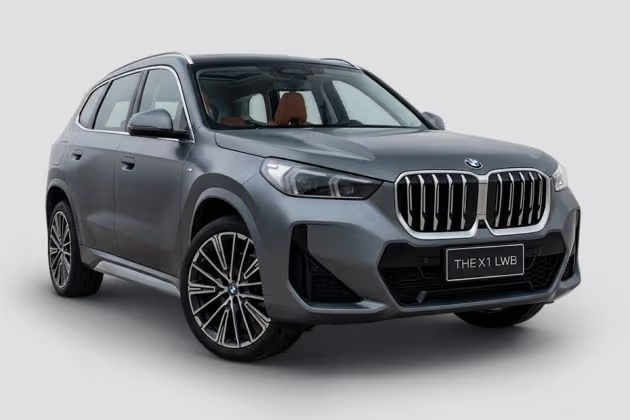
The SUV is likely to feature Audi’s Quattro all-wheel-drive system as standard, giving it an advantage over rivals such as the BMW X1 and Mercedes-Benz GLA. It is expected to be offered in both standard SUV and Sportback versions.
Expected features include an 11.9-inch digital instrument cluster, a 12.8-inch touchscreen infotainment system, three-zone climate control, a panoramic sunroof and premium interior technology.
Audi A5 to Replace the A4 in India
The new Audi A5 will replace the ageing A4 sedan in the company’s Indian portfolio. Based on Audi’s latest Premium Platform Combustion (PPC) architecture, the A5 will offer a more modern design, advanced technology and increased dimensions compared to its predecessor.
The new-generation sedan features a high-tech cabin inspired by newer Audi models, including an optional passenger-side display. The India-spec version is expected to use the same 204hp 2.0-litre turbo-petrol engine paired with a 7-speed dual-clutch gearbox.
Unlike global markets, where higher-powered Quattro versions are available, India is expected to receive the front-wheel-drive variant initially.
Audi Q9: New Flagship SUV for India
The Audi Q9 will become the brand’s new flagship SUV, positioned above the Q7 and Q8. It marks the first time Audi has introduced a model carrying the “Q9” nameplate.
Measuring over 5.3 metres in length, the Q9 will compete directly with premium three-row SUVs such as the Mercedes-Benz GLS and BMW X7. The model represents Audi’s entry into the ultra-luxury SUV segment where it has previously had limited presence.
For India, the Q9 is expected to be offered with a 3.0-litre V6 petrol engine producing approximately 367hp and 550Nm of torque. Power will be sent to all four wheels through an 8-speed automatic transmission. A diesel engine option is unlikely for the Indian market.
Audi India Expands Dealer Network
Along with new products, Audi India is also strengthening its retail presence. The company currently operates around 29 dealerships and plans to expand this network to nearly 40 outlets by the end of next year.
Existing dealerships are being upgraded to Audi’s latest global “Progressive Retail” showroom format, while new outlets are expected to contribute significantly to future sales growth.
Audi Approved Plus, the company’s pre-owned vehicle division, will also play an important role. The used-car business currently sells nearly one certified pre-owned vehicle for every new Audi sold, helping the brand build stronger customer relationships