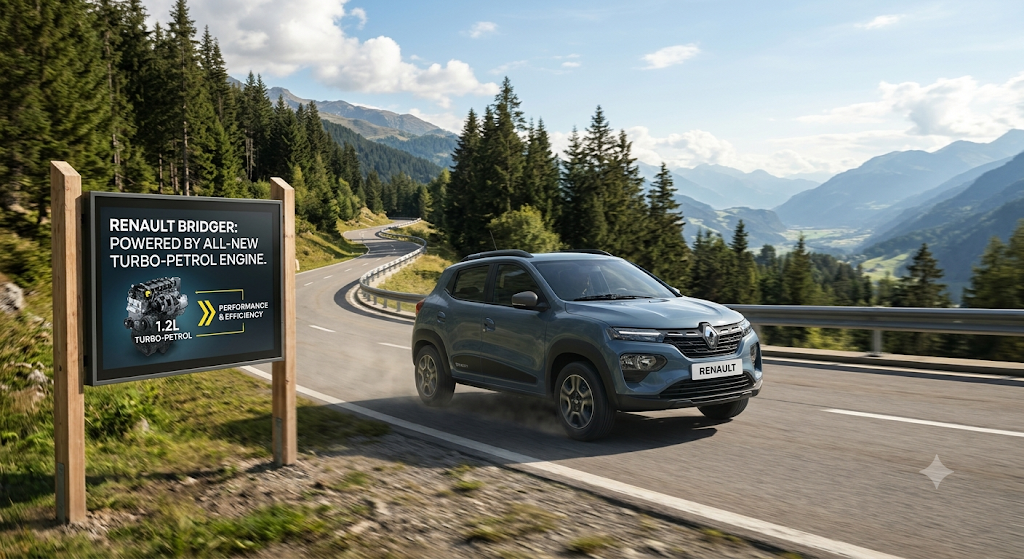
Renault cars is expanding its powertrain development plans for the Indian market with a new 1.2-litre turbo-petrol engine expected to power its upcoming compact SUV cars, the Renault Bridger. The new engine is expected to offer a combination of performance, improved cost efficiency and compatibility with alternative fuel options, including CNG.
The upcoming Renault Bridger is an important product for the French automaker as it looks to strengthen its presence in India's highly competitive compact SUV segment. Positioned below the Duster, the new SUV is expected to compete with popular models such as the Tata Nexon, Maruti Suzuki Brezza, Hyundai Venue and Kia Sonet.
According to reports, Renault is developing a four-cylinder 1.2-litre MPFi turbo-petrol engine derived from the existing 1.3-litre turbocharged unit used in the Duster. The new powertrain could help Renault offer a more affordable SUV while maintaining competitive performance.
Renault Developing a New 1.2-Litre Turbo-Petrol Engine
According to an exclusive report by Autocar India, Renault is working on a new 1.2-litre, four-cylinder turbo-petrol engine for the upcoming Bridger. The engine is reportedly derived from the Duster's existing 1.3-litre TGDi unit.
Renault is expected to reduce the engine's stroke to bring its displacement below 1,200cc. This is an important development for the Indian market because vehicles measuring less than four metres with qualifying engine specifications can benefit from the lower small-car tax structure.
The strategy could allow Renault to price the Bridger more competitively without compromising its performance-oriented positioning.
The new engine is expected to produce approximately 120hp in its turbo-petrol configuration. However, these performance figures are based on media reports and should not be considered final specifications.
MPFi Technology Could Make the Engine More Cost-Effective
One of the biggest differences between the upcoming 1.2-litre engine and the Duster's 1.3-litre turbo-petrol unit is expected to be the fuel injection technology.
The Duster's 1.3-litre turbo-petrol engine uses a direct-injection system, while the new Bridger engine is reportedly being developed with a multi-point fuel injection (MPFi) system.
MPFi technology is generally simpler and less expensive than direct injection. It could help Renault reduce powertrain development and production costs, supporting a more competitive price for the upcoming SUV.
Another important advantage is its potential compatibility with CNG. The MPFi setup could make it easier for Renault to introduce a factory-fitted CNG version of the Bridger.
This would be particularly relevant in India, where CNG-powered passenger vehicles have become an important alternative for customers looking to reduce their fuel expenses.
Renault Bridger Could Get a Factory-Fitted CNG Option
The availability of a factory-fitted CNG option could become one of the major highlights of the upcoming Renault Bridger.
Reports suggest that Renault is considering a CNG-compatible version of the new 1.2-litre engine. The SUV's RGMP platform has reportedly been designed to accommodate alternative powertrain configurations, including CNG.
A factory-fitted CNG option could attract private buyers as well as customers who regularly travel long distances and want lower running costs.
Renault could also offer a naturally aspirated version of the 1.2-litre engine. This would provide a more affordable entry-level powertrain for customers who do not require the additional performance of a turbocharged engine.
However, the company has not yet announced the complete engine specifications or confirmed the availability of individual variants.
Renault Bridger to Offer Multiple Powertrain Options
Renault is reportedly planning a wider powertrain range for the Bridger to appeal to different types of customers. Alongside the turbo-petrol and naturally aspirated petrol engines, the SUV could also receive CNG, hybrid and fully electric powertrain options.
The hybrid version is expected to use a separate 1.2-litre, three-cylinder engine based on Miller-cycle technology. This powertrain is reportedly being developed with Horse Powertrain, a company jointly owned by Renault, Geely and Saudi Aramco.
The hybrid setup is expected to focus on fuel efficiency, while the electric version could help Renault enter India's battery-electric SUV market with a locally developed product.
Interestingly, Renault is not expected to offer a diesel engine with the Bridger. Instead, the company could use its hybrid technology to attract customers who want better fuel efficiency without choosing a conventional diesel SUV.
Renault Bridger Design and Platform Details
The Renault Bridger was previewed as a concept in March 2026. It features a rugged SUV design with an upright stance, muscular body panels, modern LED lighting and a tailgate-mounted spare wheel.
The concept also showcased approximately 200mm of ground clearance and a claimed 400-litre boot capacity. These figures relate to the concept and could change in the production version.
The upcoming SUV will be based on Renault's new RGMP platform, which has been developed to support multiple body styles and powertrain technologies.
Renault has confirmed that the Bridger will be designed and developed in India before being introduced to international markets. Production is planned at the company's Chennai manufacturing facility.
What This New Engine Means for Renault in India
The development of a new 1.2-litre turbo-petrol engine highlights Renault's focus on creating powertrains specifically suited to Indian market requirements.
Instead of relying entirely on existing global engines, the company appears to be exploring a more flexible and cost-efficient approach for its upcoming compact SUV.
The combination of MPFi technology, turbocharging and potential CNG compatibility could give the Bridger a wider customer base. It could also help Renault compete in a segment where affordability, fuel efficiency, performance and maintenance costs play important roles in purchasing decisions.
The upcoming SUV will be an important part of Renault's broader India growth strategy. Its success will depend on competitive pricing, engine performance, fuel efficiency, features and after-sales support.
For now, the new 1.2-litre MPFi turbo-petrol engine remains one of the most interesting developments associated with the upcoming Renault Bridger. More technical details, including final power output, transmission options and fuel-efficiency figures, are awaited.
Conclusion
Renault's upcoming Bridger SUV could introduce a new 1.2-litre MPFi turbo-petrol engine designed to balance performance and affordability. With a reported output of around 120hp and the possibility of a factory-fitted CNG option, the new powertrain could become an important part of Renault's strategy for India.
With petrol, CNG, hybrid and electric possibilities, the Bridger could offer a diverse range of choices when it arrives in the Indian market by the end of 2027.

 Khyati Sharma 2026-11-07