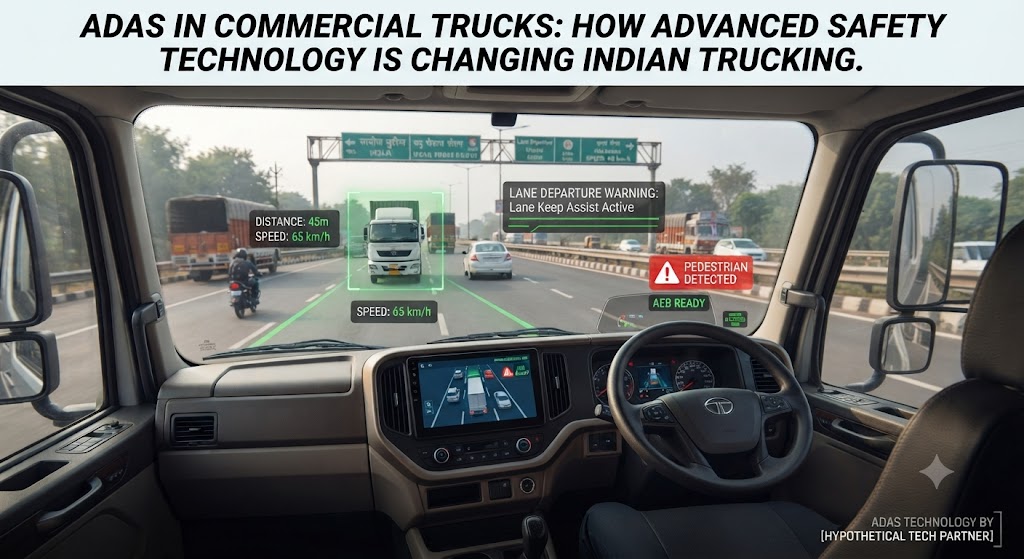
Advanced Driver Assistance Systems, commonly known as ADAS, are becoming an important part of modern commercial vehicle safety. While ADAS was initially associated mainly with premium passenger cars, the technology is increasingly finding its way into trucks and other commercial vehicles.
For truck operators, ADAS can provide an additional layer of safety by helping drivers identify potential hazards, maintain awareness and respond to dangerous situations. This is particularly important for commercial trucks because of their larger size, higher weight and longer stopping distances.
India is also moving towards stronger active-safety requirements for trucks. The Ministry of Road Transport and Highways has announced upcoming requirements covering systems such as Advanced Emergency Braking, electronic stability control, blind-spot information, moving-off information, driver drowsiness detection and lane-departure warning for specified truck categories and timelines.
What Is ADAS in Commercial Trucks?
ADAS is a combination of cameras, sensors, radar and electronic control systems designed to assist the driver while driving.
Unlike autonomous driving, ADAS does not necessarily take complete control of the truck. Instead, it can warn the driver about potential hazards and, in certain systems, automatically intervene when required.
Typical truck ADAS functions include:
- Forward collision warning
- Automatic or advanced emergency braking
- Lane departure warning
- Blind-spot monitoring
- Driver monitoring
- Drowsiness detection
- Collision alerts
- Moving-off information
- Adaptive cruise control
- Traffic and obstacle detection
The exact features vary according to the truck, variant and manufacturer.
ADAS Trucks Available in the Wheels42 Database
| Truck |
ADAS / Safety Technology |
Other Advanced Features |
| Euler Storm EV T1500 |
ADAS, Front & Rear Collision Alerts |
Night Vision Assistance, Dash Camera, Reverse Camera, Live Camera Feed, Hill Hold |
| Euler Storm EV Long Range 200 |
ADAS, Collision Alerts |
Night Vision Assist, CCTV Monitoring, Dash Camera, Reverse Camera, Vehicle Tracking |
The Euler Storm EV T1500 is listed with a 30 kWh battery, 278 km certified range and 1,500 kg certified payload. Its equipment list includes ADAS, night-vision assistance, front and rear collision alerts, dash camera and reverse camera.
The Euler Storm EV Long Range 200 also features ADAS along with night-vision assistance, collision alerts and CCTV monitoring, making driver and vehicle awareness an important part of its technology package.
Key ADAS Features for Trucks
1. Forward Collision Warning
Forward Collision Warning monitors the road ahead and alerts the driver when the truck is approaching another vehicle or obstacle too quickly.
This can be particularly useful for heavy trucks because their stopping distance can increase considerably with vehicle load and road conditions.
2. Advanced Emergency Braking
Advanced Emergency Braking can detect an imminent collision and assist with braking when the driver does not respond quickly enough.
India's upcoming truck safety requirements include Advanced Emergency Braking System under AIS 162 from October 1, 2027 for applicable trucks.
3. Lane Departure Warning
Long-distance truck drivers can experience fatigue, particularly during extended highway journeys. Lane Departure Warning can alert the driver when the vehicle unintentionally moves away from its lane.
The government has announced Lane Departure Warning requirements for applicable trucks from January 1, 2028.
4. Driver Drowsiness Detection
Driver fatigue is a major concern in long-distance trucking. Driver Monitoring Systems can observe driver behaviour and identify signs associated with fatigue or reduced attention.
The upcoming Indian requirements include Driver Drowsiness Detection and Alert Systems for applicable vehicles from January 2028.
5. Blind-Spot Monitoring
Large commercial trucks have significantly larger blind areas than passenger cars. Blind-Spot Information Systems can warn drivers about vehicles or vulnerable road users that may not be visible through conventional mirrors.
India has announced Blind Spot Information System requirements for applicable trucks from January 2028.
6. Collision Cameras and Monitoring
Camera-based systems can provide the driver with a wider view around the vehicle. Some modern commercial trucks also combine cameras with recording and monitoring functions.
Benefits of ADAS for Commercial Truck Operators
Improved Road Safety
The primary advantage of ADAS is improved driver awareness. Warnings for collisions, lane departure and blind spots can give drivers additional time to react.
Reduced Accident Severity
Some systems can intervene automatically. Emergency braking technology, for example, can reduce the severity of a crash when avoiding the collision completely is not possible.
Better Driver Awareness
ADAS can act as an additional safety layer, especially during long-distance operations, night driving and highway travel.
Lower Driver Fatigue
Features such as driver monitoring and drowsiness alerts can help identify situations where the driver may need to take a break.
Better Fleet Management
When ADAS is combined with cameras and connected vehicle technology, fleet operators can gain more information about driver behaviour and vehicle operation.
Greater Safety for Other Road Users
Truck safety is not only about protecting the driver. Blind-spot detection, moving-off information and collision-warning systems can also help protect pedestrians, cyclists, motorcyclists and smaller vehicles.
Why ADAS Is Important for Indian Trucks
Indian roads present a unique combination of challenges. Trucks regularly operate alongside motorcycles, three-wheelers, cars, pedestrians and other commercial vehicles.
Heavy traffic, night driving, weather conditions, road construction and unpredictable road-user behaviour can increase the workload on truck drivers.
ADAS can therefore become an important supporting technology rather than simply a premium feature.
The need is particularly relevant because trucks account for a significant share of serious road-safety challenges. A 2026 SAE technical paper on truck safety in India notes that commercial vehicles were involved in 42% of total accidents in the cited RASSI FY2016–23 database, while N2 and N3 trucks accounted for more than 25% of total accidents in that dataset.
Government Push for Advanced Truck Safety
India is moving beyond basic safety equipment towards active safety technologies.
According to the Ministry of Road Transport and Highways, revised braking standards and Electronic Stability Control are scheduled to become applicable to trucks from October 1, 2027. Advanced Emergency Braking is also scheduled from the same date.
From January 1, 2028, applicable trucks will additionally need systems such as Blind Spot Information, Moving Off Information, Driver Drowsiness Detection and Lane Departure Warning.
This regulatory direction is likely to accelerate the adoption of ADAS across India's commercial vehicle industry.
ADAS vs Traditional Truck Safety
| Safety Approach |
Traditional Trucks |
ADAS-Equipped Trucks |
| Driver awareness |
Mainly dependent on driver |
Driver + electronic assistance |
| Collision prevention |
Driver reaction |
Warnings and, where equipped, automatic intervention |
| Lane monitoring |
Driver responsibility |
Lane-departure alerts |
| Blind spots |
Mirrors and driver observation |
Additional electronic monitoring |
| Driver fatigue |
Driver awareness |
Drowsiness monitoring can provide alerts |
| Emergency response |
Manual braking |
Advanced braking assistance on equipped systems |
| Camera assistance |
Limited/basic |
Multiple camera and monitoring options |
Future of ADAS in Indian Commercial Trucks
ADAS is expected to become increasingly common in Indian trucks as regulations, technology and customer expectations evolve.
The next stage will likely involve closer integration between ADAS, telematics, driver monitoring, connected vehicles and artificial intelligence.
Mahindra's recently launched BLAZO i-TRK, for example, demonstrates how AI and connected technologies are already moving into India's heavy-truck segment. Its optional Driver Monitoring System can monitor road-facing safety incidents, driver recognition, seat-belt usage and signs of fatigue or drowsiness.
Tata Motors has also expanded advanced safety technology across its next-generation truck portfolio, including features such as adaptive cruise control, lane-departure warning and collision mitigation systems.
This indicates that the future of Indian trucking is moving towards trucks that can not only carry more efficiently but also sense, monitor and respond to potential safety risks.

 Khyati Sharma 2026-09-14