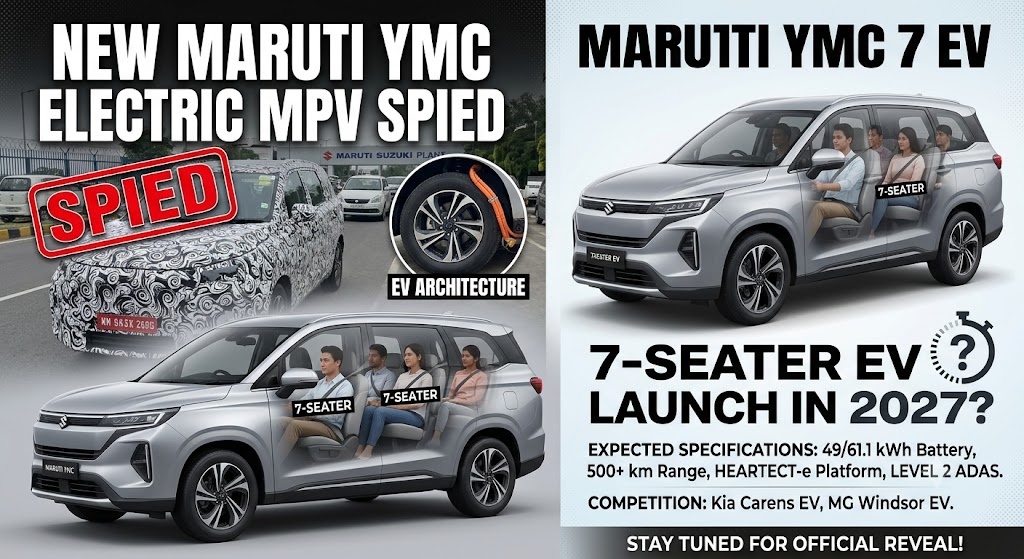
Maruti Suzuki cars is preparing to expand its electric vehicle portfolio in India, and its upcoming electric MPV, internally codenamed YMC, has been spotted testing on Indian roads. The new model is expected to become the brand's first three-row electric vehicle, targeting families looking for a spacious, practical and more environmentally friendly alternative to conventional petrol and diesel MPVs.
The upcoming Maruti YMC is expected to share its electric vehicle platform and several powertrain components with the Maruti Suzuki e Vitara. While the company has not officially announced the final name, specifications, price or launch date, reports point towards a possible reveal around late 2026 or early 2027, with sales potentially beginning in 2027.
Maruti YMC Electric MPV: Expected Launch Timeline
The YMC project is part of Maruti Suzuki's broader plan to expand beyond its traditional petrol, CNG and hybrid offerings. Following the e Vitara, this electric MPV could help the company enter the growing market for multi-row electric family vehicles.
Recent spy images show a heavily camouflaged vehicle with an upright body, a tall roofline and proportions that suggest a spacious cabin. The absence of a visible exhaust system and the presence of aerodynamic alloy wheels also support the possibility that the test vehicle is fully electric.
The exact launch schedule remains unconfirmed. Buyers should therefore treat 2027 as an expected sales timeline rather than an officially announced launch date.
Design and Exterior: SUV-Like Styling With MPV Practicality
Spy shots suggest that the Maruti YMC could combine the practical proportions of an MPV with the rugged appearance of an SUV. The test vehicle appears to have an upright front end, a relatively boxy silhouette, a long roofline and a substantial rear section that may help accommodate a third row of seats.
At the front, the electric MPV is expected to feature a closed-off grille area, modern headlamp elements and a bumper with dedicated air openings. The aerodynamic alloy wheels are another visible detail that could help reduce aerodynamic drag.
The rear appears to feature vertically oriented tail-lamps, potentially connected by a light bar. However, the vehicle remains camouflaged, so the final lighting design, bumper styling and body details may change before production.
Battery, Range and Performance: What to Expect
The upcoming YMC is expected to use the same dedicated electric vehicle architecture as the Maruti Suzuki e Vitara. Reports suggest that it could share the e Vitara's 49kWh and 61kWh battery pack options, along with key electric powertrain components.
A driving range of around 500km or more has been discussed in reports, but this remains an estimate. The YMC's larger body and additional seating could affect its efficiency, meaning its final range may differ from that of the e Vitara.
|
Specification
|
Expected Details
|
|
Model name
|
Maruti Suzuki YMC (internal codename)
|
|
Body style
|
Electric MPV / three-row EV
|
|
Seating
|
5- or 7-seat configuration possible
|
|
Platform
|
Expected to share e Vitara's EV architecture
|
|
Battery options
|
49kWh and 61kWh expected
|
|
Driving range
|
Around 500km or more estimated for a larger-battery version
|
|
Expected debut
|
Late 2026 or early 2027
|
|
Expected market launch
|
2027
|
|
Expected price
|
Around ₹14 lakh–₹18 lakh, unconfirmed
|
|
Main potential rivals
|
Kia Carens Clavis EV, Mahindra XEV 9S
|
Interior and Features: Focus on Family Comfort
The cabin is expected to prioritise space, convenience and technology. If Maruti Suzuki follows the e Vitara's equipment strategy, higher variants could receive a digital instrument cluster, a touchscreen infotainment system, automatic climate control and wireless smartphone charging. Other possible features include reclining seats and a panoramic sunroof, although none of these has been confirmed for the YMC.
The most important factor will be the usability of the third row. A successful seven-seater electric MPV must offer sufficient headroom, legroom and convenient access to the rear seats, along with practical boot space when all rows are occupied.
Battery packaging and cabin-floor height will also influence passenger comfort. Maruti Suzuki will need to balance interior space, battery capacity and driving range to make the YMC a practical family vehicle.
Safety equipment could include multiple airbags, electronic stability control, parking sensors and advanced driver assistance features on selected variants. The final safety package will only be clear once the company reveals the production model.
Expected Price and Rivals
The Maruti YMC is expected to target customers who want a spacious electric vehicle for family use. Media estimates place its potential starting price around ₹14 lakh, with higher variants possibly approaching ₹18 lakh. These figures are provisional, and the final price could differ depending on battery options, equipment and the company's sales strategy.
Its potential rivals include the Kia Carens Clavis EV and Mahindra XEV 9S. The YMC could benefit from Maruti Suzuki's established dealership network and experience in the mass-market family-car segment. However, its competitiveness will depend on pricing, real-world range, charging speed, cabin space and after-sales support.
A Toyota-branded derivative is also expected to follow at a later stage, according to media reports. Such a model could share the underlying platform and powertrain while receiving different styling and interior details.
Final Verdict
The upcoming Maruti Suzuki YMC electric MPV could become an important addition to India's expanding electric-car market. Its expected three-row layout, e Vitara-derived electric architecture and family-focused packaging could appeal to buyers looking to move from conventional MPVs to electric mobility.
However, several important details remain unknown, including the final design, battery specifications, certified range, seating configuration and price. The 2027 launch timeline is also an expectation rather than an official confirmation.
If Maruti Suzuki can deliver competitive pricing, useful third-row space and a practical driving range, the YMC could become an interesting option for Indian families considering a seven-seater EV.

 Khyati Sharma 2026-10-23