TATA Harrier EV
21.69 Lakh*

 Khyati Sharma 2026-08-20

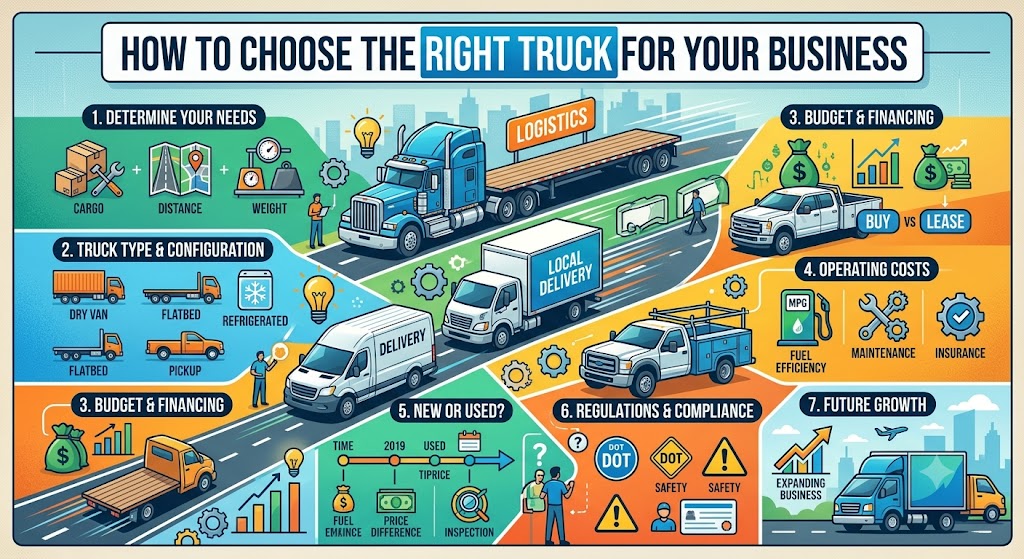
Buying a truck is a major business decision. Whether you run a delivery service, logistics company, construction business, FMCG operation or a small local enterprise, the right commercial vehicle can improve productivity and reduce operating costs.
However, choosing a truck only because it has a lower price or a more powerful engine can lead to higher expenses later. The right choice depends on payload, application, fuel type, operating route, mileage, maintenance cost, safety, comfort and total cost of ownership.
This guide explains the key factors you should consider before purchasing a truck for your business.
Before comparing brands and prices, understand exactly what you expect from the vehicle.
Ask yourself:
For example, a small retailer making local deliveries may not need a heavy-duty truck. A logistics company transporting large loads over long distances will require a completely different vehicle.
For smaller businesses, a mini truck or light commercial vehicle can be more practical, while heavy-load applications may require a heavy-duty truck.
|
Truck Category |
Typical Use |
Best Suited For |
|
Mini Truck / SCV |
Last-mile transportation |
Local deliveries, e-commerce, FMCG |
|
Light Commercial Truck |
City and regional cargo |
Distribution, retail, small logistics |
|
Medium-Duty Truck |
Regional and intercity transport |
FMCG, industrial goods, logistics |
|
Heavy-Duty Truck |
Large and heavy cargo |
Long haul, construction, mining |
|
Tipper Truck |
Loose and construction materials |
Sand, gravel, mining, infrastructure |
One of the most important specifications when buying a truck is payload capacity.
Payload is the maximum weight of goods a truck can legally carry. GVW (Gross Vehicle Weight) is the total permissible weight of the vehicle, including the truck itself, fuel, passengers and cargo.
For example:
GVW = Vehicle Weight + Cargo + Passengers + Other Load
Do not confuse GVW with payload.
A truck with a higher GVW does not automatically mean that it can carry the entire GVW as cargo.
For businesses handling regular heavy loads, choosing sufficient payload capacity can reduce the number of trips required and improve profitability.
Different goods require different truck body configurations.
|
Cargo Type |
Recommended Body |
|
General goods |
Fixed-side deck |
|
FMCG and packaged goods |
High-side deck / cargo body |
|
Fruits and vegetables |
Open cargo body |
|
Construction materials |
Tipper / high-side body |
|
Temperature-sensitive products |
Refrigerated body |
|
Liquid goods |
Tanker |
|
E-commerce parcels |
Closed cargo body |
For example, a truck carrying construction material may need a tipper body, while an e-commerce operator may benefit more from a closed cargo body.
Fuel type has a direct impact on operating costs.
Diesel remains a popular option for heavy-duty applications because diesel engines generally provide strong torque and are well suited to long-distance and high-load operations.
For businesses running trucks over long routes, diesel can remain a practical choice.
CNG trucks can be useful for businesses that operate primarily in cities and have reliable access to CNG stations.
They are commonly considered for:
You can compare current CNG trucks available in the market before making a decision.
Electric commercial vehicles are becoming increasingly relevant for urban logistics and last-mile deliveries.
An EV can make sense when:
For urban operators, it is worth comparing electric trucks with diesel and CNG alternatives.
Horsepower and torque should always be considered together.
Horsepower influences overall engine performance, while torque is particularly important when moving heavy loads and climbing inclines.
For a commercial truck, a useful comparison includes:
Horsepower + Torque + Transmission + Gradeability
A truck with extremely high horsepower is not necessarily the best option if your business mainly operates on flat city roads with moderate loads.
On the other hand, heavy-load or hilly operations may require higher torque and better gradeability.
Transmission affects both driver comfort and operating efficiency.
Common options include:
A manual gearbox can provide familiar operation and may suit many conventional commercial applications. AMT and automatic systems can reduce driver fatigue, particularly in traffic-heavy routes.
For electric trucks, a conventional multi-speed gearbox and clutch may not be required.

Mileage is important, but it should never be the only number you compare.
Actual fuel efficiency depends on:
Instead of asking only, “Which truck has the best mileage?”, calculate:
Cost per kilometre = Energy/Fuel Cost per Trip ÷ Distance Covered
A truck with slightly lower mileage may still be more profitable if it offers greater payload capacity or lower maintenance costs.
Your daily operating distance can help determine the right powertrain.
|
Daily Usage |
Suitable Option |
|
Below 100 km |
EV, CNG or compact diesel |
|
100–250 km |
CNG, diesel or EV depending on charging/fuel access |
|
250–500 km |
Diesel or suitable long-range alternatives |
|
500+ km |
Heavy-duty diesel generally remains a strong option |
These are broad guidelines rather than fixed rules. Actual suitability depends on payload, route, charging facilities and fuel availability.
If your truck regularly operates in hilly or steep areas, gradeability becomes an important specification.
Gradeability indicates the steepest incline the vehicle can negotiate under specified conditions.
This matters particularly for:
A truck with strong torque and suitable gearing can perform better on gradients than a vehicle focused mainly on urban efficiency.
A truck is effectively the driver's workplace.
Features such as power steering, adjustable seats, air conditioning, better visibility, ergonomic controls and low cabin noise can reduce fatigue during long working hours.
A comfortable driver can also contribute to safer and more consistent operation.
Before buying, check:
Safety features should be considered along with price and performance.
Depending on the vehicle category, useful features may include:
The right safety equipment can protect the driver, cargo and other road users.
A commercial truck earns money when it is working.
Before buying, check whether the manufacturer has a strong service network in your operating region. Easy access to genuine spare parts can reduce downtime.
Pay attention to:
Service centres + spare parts + roadside assistance + service intervals
A truck with excellent specifications but limited service support may not be the best choice for a business that depends on daily vehicle availability.
You can compare truck brand and their available models before making your final decision.
The purchase price is only the beginning.
The real cost of operating a commercial vehicle includes:
|
Cost Factor |
What to Consider |
|
Purchase Price |
Ex-showroom and on-road cost |
|
Finance |
EMI and interest |
|
Fuel/Energy |
Daily running expense |
|
Maintenance |
Scheduled and unexpected service |
|
Tyres |
Replacement cost |
|
Insurance |
Annual premium |
|
Taxes |
Applicable road and registration costs |
|
Downtime |
Lost earnings during repairs |
|
Resale Value |
Value when replacing the vehicle |
This is called Total Cost of Ownership (TCO).
A truck that costs more initially may actually be cheaper over five years if it has better fuel efficiency, lower maintenance costs and stronger resale value.
Always examine what is covered under the warranty.
For diesel and CNG trucks, check:
For electric trucks, pay particular attention to:
Warranty duration and kilometre limits can vary significantly between manufacturers.
A commercial vehicle is an asset, and resale value can influence your overall business cost.
Before purchasing, research:
A truck with stronger resale demand can reduce your effective ownership cost when it is time to upgrade.


















Mercedes-Benz
₹195.00 - 224.26 Lakh