
Kia EV9
130 Lakh*

2026-07-02
_and_X-Line_(O).webp)
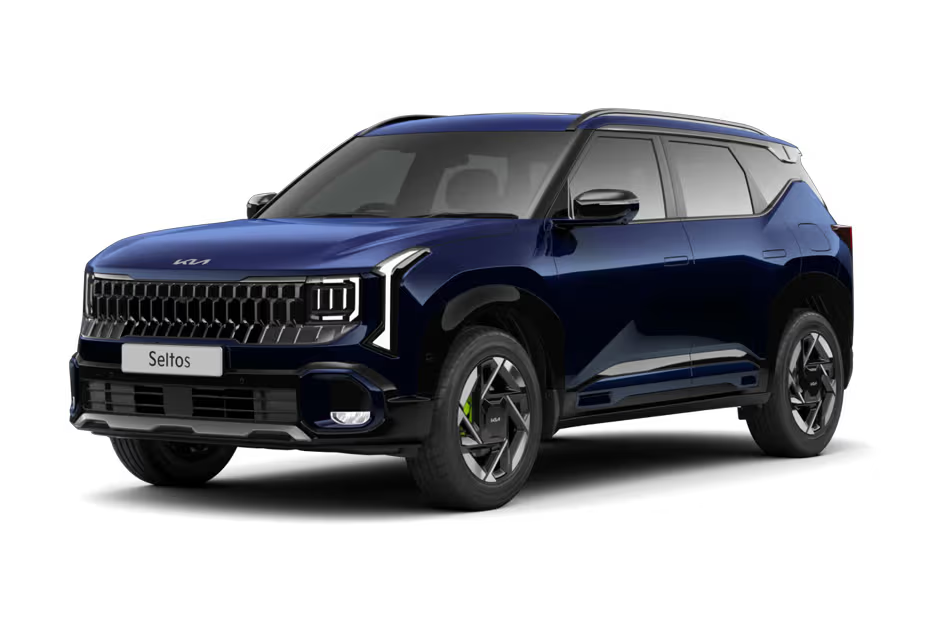
Kia just launched two new top variants of the Seltos, the GTX (O) and X-Line (O), priced between ₹21.56 lakh and ₹21.82 lakh ex-showroom. That's about ₹1.6 to 1.8 lakh more than the GTX (A), and for that money you get a bigger ADAS suite (28 functions instead of 21), a head-up display, and a proper 12.3-inch digital cluster with built-in nav. If you already wanted a loaded Seltos, this is the one to wait for. If you're on a budget, keep reading before you decide.
Here's the full breakdown.
Both variants launched on 1 July 2026. They sit right at the top of the Seltos lineup, above GTX (A) and X-Line (A).
| Detail | Figure |
|---|---|
| Petrol (1.5L Turbo, 7-speed DCT) | ₹21,56,900 |
| Diesel (1.5L Turbo, 6-speed AT) | ₹21,81,900 |
| Premium over GTX (A) | ₹1.57 lakh (petrol) / ₹1.82 lakh (diesel) |
| Engine options | Turbo petrol or turbo diesel, auto only |
| Manual or CVT? | Not offered on these two trims |
So no, you can't get a GTX (O) with a manual gearbox or a CVT. Kia's kept these two trims strictly automatic. Fair enough, honestly, since most buyers at this price point aren't shopping for a manual anyway.
This is the part people often get wrong. The GTX (O) and X-Line (O) don't get a new engine. They just inherit what's already in the Seltos lineup.
Fuel economy sits around 17 to 18 km/l for both, going by ARAI figures. In real-world driving, expect somewhere between 15 and 18 km/l depending on how heavy your right foot is. For context, the diesel iMT variant (a lower trim) is rated higher at 19.4 km/l, so if mileage is your only concern, the lower trims still win there.
Here's the thing that actually justifies the price jump. Kia's added seven new driver-assist features on top of the 21 already on GTX (A), taking the total to 28. Together, this is what Kia calls the "ADAS F+" package.
The new additions include:
That's a genuinely strong list for this price bracket. Most rivals don't offer this depth of Level 2+ ADAS, and Kia's leaning hard into "safest ICE SUV in India" as its pitch, backed by a claimed 5-star Bharat NCAP rating and 6 airbags as standard.
Beyond safety, the GTX (O) throws in a genuine "premium" pack:
Most of this already exists somewhere in the Seltos range. What's new is that GTX (O) bundles it all into one trim instead of making you chase it across multiple variants. That bundling is really the whole value proposition here.
If you're torn between the two, don't overthink it. They're mechanically and feature-wise identical. The difference is purely cosmetic, and it costs you nothing extra.
X-Line (O) gets:
GTX (O) sticks with:
So this really comes down to taste. If you like the rugged, blacked-out look, go X-Line (O). If you'd rather keep things classic, GTX (O) does the job just as well.
At ₹21.8 lakh, the Seltos GTX (O) is now bumping shoulders with some serious competition: the Hyundai Creta, Skoda Kushaq, Honda Elevate, Maruti Grand Vitara and Victoris, and even the Tata Sierra.
Here's where the Seltos separates itself: none of these rivals currently pair a 1.5L turbo engine with as many transmission choices (CVT, iMT, DCT depending on trim) while also offering Level 2+ ADAS with close to 28 functions on a top variant. The Creta has ADAS too, but Kia's list is longer and includes things like evasive steering, which not every competitor has nailed down yet.
Where rivals might still have an edge is outright cabin quality feel in some trims, and in the Kushaq and Elevate's case, a slightly more focused driving experience for people who care about that over gadgets.
Honestly, this launch feels less like a new product and more like Kia cleaning up its own lineup. They took features that already existed in bits and pieces across the Seltos range and packaged them into one "just buy this and stop thinking" trim. That's smart from a sales point of view, but it does mean if you're an existing GTX (A) owner, you're not missing out on anything mechanically new, just convenience and ADAS.
The ADAS jump, though, is the one thing I'd actually pay for. Evasive Steering Assist and Junction Crossing Assist aren't gimmicks. They genuinely reduce the odds of getting into a bad accident in Indian traffic conditions, where sudden lane changes and blind intersections are a daily reality. If safety tech matters to you more than saving ₹1.6 lakh, GTX (O) is worth it. If you mostly drive in predictable city traffic and don't care about HUDs or ambient lighting, the GTX (A) still gets you 90 percent of the experience for noticeably less money.
One thing worth asking before you commit: does your dealer even have test-drive units of GTX (O) or X-Line (O) yet? Fresh launches in India often take a few weeks to actually reach showroom floors in test-drive-ready condition, so it might be worth calling ahead before you make a special trip.









Honda
₹12.00 - 24.21 Lakh