2026 Maruti Baleno Facelift Expected in September With New Hybrid Tech
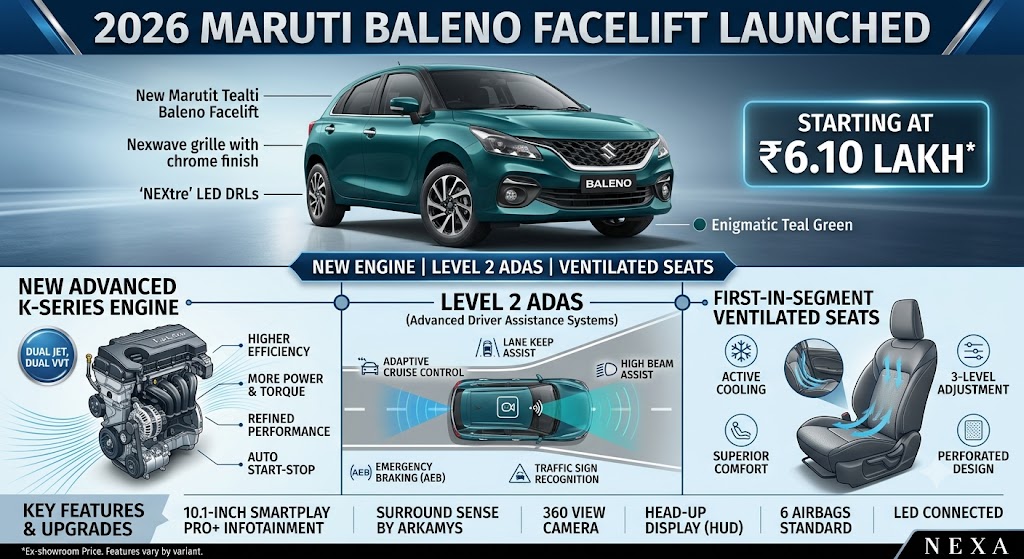
Maruti Suzuki is getting ready to give the Baleno a significant mid-life update, with the 2026 Baleno facelift expected to arrive in India in the first week of September. The timing could work well for the company, as the updated hatchback would reach dealerships just ahead of the festive season, when demand for new cars typically picks up.
The Baleno has been one of Maruti Suzuki's strongest performers in the premium hatchback category. It continues to compete with models such as the Hyundai i20 and Tata Altroz, and the upcoming update is expected to help the car stay competitive as rivals receive their own design and feature upgrades.
Fresh Styling Without Losing the Baleno's Identity
The 2026 update is expected to be a facelift rather than a completely new-generation model. As a result, the familiar proportions and overall silhouette of the Baleno are likely to remain intact.
Most of the visual changes are expected at the front and rear. The car could feature a reworked grille, slimmer LED headlamps and a redesigned front bumper, giving it a sharper appearance.
The side profile is likely to remain largely unchanged, although new alloy wheel designs could add some freshness. At the rear, revised LED tail-lamp graphics and a mildly redesigned bumper are expected to complete the exterior makeover.
Cabin Could Get a More Premium Feel
Inside, Maruti is expected to retain the current dashboard layout while making several smaller improvements to the cabin.
The facelift could bring new upholstery, updated dashboard finishes and improved interior materials. The infotainment system may also receive software upgrades, while additional connected-car functions and convenience features could be introduced depending on the variant.
Rather than completely redesigning the cabin, Maruti appears likely to focus on making the existing setup feel more modern and better equipped.
Affordable Hybrid Technology Could Be the Biggest Change
The most interesting update, however, could be hidden under the bonnet.
The facelifted Baleno is widely expected to become one of the first Maruti Suzuki models to use the company's new affordable hybrid technology. Unlike the more sophisticated strong-hybrid systems used in larger vehicles, this technology is being developed with smaller and more affordable cars in mind.
The objective is to improve fuel efficiency without pushing the price significantly higher. If introduced as expected, the system could give the Baleno an important advantage in a segment where running costs remain a major consideration for buyers.
The existing 1.2-litre petrol engine is expected to continue, with petrol and CNG options likely to remain part of the lineup.
There has also been speculation about the return of a 1.0-litre Boosterjet turbo-petrol engine, but Maruti Suzuki has not officially confirmed whether the powertrain will be offered with the facelift.
Maruti some cars also known for Best Cars for Families in India
| Best Cars for Families in India |
| |
Car |
Price* |
Seating |
Why It’s Great for Families |
| |
Maruti Suzuki Ertiga |
₹8.97–13.26 Lakh |
7 |
Spacious cabin, excellent mileage, low running & maintenance cost |
| |
Kia Carens |
₹10.60–19.67 Lakh |
6 |
Comfortable 3-row seating, premium features, versatile family car |
| |
Toyota Innova HyCross |
₹19.15–31.97 Lakh |
7 |
Excellent space, hybrid efficiency, strong highway comfort |
| |
Hyundai Creta |
₹11.16–20.18 Lakh |
5 |
Premium features, comfortable ride, strong safety package |
| |
Mahindra XUV 7XO |
~₹13.5–25 Lakh |
6 |
Powerful engines, spacious cabin, ADAS & feature-rich interior |
| |
Tata Safari |
~₹15–27 Lakh |
6 |
Large SUV, comfortable long-distance travel, strong safety credentials |
| |
Maruti Suzuki Grand Vitara |
₹11.42–20.99 Lakh |
5 |
Excellent fuel efficiency, spacious cabin, hybrid option |
| |
Honda Elevate |
₹11.69–16.70 Lakh |
5 |
Spacious rear seat, large boot, comfortable ride |
| |
Toyota Rumion |
₹10.44–13.79 Lakh |
7 |
Practical 7-seater, efficient engine, Toyota ownership experience |
| |
Tata Nexon |
~₹8–15.6 Lakh |
5 |
Compact dimensions, good safety, feature-rich and versatile |
September Launch Could Give Baleno a Festive Season Advantage
Launching the updated Baleno in early September would give Maruti Suzuki enough time to start deliveries before the main festive buying period begins.
This could be particularly important for the Baleno, as buyers are increasingly shifting towards SUVs and compact SUVs. While Maruti has expanded its SUV portfolio considerably, the Baleno remains an important model in the company's passenger-car lineup.
With fresh styling, more equipment and the possibility of improved fuel economy through hybrid technology, the 2026 Baleno facelift could give the premium hatchback a much-needed boost.
Maruti Suzuki is expected to reveal more details about the updated Baleno, including its variant-wise features, prices and exact launch timeline, closer to its market debut.