Khyati Sharma 2026-10-14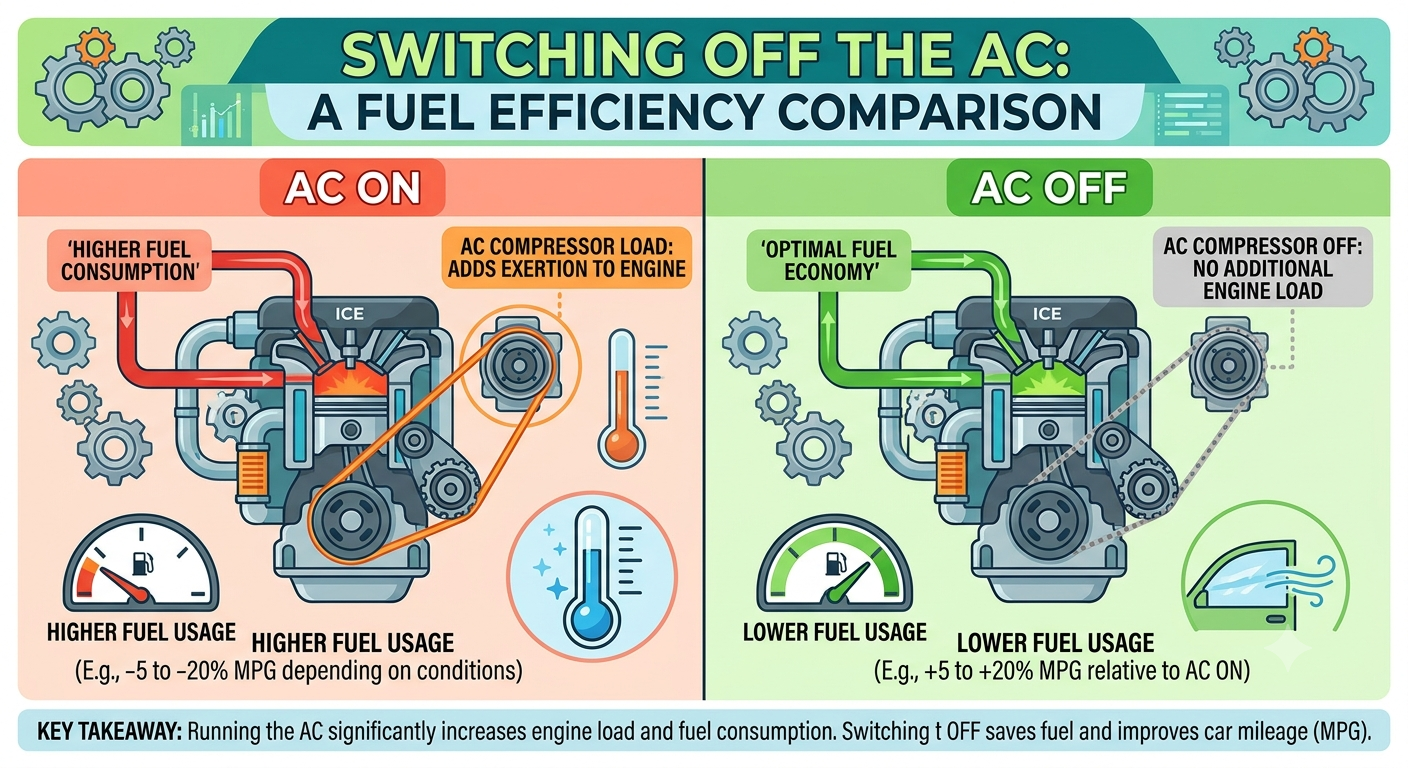
Switching off the air conditioner is one of the most common tricks drivers use to improve fuel efficiency. Whether driving through city traffic or cruising on the highway, many motorists believe that turning off the AC will automatically help their cars deliver better mileage.
But is the difference really significant? The answer depends on several factors, including driving speed, outside temperature, the car's engine, the intensity of cooling and whether the windows are open or closed.
Your car's air conditioning system requires energy to cool the cabin. In conventional petrol and diesel cars, this energy generally comes from the engine, which means the AC can increase fuel consumption. However, switching it off does not guarantee a major improvement in mileage under every driving condition.
Let's examine how car AC affects fuel economy, what real-world testing has shown and when switching it off makes sense.
A car's air conditioning system does more than simply blow cool air into the cabin. It uses a compressor to circulate refrigerant through the system, removing heat and moisture from the air inside the vehicle.
In conventional petrol and diesel cars, the compressor is typically powered by the engine through a belt, although some vehicles use different arrangements. When the AC compressor operates, the engine must supply additional power to run it.
This additional load can increase fuel consumption, particularly when the system is working hard to cool a hot cabin.
The amount of extra fuel used is not the same for every car. A small hatchback cars, a large SUV cars and a diesel-powered vehicle may respond differently to the same cooling demand. Outside temperature, humidity, sunlight, cabin temperature and the AC setting also influence how hard the system needs to work.
For example, a car parked outdoors in direct sunlight may need substantial cooling when the journey begins. Once the cabin reaches a comfortable temperature, the system may require less cooling effort, depending on its design and operating conditions.
This is why switching off the AC can save fuel, but the actual benefit varies from one journey to another.
There is no single mileage improvement that applies to every vehicle. The result depends on the car, the route and the cooling load.
A useful real-world example comes from a 2023 test involving a Toyota Glanza with a 1.2-litre petrol engine. The car was driven for 81 km at an average speed of approximately 100 km/h under three different AC and window configurations.
The reported results were:
|
Driving condition |
Fuel efficiency |
|
AC on, windows closed |
21.66 km/l |
|
AC off, windows open |
21.31 km/l |
|
AC off, windows closed |
23.47 km/l |
The results offer an interesting lesson. Driving with the AC switched off and the windows open did not improve mileage in this particular test. In fact, fuel efficiency was slightly lower than with the AC running and the windows closed.
However, switching off the AC while keeping the windows closed delivered the best result in that test.
The difference between the AC-on and AC-off, windows-closed runs was approximately 1.81 km/l, or about 8.3% relative to the AC-on figure. This does not mean every car will save 8.3% fuel by switching off its AC. The result reflects one vehicle, one route and specific test conditions.
For some drivers, the saving may be noticeable. For others, the difference could be much smaller.
Many drivers assume that opening the windows is the best alternative to using the AC. At low speeds, this can be a reasonable way to ventilate the cabin without running the compressor.
The situation changes as the vehicle accelerates.
At higher speeds, air flowing around the car creates aerodynamic drag. Opening the windows can disturb the airflow around the body and increase resistance, requiring the engine to produce more power to maintain speed.
This creates a trade-off: the AC consumes energy, while open windows can increase aerodynamic drag.
Research conducted by Oak Ridge National Laboratory and published through SAE International compared AC operation with open-window driving in a 2009 Ford Explorer and a 2009 Toyota Corolla. The results showed that the balance between the two options depended on the vehicle and speed. Under the study's conditions, maximum AC cooling used more fuel than open-window driving at moderate highway speeds, but the comparison changed at higher speeds for the Corolla.
The important takeaway is that there is no universal speed at which opening the windows always becomes better or worse. Vehicle shape, speed and AC demand all matter.
For typical highway driving, keeping the windows closed and using the AC at a comfortable setting can be a sensible choice.
Ex-Showroom vs On-Road Price: What's the Real Difference?
City driving introduces a different set of challenges. Cars frequently stop at traffic lights, move slowly through congestion and accelerate repeatedly.
During these conditions, the AC compressor can add to the engine's workload while the vehicle covers relatively little distance. As a result, the additional fuel consumption can become more noticeable in the overall mileage figure.
Consider a car spending 20 minutes in congested traffic on a hot afternoon. The AC may need to work continuously to maintain a comfortable cabin temperature, especially when sunlight heats the dashboard and seats.
Turning off the AC temporarily can reduce compressor demand, provided the system is actually disengaged and the engine is running. However, the saving will depend on the duration and the cooling conditions.
There is another consideration: leaving the engine running while the car is stationary still consumes fuel. If you are parked and waiting for an extended period, switching off the engine where safe and appropriate can avoid unnecessary idling fuel consumption.
Drivers should not sacrifice comfort or concentration simply to improve mileage. In hot weather, excessive cabin temperatures can make driving uncomfortable and potentially affect alertness.
You do not necessarily need to switch off the AC throughout every journey to reduce fuel use. A few sensible habits can help limit unnecessary cooling demand.
Ventilate the cabin before cooling
When a car has been parked in direct sunlight, the cabin can become much hotter than the outside air. If conditions are safe, briefly opening the doors or windows before setting off can help release some of the accumulated heat.
Once driving, close the windows and use the AC as needed. This can help the system cool the cabin without having to deal with as much trapped hot air.
Choose a comfortable temperature
Setting the AC to its coldest setting immediately does not guarantee the best efficiency. Use a comfortable temperature and adjust the blower as required.
In automatic climate-control systems, the car manages cooling to reach the selected temperature. The energy required will still depend on the conditions, but there is little reason to demand unnecessarily intense cooling after the cabin is already comfortable.
Use recirculation appropriately
The recirculation setting reuses cabin air rather than continuously drawing in warm outside air. In suitable conditions, this can reduce the cooling workload.
However, recirculation should not be used blindly for every situation. Follow the vehicle manual, and allow fresh air when necessary to prevent the cabin from becoming stuffy or windows from fogging.
Maintain the AC system
A clogged cabin air filter can restrict airflow, while an AC system that is not working correctly may struggle to cool the cabin. Follow the manufacturer's maintenance schedule and have unusual noises, weak cooling or other problems checked by a qualified technician.
Do not assume that adding refrigerant will automatically improve mileage. The system should be inspected and serviced according to the manufacturer's recommendations.
For more practical ownership advice, see our suggested internal guide: Car Maintenance Tips to Improve Fuel Efficiency.
How to Set a Realistic Car Buying Budget (On-Road Price Explained)
On highways, the answer is usually more nuanced than simply turning the AC off.
At steady speeds, aerodynamic drag becomes increasingly important. Opening the windows can reduce aerodynamic efficiency, particularly at higher speeds. Meanwhile, the AC compressor continues to draw power when cooling is required.
A sensible approach for most conventional cars is to keep the windows closed and use moderate AC settings while cruising. If the weather is mild and you can comfortably drive without cooling, switching off the AC while keeping the windows closed may reduce the engine's workload.
Avoid opening all the windows at high speed solely to save fuel. The resulting drag may offset some or all of the potential benefit.
Smooth acceleration, steady cruising and avoiding unnecessary high speeds can also make a meaningful contribution to fuel economy. These habits are worth considering alongside AC use.
You can also read our proposed guide, How Driving Habits Affect Car Mileage, for more ways to reduce fuel consumption.
The effect of AC use depends on the vehicle's powertrain.
Petrol cars: The AC compressor typically adds mechanical load to the engine, increasing fuel use when cooling is required.
Diesel cars: The same general principle applies. The size of the effect varies with the engine, compressor system and driving conditions.
Hybrid cars: The effect depends on the hybrid system and whether the AC compressor is electrically driven. The engine may stop at certain times, but the AC can still draw energy from the hybrid battery.
Electric cars: An EV does not burn petrol or diesel to operate its AC, but cooling uses electricity from the battery and can reduce driving range. The size of the effect depends on the weather, cabin temperature, journey length and climate-control system.
For EV drivers, pre-conditioning the cabin while the vehicle is connected to a charger, where supported, can help reduce the energy drawn from the battery during the journey.
For more information, explore our proposed internal article: How Air Conditioning Affects Electric Car Range.
For most drivers, switching off the AC is not a decision that needs to be made constantly throughout the journey. It is more useful to understand when cooling demand is high and how the vehicle responds.
If you are driving slowly in mild weather, turning the AC off can reduce fuel consumption. If you are travelling on a highway in hot weather, keeping the windows closed and using moderate cooling may be a better balance.
In very hot conditions, comfort and concentration should take priority over small potential fuel savings. Never leave children, vulnerable passengers or pets in a hot parked vehicle simply to avoid running the AC.
The most reliable way to know your car's actual fuel-saving potential is to compare similar journeys under similar conditions. Keep the route, driving style, traffic, tyre pressures and passenger load as consistent as possible. A single dashboard mileage reading can fluctuate because of traffic, weather and driving conditions, so repeated comparisons are more useful.
Yes, switching off the AC can save fuel in a conventional petrol or diesel car because it reduces the energy required to operate the compressor. However, the amount saved depends on the vehicle, outside temperature, cooling demand and driving conditions.
The biggest mistake is assuming that AC-off driving with open windows is always the most efficient option. At higher speeds, aerodynamic drag can reduce the benefit of opening the windows, and the best approach varies between vehicles.
For everyday driving, use the AC sensibly, keep the cabin filter and system maintained, avoid unnecessary idling and focus on smooth driving. These practical habits can help balance comfort with fuel efficiency without making every journey uncomfortable.
The goal is not to avoid using the AC at all costs. It is to use it when you need it and avoid unnecessary energy consumption when you do not.











Volkswagen
₹46.99 - 54.26 Lakh