
 Khyati Sharma 2026-10-12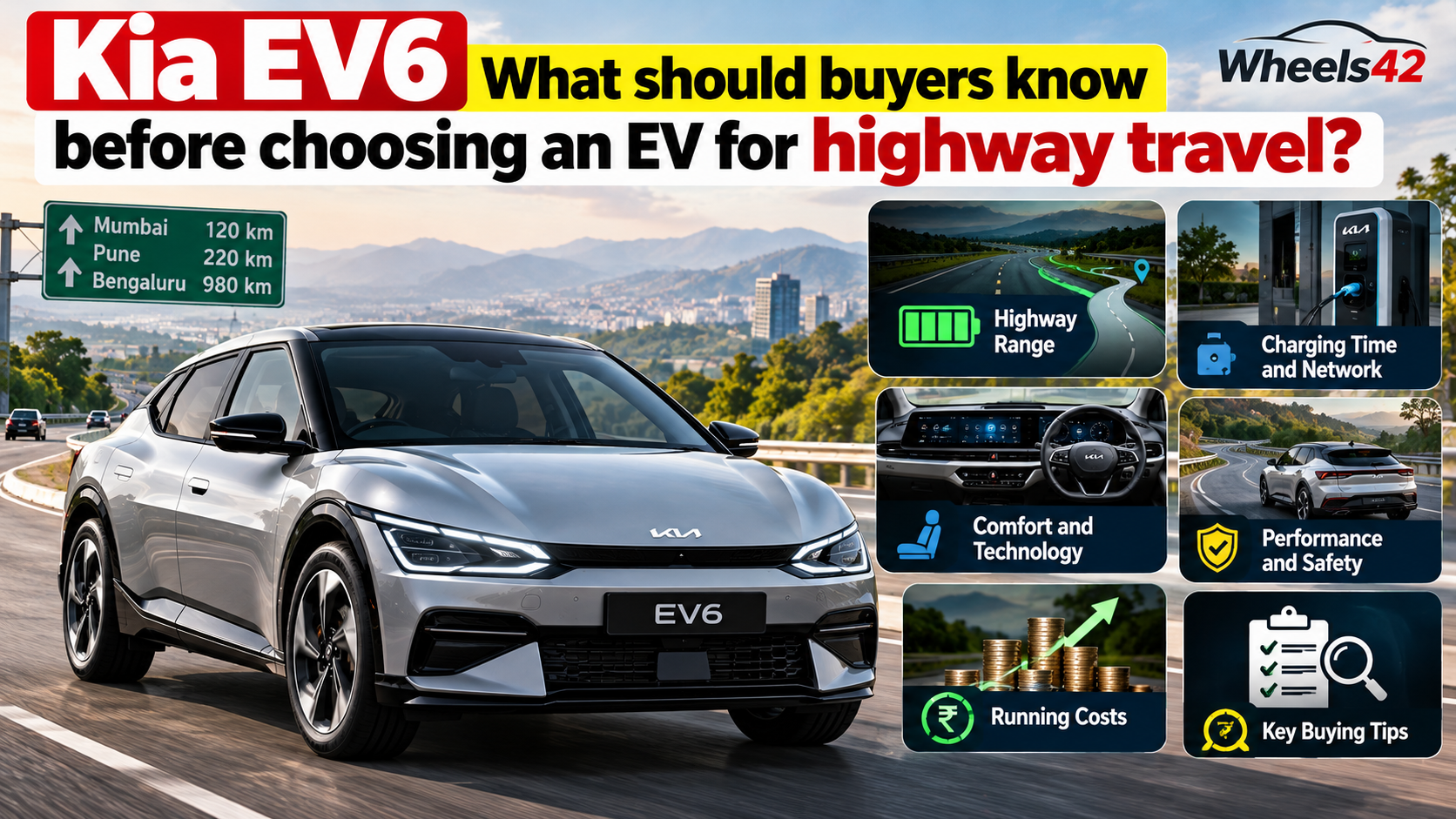
Electric cars or other vehicles are becoming an increasingly practical option for long-distance journeys, offering quiet cabins, instant acceleration and lower running costs compared with many petrol and diesel vehicles. However, highway travel requires buyers to consider more than just the advertised driving range.
The Kia EV6 is a premium electric crossover designed for customers who want long-distance usability along with modern technology and strong performance. In India, the updated EV6 features an 84kWh battery pack and a claimed range of more than 650km on a full charge, depending on the variant and applicable test cycle.
Real-world range, charging availability, highway speeds, weather conditions and passenger load can all affect how far the vehicle travels between charging stops. Buyers planning regular intercity journeys should therefore understand the EV6's charging capabilities and practical limitations before making a purchase.
Here are seven important things to know before choosing the Kia EV6 for highway travel.
Driving range is one of the most important considerations when purchasing an electric car for highway journeys. The Kia EV6 features an 84kWh battery pack, with Kia cars advertising a range of more than 650km under its specified test conditions.
However, the official figure should not be treated as the distance the vehicle will always cover on Indian highways.
Independent testing of the updated EV6 recorded approximately 498km of combined real-world range. In the same testing, highway efficiency was reported at around 6.67km/kWh, translating to an estimated 560km under those particular conditions.
Actual range will vary depending on driving speed, traffic, road gradients, air-conditioning use, weather, tyre pressure and the number of passengers.
For long journeys, buyers should plan charging stops using a conservative estimate rather than relying on the maximum advertised range. Maintaining a reserve of battery charge is particularly useful when travelling through areas with limited charging infrastructure.
Hatchback vs Sedan vs SUV: Which Car Type Suits You Best?
Charging speed is another important advantage of the Kia EV6. The vehicle supports DC fast charging at power levels of up to 350kW under suitable conditions.
Kia states that the battery can charge from 10% to 80% in approximately 18 minutes when connected to a compatible 350kW DC charger. Using a 50kW DC charger, the same charging window takes approximately 73 minutes.
These figures are based on specified conditions. Actual charging times depend on charger output, battery temperature, battery state of charge and other factors.
For highway trips, buyers should check whether compatible fast chargers are available along their intended routes. A charger rated at 350kW does not guarantee that the vehicle will continuously receive that power, and the charging station itself must be operational.
Planning stops around reliable high-power chargers can make the EV6 more convenient for long-distance travel.
Even a long-range electric vehicle requires charging stops on extended journeys. The availability of public charging infrastructure can differ considerably between major highways, smaller towns and remote destinations.
Before leaving, drivers should identify charging stations along the planned route and check their connector compatibility, charging speed, operating status and payment requirements.
It is also sensible to identify a backup charging station near each planned stop. A charger may be occupied, unavailable or operating below its advertised power output when the vehicle arrives.
Drivers should avoid planning routes that depend entirely on reaching a charger with almost no battery remaining. Keeping a comfortable reserve provides flexibility if a detour or unexpected delay becomes necessary.
For frequent highway travellers, the availability of dependable chargers at hotels, destinations and frequently visited locations can be just as important as the vehicle's maximum range.
The Kia EV6 offers a modern cabin designed to make longer journeys more comfortable. Its quiet electric powertrain helps reduce engine noise, while the spacious interior and premium seating contribute to a relaxed driving experience.
The vehicle features a panoramic curved display comprising a 12.3-inch touchscreen and a 12.3-inch digital instrument cluster. These displays provide access to driving information and infotainment functions.
Depending on the variant and equipment, the EV6 also offers features such as a Meridian sound system, relaxation seats, a head-up display and a smart power tailgate.
For buyers planning regular highway travel, it is worth checking seat support, driving position, visibility, luggage capacity and rear-passenger comfort during a test drive.
A vehicle that feels comfortable during a short city drive may feel different after several hours on the highway. Buyers should therefore assess the EV6 with their typical passenger and luggage requirements in mind.

The Kia EV6 combines strong electric performance with modern driver-assistance technology. Depending on the variant, the vehicle is available with rear-wheel-drive or all-wheel-drive configurations.
The rear-wheel-drive version produces 229PS and 350Nm of torque, while the all-wheel-drive version delivers a combined 325PS and 605Nm.
This performance provides quick acceleration for overtaking and merging onto highways. However, drivers should remember that rapid acceleration can increase energy consumption.
The EV6 also offers ADAS 2.0 with multiple driver-assistance functions, with availability depending on the configuration. Buyers should check the precise safety equipment included in the version they intend to purchase.
Driver-assistance systems are designed to support the driver rather than replace attention and control. Maintaining a safe following distance, observing speed limits and taking regular breaks remain essential on long journeys.
Car Waiting Period: How to Get Your New Car Faster
Battery durability and replacement costs are important considerations when buying a premium electric vehicle.
Kia India's published warranty information specifies high-voltage battery capacity coverage for the EV6 for eight years or 160,000km, whichever comes first. Buyers should review the applicable warranty terms, exclusions and conditions with an authorised dealer.
The standard vehicle warranty and the high-voltage battery warranty are separate. Customers should understand what each covers, including the conditions that apply to battery capacity and repair claims.
It is also useful to ask about roadside assistance, service availability along frequently travelled routes and the availability of authorised workshops in the cities and regions where the vehicle will be used.
These details can be particularly important for drivers who regularly travel long distances away from their home city.
Electric vehicles can offer lower energy costs than petrol-powered vehicles, particularly when owners can charge at home or at comparatively inexpensive charging points.
However, public DC fast charging may cost more per unit of electricity than home charging. The total cost of a highway journey depends on the vehicle's efficiency, charging tariffs, the amount of energy required and any additional charging fees.
For example, if the EV6 averages 6km/kWh during a particular journey, travelling 600km would require approximately 100kWh of energy delivered to the vehicle. The actual electricity drawn from the charger could be higher because charging involves some energy losses.
This is an illustrative calculation, not a guaranteed efficiency figure.
Buyers should compare estimated electricity expenses with the fuel costs of their existing vehicle, while also considering insurance, tyres, maintenance, depreciation and the purchase price.
|
Specification |
Kia EV6 |
|
Vehicle type |
Premium electric crossover |
|
Battery capacity |
84kWh |
|
Claimed range |
More than 650km, depending on variant and test cycle |
|
Tested combined real-world range |
Approximately 498km in one published test |
|
Maximum DC charging capability |
Up to 350kW |
|
DC charging time, 10–80% |
Approximately 18 minutes at 350kW |
|
DC charging time, 10–80% |
Approximately 73 minutes at 50kW |
|
Rear-wheel-drive output |
229PS and 350Nm |
|
All-wheel-drive output |
325PS and 605Nm |
|
Infotainment display |
12.3-inch touchscreen |
|
Digital instrument cluster |
12.3 inches |
|
Seating capacity |
Five |
|
High-voltage battery warranty |
Eight years or 160,000km, subject to terms |
The Kia EV6 is worth considering for buyers who want a premium electric vehicle for intercity driving. Its large battery, strong performance, fast-charging capability and comfortable cabin make it suitable for planned highway journeys.
Its suitability will depend on the routes the owner regularly travels. People who frequently drive between major cities with dependable fast-charging infrastructure may find long trips relatively convenient. Those who regularly travel through remote areas should investigate charging availability more carefully.
Before buying, it is advisable to complete a test drive, compare the available variants and check the charging network on the routes that matter most.










Kia Cars
₹59.65 Lakh

Volkswagen
₹49.00 - 56.57 Lakh