 Khyati Sharma 2026-10-10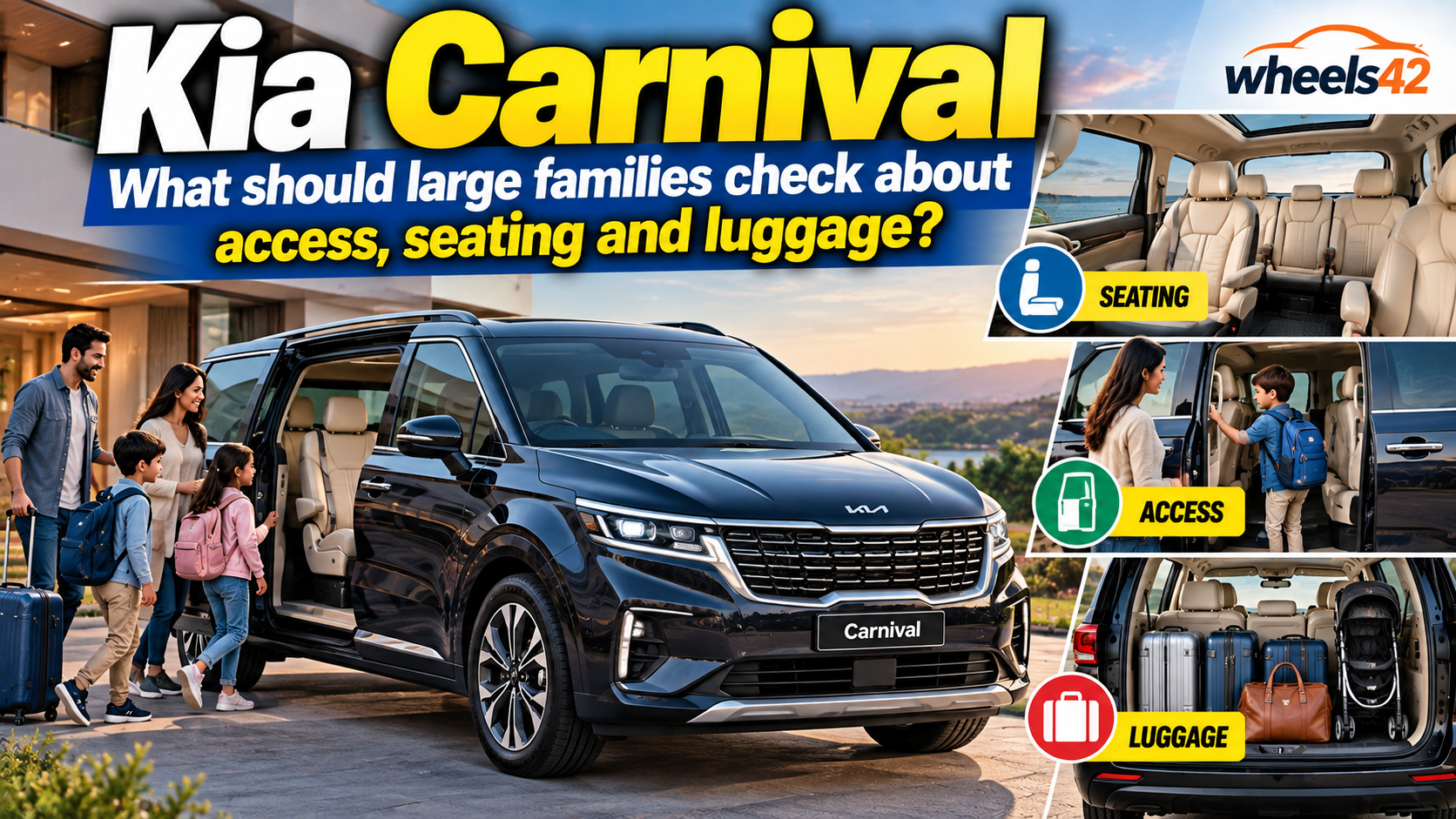
The Kia Carnival is a premium multi-purpose vehicle (MPV) designed for families that need generous cabin space, comfortable seating and practical luggage capacity. With its large body, sliding rear doors and flexible seating arrangements, the Carnival can be an attractive option for families who regularly travel together.
However, choosing a family vehicle involves more than checking the number of seats. Easy entry and exit, child-seat compatibility, third-row comfort and luggage space are equally important, particularly when travelling with children, elderly passengers or multiple pieces of baggage.
Here is what large families should check before buying the Kia Carnival.
How to Compare Car Variants: Base vs Mid vs Top Trim
One of the biggest advantages of the Kia cars the kia Carnival is its sliding rear doors. Unlike conventional hinged doors, sliding doors require less space to open, making them useful in crowded parking lots, apartment garages and narrow spaces.
Families with young children can benefit from the wider access when helping children enter or exit the vehicle. The design can also make it easier for elderly passengers to get into the second and third rows.
Before purchasing, check the following:
Door opening width: Ensure there is enough room for passengers to enter comfortably.
Door operation: Test the power sliding doors, if equipped, and check whether they operate smoothly.
Step-in height: Ask elderly family members to try entering and exiting the cabin.
Parking clearance: Check whether the sliding doors can open fully in your usual parking space.
Child safety: Understand the door-locking and child-safety features before carrying young passengers.
It is also worth checking the availability of grab handles and how easily passengers can move between rows.
The Kia Carnival's seating layout varies by market and model year. Buyers should confirm the exact number of seats and configuration available in their region rather than assuming every version has the same arrangement.
The second row deserves particular attention because it is often used by children, parents and elderly passengers. Depending on the variant, features may include reclining seats, adjustable headrests, armrests and additional comfort functions.
The third row is equally important for larger families. Although a vehicle may officially accommodate several passengers, comfort can vary depending on passenger height, body size and journey duration.
|
Seating factor |
What families should check |
|
Second-row space |
Legroom, headroom and seat adjustability |
|
Third-row comfort |
Knee room, foot space and seat cushioning |
|
Seat configuration |
Number of seats and flexibility for different family needs |
|
Headrests |
Proper support for passengers in every occupied row |
|
Air conditioning |
Airflow and cooling effectiveness in the rear cabin |
|
Entry to the third row |
Whether passengers can access it without excessive effort |
|
Seat belts |
Availability and correct fit for every passenger |
|
Child-seat compatibility |
ISOFIX or other approved child-seat anchorage points, depending on the version |
Families should test every row with the people who will regularly use it. A short showroom visit can reveal whether adults can sit comfortably in the rear seats and whether passengers can move in and out without difficulty.
Families travelling with babies or young children should check the exact child-seat anchorage points and approved installation positions. Confirm whether the intended child seats fit properly without interfering with adjacent passengers.
It is also important to check whether the second-row seats can move or fold easily when a child seat is installed. Some configurations may limit seat movement when child restraints are fitted.
For elderly passengers, focus on the seat height, grab handles, door opening and ease of movement between rows. A low seat may make entry difficult, while a very high seat can require extra effort to climb into.
If family members use walking aids or need additional assistance, check whether those items can be stored securely without obstructing the cabin or reducing essential passenger space.

Luggage capacity is one of the most important considerations when selecting an MPV for a large family.
A spacious vehicle does not necessarily provide enough boot space when every seat is occupied. The third row may reduce the available luggage area, so buyers should assess the Carnival with the full family seating arrangement in place.
For example, a weekend trip may involve several suitcases, backpacks, a stroller and shopping bags. A family travelling with all three rows occupied should check whether these items fit without blocking rear visibility or compromising passenger safety.
Luggage Checks for Family Trips
Everyday luggage: Test the boot with shopping bags, school bags and everyday essentials.
Holiday baggage: Bring representative suitcases to assess how much can fit.
Strollers and baby equipment: Check whether bulky items fit through the boot opening.
Third-row folding: Test how the rear seats fold and whether additional cargo space becomes available.
Loading height: Check whether heavier bags can be lifted into the boot comfortably.
Cargo security: Ensure luggage can be secured and does not move into the passenger compartment.
Do not rely only on the manufacturer's maximum luggage-capacity figure. That figure may refer to a configuration with seats folded or removed. Ask for the luggage capacity with all passenger seats in use.
Car Waiting Period: How to Get Your New Car Faster
A family vehicle should adapt to different daily requirements. The Kia Carnival may be used for school runs during the week, airport transfers at weekends and longer road trips during holidays.
Check whether the seats can be folded, reclined or moved according to your needs. Also verify whether the seating arrangement allows you to carry passengers and bulky items at the same time.
The ability to access the rear seats without removing child seats or rearranging the entire cabin can be particularly valuable for families with multiple children.
Storage compartments, cup holders, charging ports and convenient places for small personal items also make a difference during longer journeys.
A large cabin needs effective climate control, especially when the vehicle carries passengers across several rows. During a test drive, check whether the rear cabin cools quickly and whether the airflow reaches the third row.
Depending on the market and variant, the Carnival may offer additional comfort and entertainment features. Check the exact equipment list rather than assuming every version includes the same features.
Useful features for families may include rear charging ports, sunshades, USB connections, multiple storage areas and rear-seat entertainment equipment where available.
These features are not essential for every buyer, but they can make long journeys more comfortable for children and adults alike.

When carrying several passengers, safety should be a priority. Check the number of airbags, availability of electronic stability control, braking assistance and driver-assistance technologies on the specific variant.
Also verify that every intended seating position has a suitable seat belt and headrest. Child seats should be installed according to the manufacturer's instructions and applicable safety standards.
Before buying, review the exact safety equipment offered in your country. Features and specifications can differ between model years and regional versions.
|
Priority |
What to verify |
|
Access |
Sliding-door operation and ease of entry |
|
Seating |
Comfort in the second and third rows |
|
Child safety |
Approved child-seat positions and anchorage points |
|
Luggage |
Boot space with every seat occupied |
|
Climate control |
Cooling performance across all rows |
|
Storage |
Cup holders, compartments and charging options |
|
Safety |
Airbags, seat belts and available driver-assistance features |
|
Running costs |
Fuel consumption, insurance, servicing and tyre replacement |
|
Parking |
Overall dimensions and suitability for your parking space |
The Kia Carnival can be a compelling choice for large families looking for a spacious vehicle with convenient access, flexible seating and long-distance comfort. Its sliding doors and multi-row layout can be particularly useful for households travelling with children, elderly relatives or several passengers.
However, the most important checks are practical ones: whether everyone can enter and exit easily, whether all passengers remain comfortable on longer journeys and whether enough luggage fits with every seat occupied.
Before making a purchase, take the entire family for a showroom visit or test drive. Try all seating rows, install any child seats you use and test the boot with your usual luggage. These simple checks will help determine whether the Kia Carnival genuinely fits your family's everyday needs.
















Hyundai
₹5.99 - 11.88 Lakh