2026-09-29
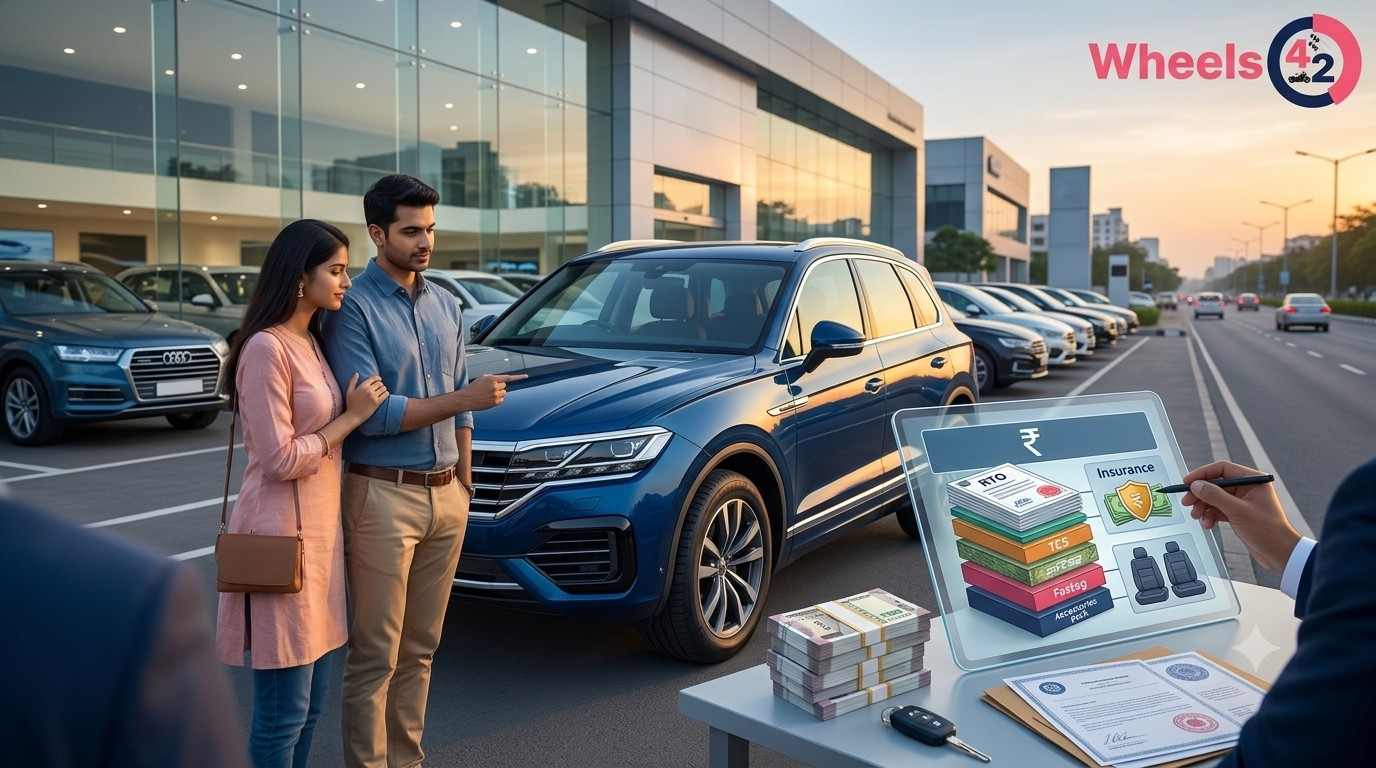
Ex-showroom price is what the car costs at the showroom before state taxes and legal charges. On-road price is what you actually pay to drive it out. For most petrol and diesel cars, the final number lands 10% to 25% above the sticker, so a ₹12 lakh car ends up near ₹14 lakh.
Most of that gap is fixed by law or set by regulators. The rest is where dealers add padding. This guide shows every line, which ones you can push back on, and how to check your own quote in 10 minutes.
|
|
Ex-showroom price |
On-road price |
|
What it is |
Car price at the showroom, before state and legal charges |
Total you pay to drive the car out legally |
|
What's inside |
Build cost, dealer margin, GST |
Ex-showroom plus road tax, registration, insurance, TCS (if any) and dealer extras |
|
Who sets it |
The carmaker (can differ by city) |
State governments, IRDAI and your dealer |
|
Where you see it |
Ads and brand websites |
Dealer quote, EMI sheet, invoice |
|
Typical size |
The sticker |
Sticker plus 10% to 25% |
|
Negotiable? |
Rarely, discounts come separately |
Partly. Taxes no, extras yes |
Three things sit inside it: the cost of building the car and getting it to the dealer, the dealer's margin, and GST. That's why it can differ a little from city to city.
GST changed recently, and it matters. Since 22 September 2025, cars fall into two slabs, 18% for small cars and 40% for larger ones, with no separate compensation cess. Small means petrol, CNG or LPG cars up to 1200cc, or diesel up to 1500cc, and no longer than 4 metres. Electric cars pay 5%.
If a guide still says 28% GST, it's out of date.
On-road price is the ex-showroom price plus everything the law and your dealer add before the car can leave the lot. Some pieces are fixed. Others are yours to argue with.
|
Component |
Who decides it |
Can you negotiate? |
Rough size |
|
Ex-showroom price |
Carmaker |
Not directly, discounts are separate |
The base |
|
Road tax |
State government |
No |
Roughly 4% to 20% of price, depends on state, price and fuel |
|
Registration, HSRP plates, FASTag |
State and NHAI |
No |
A few thousand rupees |
|
TCS |
Central government |
No |
1% if the car is above ₹10 lakh |
|
Insurance (3-year third-party + 1-year own damage) |
IRDAI sets third-party, insurers price own damage |
Yes, buy it anywhere |
Around 4% of ex-showroom in our model |
|
Loan entry at RTO (loan buyers only) |
RTO |
No |
About ₹1,500 |
|
Handling or logistics |
Dealer |
Yes |
Varies. Ask why it isn't already in the sticker |
|
Accessories, extended warranty, coatings |
Dealer |
Yes, all optional |
Whatever you say yes to |
Road tax, TCS and own-damage insurance all ride on the price of the car. So when the base moves, the whole bill moves.
Think about what happened when GST dropped in September 2025. Own-damage premiums fell along with car prices, but third-party premiums stayed the same. Road tax followed the same logic, because it's a percentage of the price, so a higher GST directly raises it.
Here's the catch for negotiation. Ask whether a discount comes off the invoice or arrives as free accessories. In many states, taxes are worked out on the invoice value, so an invoice discount can shrink your road tax too, while freebies won't. Confirm the rule for your state with the dealer.
Road tax is a one-time state levy on a private car. It's paid once and covers the car for 15 years. It's the biggest single piece of the gap, and it depends on where you live.
Most states charge between 7% and 14% of the ex-showroom price, while Gujarat sits lower at about 6% of the price before GST. The same car can cost very different amounts. On an ₹8 lakh petrol car, one tracker puts total RTO costs at about ₹38,000 in Gujarat and about ₹1,27,000 in Karnataka.
Fuel matters as well. Some states, including Maharashtra and Karnataka, add a 2% surcharge on diesel cars. Electric cars usually pay little or no road tax, but four states rewrote their EV tax rules in 2026 alone, so check your state before you assume.
Registration itself is cheap. Expect about ₹600 for the registration fee, ₹230 to ₹400 for HSRP plates, ₹500 to ₹600 for FASTag, and ₹1,500 for the loan entry if you're financing.
Don't try to save money by registering in a cheaper state. A car must be registered in the state where you live, and one kept from another state for over 12 months has to be re-registered and taxed in yours. Check your state's rate on its transport department site or Parivahan, and ask the dealer for the RTO receipts.
Why does insurance look so heavy on a new-car quote? Because you're paying for more than one year. The bundled policy gives three years of third-party cover and one year of own-damage cover.
The third-party part is fixed. IRDAI sets it at ₹2,094 a year up to 1000cc, ₹3,416 from 1001cc to 1500cc, and ₹7,897 above 1500cc, plus 18% GST. Electric cars get a 15% discount. You can't bargain on that piece. What you can compare across insurers is the own-damage premium and the cashless garage network.
Own-damage cost depends on your IDV, the value your insurer agrees to pay if the car is stolen or totalled, and on add-ons like zero depreciation cover. So compare like for like. Ask the dealer for the premium breakup, then get an outside quote with the same IDV and add-ons. You're free to buy from any insurer.
If the sale value crosses ₹10 lakh, the dealer collects 1% TCS. It isn't only for luxury cars. The threshold applies per vehicle and covers all motor vehicles. From 1 April 2026 the rule sits in Section 394 of the Income-tax Act, 2025, at the same 1% rate. It's worked out on the ex-showroom price including GST.
So is it a cost? Not really. It works as a tax credit that reduces your income tax or comes back as a refund. But it's cash out on day one. On a ₹30 lakh car, that's ₹30,000 you need in hand.
Ask for the certificate. The old Form 27D is now called Form 133. Then check that the amount shows up in your Form 26AS before you file your return.
A good new car buying guide should also cover the charges that don't appear in the advertised price. These are the lines that make quotes swell. Every one of them is worth a question.
Timing helps too. Dealers chase targets at month-end, quarter-end and year-end, so freebies and cash discounts come easier then. Keep an eye on monthly car discounts and plan around them.
On-road price = Ex-showroom + Road tax + Registration, plates and FASTag + TCS (if above ₹10 lakh) + Insurance + Extras you choose
Stop here. That number is your Legal Floor: the least you can pay to drive the car out. Anything a dealer adds above it is extra.
Here's a worked example for a ₹12 lakh car. We assumed a 12% road tax, so swap in your own state's rate.
|
Line |
Amount |
|
Ex-showroom price |
₹12,00,000 |
|
Road tax at 12% (assumed) |
₹1,44,000 |
|
Registration, plates, FASTag (assumed) |
₹4,000 |
|
TCS at 1% |
₹12,000 |
|
Insurance with GST (modelled) |
₹47,493 |
|
Legal Floor |
₹14,07,493 |
That's 17.3% above the sticker. The insurance figure uses ₹3,416 a year for three years of third-party cover and own damage at 2.5% of ex-showroom, plus 18% GST. Your actual quote will differ.
Now you can measure a dealer quote instead of guessing. Take the dealer's total, subtract your Legal Floor, and divide by the floor. That's your padding percentage.
Say the dealer quotes the same car like this:
|
Extra above the floor |
Amount |
|
Insurance (₹62,000 vs ₹47,493) |
₹14,507 |
|
Accessory kit |
₹22,000 |
|
Extended warranty |
₹18,000 |
|
Paint protection |
₹9,000 |
|
Handling |
₹5,500 |
|
Total padding |
₹69,007 |
Dealer total: ₹14,76,500. Padding: 4.9%.
Here's how we read the score. It's our own rule of thumb, not an industry standard.
|
Padding |
What it usually means |
|
Under 2% |
Clean quote |
|
2% to 5% |
Normal, mostly extras you might want |
|
5% to 8% |
Pushy. Start cutting lines |
|
Above 8% |
Padded. Get a rival quote or walk |
Now cut. Buy insurance outside, drop paint protection and handling, negotiate the kit to ₹12,000, and skip the warranty for now. The new total is ₹14,19,493, which saves about ₹57,000 and drops padding below 1%.
A lower sticker doesn't always mean a lower bill. Watch for these lines.
Lenders fund against the on-road number. They generally finance about 90% of it, so padding doesn't just cost you today. It goes into your loan.
Take a 9% rate over five years (an assumed rate). Every ₹1 lakh borrowed costs about ₹2,076 a month. On our example car, the EMI is about ₹26,300 on the Legal Floor and ₹27,600 on the padded quote. A ₹22,000 accessory kit financed the same way ends up costing about ₹27,000.
So run your car loan EMI on the on-road price, never the sticker. The 20/4/10 rule is a handy check: 20% down, a loan of no more than four years, and total car costs under 10% of your monthly income.
Stuck between two cars? Don't compare two similar cars by ex-showroom price alone. Score both on the same ten lines. Each line gets 0 to 10 points, multiplied by its weight, and the maximum is 100.
|
Criterion |
Weight |
How to score 0 to 10 |
|
On-road price gap |
15 |
Cheaper car gets 10. The other loses 1 point per 2% dearer |
|
Monthly EMI gap |
10 |
Same rule, same loan terms |
|
Safety |
15 |
Use Bharat NCAP ratings: 5 stars = 10, 4 = 8, 3 = 6, untested = 4 |
|
Service cost |
10 |
Five-year cost from each price list. Cheaper gets 10, other loses 1 per 10% higher |
|
Resale |
10 |
Check 3-year-old listings. Better retention gets 10, 7 if close, 4 if clearly worse |
|
Fuel or running cost |
10 |
Real cost per km. Lower gets 10, other loses 1 per 10% higher |
|
Boot space |
5 |
Try your own luggage: fits all = 10, tight = 6, doesn't fit = 2 |
|
Warranty |
5 |
Longer standard cover gets 10, 7 if similar, 4 if shorter |
|
Feature difference |
10 |
List five features you'd really use. Two points each, per car |
|
Ownership profile fit |
10 |
City or highway, family size, yearly km, how long you'll keep it |
A gap under 5 points is a tie, so let the test drive decide.
Can I pay only the ex-showroom price and skip the rest?
No. Road tax, registration and insurance are needed to drive legally.
Does the dealer decide my insurance?
No. You can buy from any insurer. Just compare the same IDV and add-ons.
Is the on-road price the same at every dealer?
The ex-showroom price is usually the same within a city. The on-road price differs because of insurance and extras.
Does the same logic work for bikes?
Yes. Small bikes pay 18% GST and bigger ones (around 350cc and above) pay 40%. Road tax and insurance differ, so see our bike on-road price guide.
Can I register in a cheaper state?
Not unless you live there. It has to be your home state.
Ask for the itemised quote, build your Legal Floor, then negotiate only the gap.
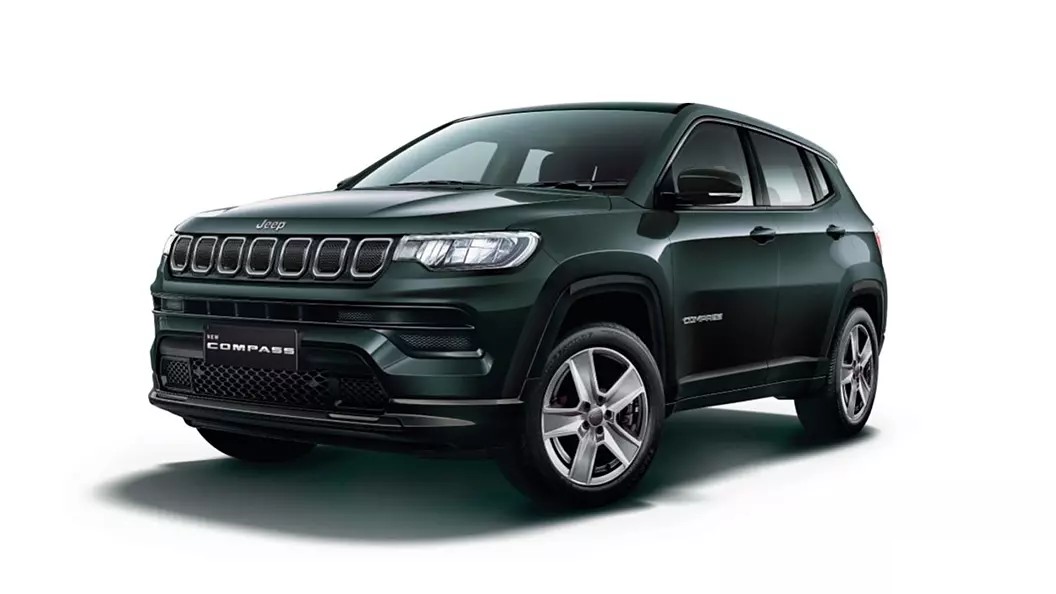
Jeep
₹23.16 - 38.83 Lakh