



2026-10-01

Don't compare two cars by their spec sheets. Compare them by cost, safety and whether they actually fit how you drive. Run both through the scorecard further down, weight each line by what matters to you, and the better car for you usually becomes obvious in minutes, not after three weekends of test drives.
Here's how to do it properly.
A car comparison that starts with features almost always ends with the wrong car. It should start with you.
Before you look at either car again, answer these in one sitting:
Now write down three short lists:
Honestly, that third list is the one that saves you money. A lot of buyers end up paying for a higher variant just to get one feature they actually wanted, while carrying four others they'll never touch. If you haven't settled on a body type yet, our guide on hatchback vs sedan vs SUV is worth five minutes before you go further, and if the budget itself still feels fuzzy, setting a realistic car buying budget will pin that down too.
Here's a mistake that quietly wrecks a lot of comparisons. Someone compares the base version of Car A against the top variant of Car B, then wonders why Car B seems so much better.
Match them properly:
| Factor | Car A | Car B | What matters |
| Comparable variant | Variant X | Variant Y | Similar equipment, not similar name |
| Ex-showroom price | ₹ | ₹ | Starting point only |
| Key safety kit | Must-have check | ||
| Powertrain | Match your usage | ||
| Manual or automatic | Preference, not a given | ||
| Boot space | Family and luggage needs | ||
| Warranty | Ownership protection | ||
| One missing feature | Could be a deal-breaker |
If you're not sure which trim actually gets you the features you circled as must-haves, our piece on how to compare car variants between base, mid and top trim breaks that down properly. And if manual vs automatic is still an open question for either car, it's worth settling before you score anything, our manual vs automatic transmission guide covers the trade-off.
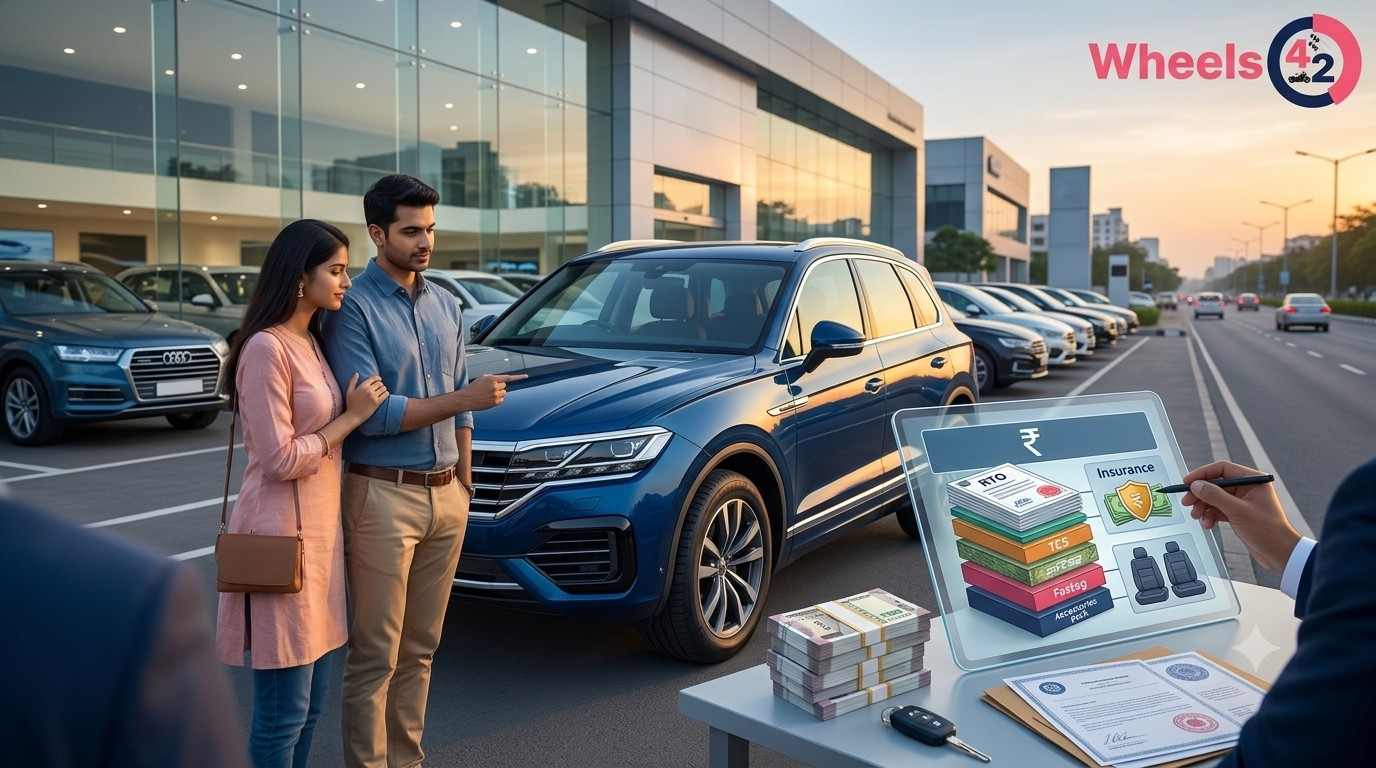
The ex-showroom price is the one everyone quotes. It's also the one that misleads you the most, because it hides road tax, registration, insurance and whatever the dealer bundles in.
Ask both dealers for the full on-road price, in writing, for the exact variant, fuel type and transmission you want. Compare those two documents line by line, not the headline numbers. If you want to understand exactly what's inside that on-road figure and which parts are actually negotiable, our breakdown of Ex-Showroom vs On-Road Price walks through every line.
Don't copy the dealer's insurance quote straight into your comparison either. Check the own-damage premium, the IDV, and what add-ons are included separately for each car. A cheaper on-road price with a thin insurance cover isn't actually cheaper.
The sticker price is one number. What you'll actually spend over five years is a different one entirely, and it's the one that should decide close calls.
5-year ownership cost = On-road price + financing cost + fuel or charging cost + insurance + maintenance + expected consumables − resale value
For fuel cost, don't trust the brochure mileage. Use real-world efficiency:
Annual fuel cost = Annual kilometres ÷ actual km/l you're getting ÷ no wait, that's ÷ real-world mileage × fuel price
So if you drive 15,000 km a year and the car realistically gives 14 km/l, not the claimed 18, that's 15,000 ÷ 14 × fuel price. The gap between claimed and real-world efficiency is usually where people get surprised at the pump.
For an EV, swap in: Annual charging cost = Annual kilometres ÷ real-world km/kWh × electricity rate, and also weigh in home charging access, battery warranty, and how practical long highway runs will actually be.
Vehicle maintenance costs deserve their own line too. Check the service interval, what each scheduled service actually costs, consumables like tyres and brake pads, and whether a bigger wheel size on one car means pricier tyre replacements down the line. A car that's cheap to service but drinks fuel isn't automatically the cheaper one to own. Add it all up using TCO, don't judge each cost in isolation.
Petrol, diesel, CNG or electric isn't a question with one right answer. It's a question with one right answer for you.
High annual running on highways tends to favour diesel. Mostly city driving with stop-go traffic usually favours petrol or a hybrid. CNG makes sense if your regular routes pass stations and you can live with the boot space hit. And electric only makes sense if home charging and your daily range actually line up, not just because it looks like the future. Our petrol vs diesel vs CNG vs electric guide goes deeper into which one fits which driving pattern.
A 5-star Bharat NCAP rating tells you something. It doesn't tell you everything.
Check that the rating applies to the exact model year and variant you're buying, not an older version of the same name. Then look past the star rating at what's actually fitted: airbag count, ESC, hill-hold, and whether ADAS features are real or just marketing copy on a brochure. If you're unsure how many airbags actually matter for your situation, how many airbags do you really need answers that directly instead of assuming more is always better.
Specs can't tell you how a seat feels after two hours, or whether the driving position suits you. This is the one section you can't outsource to a website, including this one.
Use this as your test drive checklist:
Drive both cars on the same route, same time of day, similar traffic. That's the only way the comparison is actually fair.
A longer warranty on paper means little if the nearest authorised workshop is an hour away. Before you commit, check the service network near you specifically, not the brand's national numbers.
Ask the dealer directly: what's the service interval, what's a scheduled service likely to cost, what's covered under warranty and what's excluded, and what does extended warranty cost if you want it. For EVs, treat battery warranty as its own separate check, since that's the most expensive part to replace outside of cover.
This is the part most car comparisons skip. They'll tell you to "weigh your priorities" without ever showing you how.
Step 1: Run hard filters first. Before you score anything, eliminate a car outright if it fails any of these:
If a car fails even one of these, don't score it. It's already out.
Step 2: Score what's left on these 10 lines.
| Criterion | Weight | How to score it |
| On-road price gap | 15 | Cheaper car scores 10, the other loses a point per 2% it's pricier |
| Monthly EMI gap | 10 | Same method, same loan terms for both |
| Safety | 15 | Bharat NCAP plus real equipment: 5-star with full kit = 10, untested = 4 |
| Service cost | 10 | Five-year cost estimate, cheaper gets 10, other loses a point per 10% higher |
| Resale value | 10 | Check 3-year-old listings for both, better retention scores 10 |
| Fuel or running cost | 10 | Use real-world efficiency, not claimed mileage, lower cost scores 10 |
| Boot space | 5 | Test with your actual luggage, fits everything = 10 |
| Warranty | 5 | Longer standard cover scores 10, shorter scores 4 to 7 |
| Feature difference | 10 | List five features you'd genuinely use, two points each, per car |
| Ownership profile fit | 10 | How well it matches your driving pattern, family size, and how long you'll keep it |
Multiply each score by its weight, add them up, and you've got a number out of 100 for each car.
Say Car A scores 78 and Car B scores 71. That's a real gap, go with A. If they land within about 5 points of each other, treat it as a tie and let the test drive settle it, not the spreadsheet.
Before you pay more for the car that scored higher, ask one more question. How much more are you actually paying for the thing you care about?
"Car A costs ₹1.2 lakh more, but that difference buys exactly the safety kit and space I need." That's a fair trade. "Car A costs ₹1.2 lakh more, mostly for a sunroof and ambient lighting I probably won't use much." That's a different conversation entirely.
This one question catches more bad decisions than any spec comparison does.
1. How do I choose between two cars when both meet my basic requirements?
When both cars pass your must-have checks, compare the areas where ownership actually differs: long-term running cost, driving experience, comfort, service support, resale prospects and the features you will use most. The goal is not to find the car with the longest feature list, but the one with fewer compromises for your specific use.
2. What should I do if two cars have almost the same overall score?
Treat a near-tie as a sign that the differences may be subjective rather than decisive. Recheck your most important criteria, identify the one or two factors that matter most to you, and use identical test-drive conditions to compare them. Recent buyers facing close choices often make the final decision based on factors such as city versus highway use, driving feel, mileage and ownership expectations.
3. How important are real owner reviews when comparing two similar cars?
Real owner feedback is useful for checking issues that specifications cannot show easily, such as actual mileage, recurring maintenance concerns, service experience, comfort on longer drives and day-to-day usability. Use multiple owner experiences rather than relying on one review, especially because service experience can vary by location. These are recurring considerations in Indian car-buying discussions.
4. How do I choose between a car with better mileage and one with better performance?
Start with your actual driving pattern and calculate how much the mileage difference would cost you annually. Then ask whether the additional performance will be used regularly. Buyers commonly face this exact trade-off when one shortlisted car is more efficient while another offers stronger performance or a more engaging driving experience.
5. How can I tell whether the more expensive car is actually worth the extra money?
Calculate the price of the difference, not simply the difference in features. Identify exactly what the extra money buys you and decide whether those benefits will materially improve your ownership experience. If the premium mainly pays for features you rarely use, the cheaper car may still meet your needs; if it addresses an important long-term requirement, the higher price has a clearer justification.