
 Khyati Sharma 2026-10-09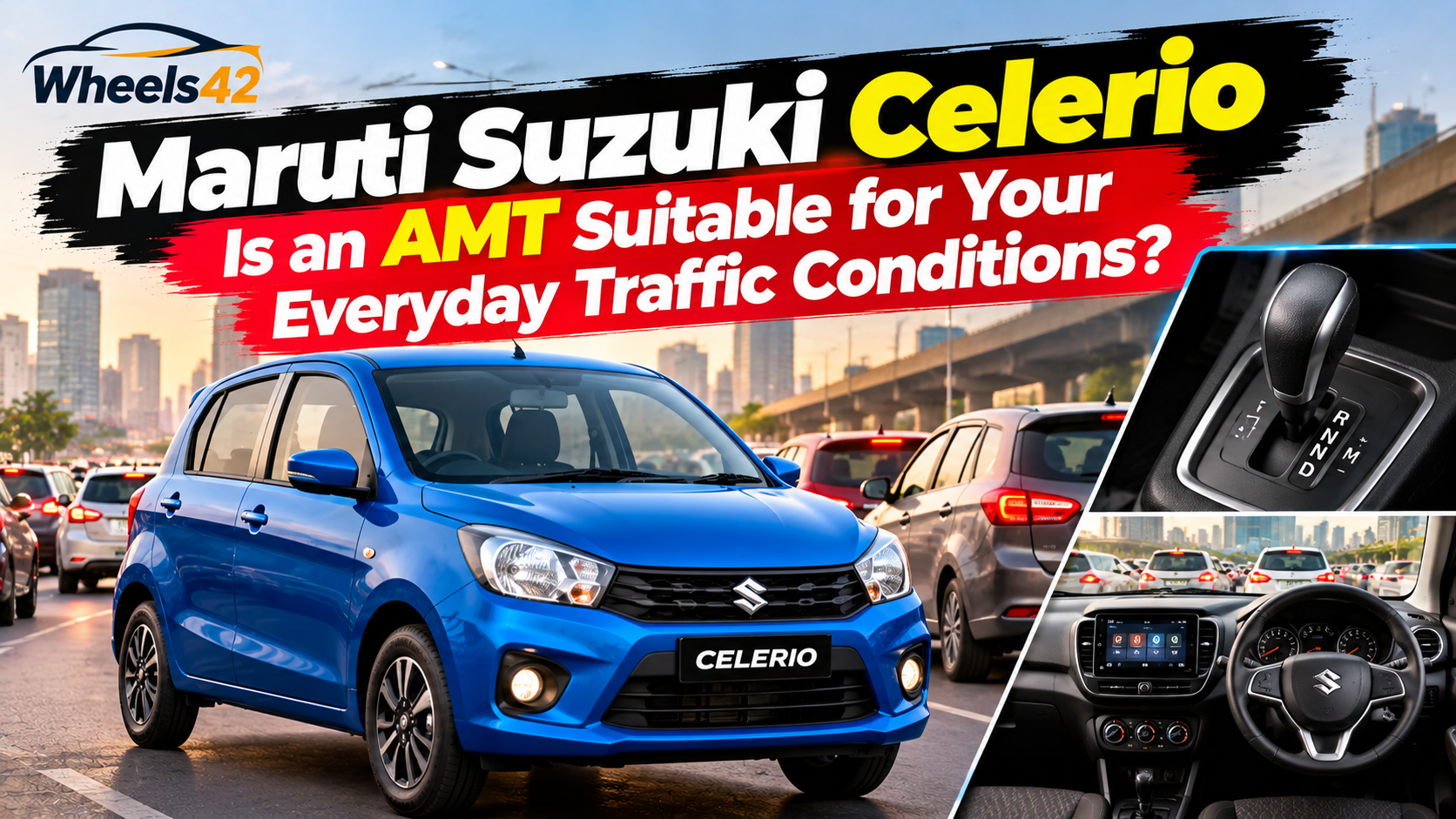
Driving through busy Indian cities can be tiring, particularly during peak hours when frequent braking, clutch operation and gear changes become part of every journey. For buyers who want a compact car that is easier to manage in congested traffic, the Maruti Suzuki Celerio AMT is worth considering.
The Celerio is a compact hatchback designed around everyday practicality, easy manoeuvrability and fuel efficiency. Its Auto Gear Shift (AGS) transmission removes the need for the driver to operate a clutch pedal manually, making routine commutes more convenient.
However, an AMT is not identical to a conventional automatic gearbox. Its gear changes can sometimes be noticeable, particularly during acceleration. So, is the Celerio AMT a suitable choice for people who regularly drive through stop-and-go traffic? Here is what prospective buyers should know.
The biggest advantage of the Celerio AMT is that it eliminates the need to operate a clutch pedal. In a manual car, drivers must repeatedly coordinate the clutch, accelerator and gear lever when traffic moves slowly.
With the Celerio's AGS transmission, the driver can concentrate on steering, braking and maintaining a safe distance from the vehicle ahead. This can make daily commuting less tiring, especially on routes with frequent traffic signals and congestion.
The compact dimensions of the Celerio also help when navigating narrow streets, crowded parking areas and busy residential neighbourhoods.
For office commuters and first-time car buyers, the combination of a small footprint and two-pedal operation can be particularly useful.
Manual vs Automatic Car: Pros and Cons Explained
The Celerio uses a five-speed AGS transmission, which is an automated manual gearbox. Unlike a conventional torque-converter automatic or a CVT, it operates a manual-style gearbox through automated clutch and gear-selection mechanisms.
During slow-moving traffic, the system changes gears without requiring the driver to press a clutch pedal. This makes it easier to move forward gradually and stop repeatedly.
However, drivers may notice a brief pause or a small head-nod sensation during some gear changes. This behaviour is characteristic of many AMTs and can be more noticeable when accelerating aggressively.
For smoother driving, gradual accelerator inputs and maintaining a steady pace when traffic permits can help. Drivers should also leave enough space in front rather than repeatedly accelerating hard and braking suddenly.

The petrol-powered Celerio uses a 998cc, three-cylinder engine. In the currently listed petrol specification, the engine produces 68.5PS of maximum power and 91.1Nm of peak torque.
These figures are suitable for the car's intended role as a lightweight city hatchback. The Celerio is designed primarily for commuting, errands and routine family journeys rather than high-performance driving.
Its relatively compact size makes it easier to position on crowded roads, while the engine provides sufficient performance for ordinary urban use.
On open roads, the car can also handle regular highway journeys, although overtaking should be planned according to traffic conditions, available space and the engine's response.
Fuel efficiency is an important consideration for people who spend considerable time commuting. Maruti Suzuki cars lists a claimed fuel-efficiency figure of up to 26km/l for the Celerio AGS, depending on the variant.
Actual mileage can vary significantly according to traffic density, driving style, air-conditioning use, passenger load and road conditions.
In extremely congested traffic, repeated acceleration and long periods of idling can reduce fuel efficiency. A smooth driving style and regular maintenance can help improve real-world results.
Buyers should also compare the AMT and manual versions based on their own daily travel patterns rather than assuming that the official mileage figure will be achieved in every situation.
Petrol vs Diesel vs CNG vs Electric Cars: How to Choose the Right Fuel Type
The Celerio's compact exterior makes it convenient for urban use, while its five-seat layout allows it to serve as a small family car.
Its cabin focuses on straightforward controls and everyday functionality. Depending on the variant, buyers can get equipment such as a touchscreen infotainment system, steering-mounted controls and convenience features.
The hatchback also offers a published boot capacity of approximately 292 litres, making it useful for grocery shopping, office bags and modest weekend luggage.
For families, it is worth checking rear-seat comfort and luggage requirements in person before making a purchase. The Celerio's small-car format is convenient in cities, but buyers needing substantial rear-seat space may prefer a larger hatchback.
|
Specification |
Details |
|
Engine |
998cc, three-cylinder petrol |
|
Maximum power |
68.5PS |
|
Peak torque |
91.1Nm |
|
Transmission |
Five-speed AGS |
|
Driving layout |
Front-wheel drive |
|
Claimed fuel efficiency |
Up to 26km/l |
|
Seating capacity |
Five |
|
Boot capacity |
Approximately 292 litres |
|
Primary use |
City commuting and everyday travel |
The Celerio AMT offers several benefits for buyers who mainly drive in urban environments.
No manual clutch operation: Reduces repetitive effort in congested traffic.
Compact dimensions: Makes narrow roads and parking easier to manage.
Convenient daily commuting: The two-pedal setup is straightforward for new drivers.
Fuel-efficiency focus: The small petrol engine is designed with economical everyday driving in mind.
Practical hatchback layout: Offers space for passengers and routine luggage.
Familiar service network: Maruti Suzuki has an established presence across India.
These advantages make the Celerio AMT a practical option for buyers prioritising convenience over sporty driving characteristics.
Although the Celerio AMT is convenient, its gearbox has some limitations that buyers should understand.
Noticeable gear changes: The automated manual transmission may pause briefly during shifts, unlike some smoother conventional automatic gearboxes.
Less predictable response during quick acceleration: Gear changes can become more noticeable when the driver presses the accelerator aggressively.
Hill driving requires attention: The driver should understand the vehicle's hill-hold or hill-start assistance equipment, where fitted, and use the brakes appropriately. Assistance availability should be confirmed for the selected variant.
Not the same experience as a premium automatic: Buyers expecting seamless, uninterrupted acceleration may prefer to test a CVT or torque-converter automatic before deciding.
These limitations do not make an AMT unsuitable for city driving. They simply mean that a test drive is important to establish whether its behaviour matches the driver's expectations.
|
Driving situation |
Suitability |
|
Daily office commute |
Very suitable |
|
Heavy stop-and-go traffic |
Suitable and convenient |
|
Narrow city streets |
Very suitable |
|
First-time car ownership |
Suitable |
|
Occasional highway trips |
Suitable |
|
Frequent spirited driving |
Less suitable |
|
Buyers seeking very smooth gear changes |
Test a conventional automatic or CVT as well |
The decision depends on your driving environment and budget.
The manual Celerio may appeal to buyers who prefer direct control over gear selection and want to minimise the initial purchase cost. It can also suit drivers who are comfortable operating a clutch in traffic.
The AMT is a better fit for people who regularly encounter congestion and would rather avoid constant clutch operation. Its convenience may be especially valuable when several family members share the car and prefer an automatic-style driving experience.
Before deciding, compare the on-road prices of equivalent variants, check the available features and take both versions for a test drive if possible.














Ferrari
₹540.00 Lakh