
 Khyati Sharma 2026-10-08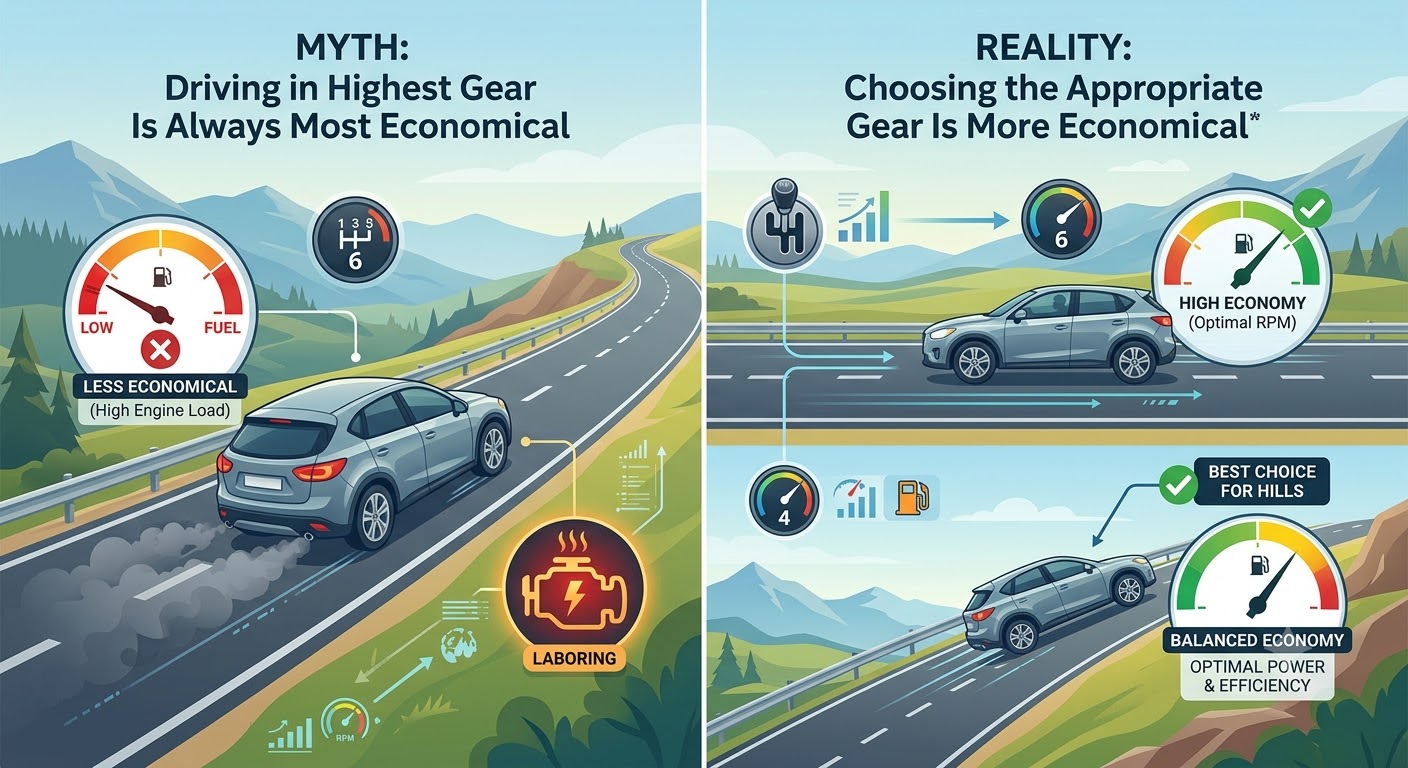
Many drivers believe that using the highest gear possible is the best way to save fuel. The logic seems simple: lower engine revolutions should mean less fuel consumption. While this idea has some truth behind it, driving in the highest gear is not always the most economical choice.
The most fuel-efficient gear depends on your speed, engine load, road conditions and the type of vehicle you are driving. Selecting a higher gear at the right speed can reduce fuel consumption, particularly during steady highway cruising. However, using a gear that is too high for your speed can make the engine struggle, reduce responsiveness and sometimes increase fuel consumption.
For example, driving a manual petrol car at a steady speed on a flat road in fifth or sixth gear may be more economical than remaining in third gear. However, attempting to accelerate uphill in the highest gear at very low engine speeds can put excessive load on the engine.
Understanding when to shift gears can help you improve fuel efficiency, enjoy smoother driving and reduce unnecessary wear on your vehicle.
Company-Fitted vs Aftermarket Accessories: Which Is Better?
A car's gearbox allows the engine to operate at different speeds while delivering power to the wheels. Lower gears provide greater torque multiplication, making them useful when starting from a standstill, climbing steep slopes or accelerating.
Higher gears reduce the engine speed required to maintain a particular road speed. Once the vehicle is moving steadily on a flat road, this can help reduce fuel consumption.
For example, a car travelling at 60 km/h in third gear may operate at significantly higher engine revolutions than the same car travelling at the same speed in fifth gear, assuming fifth gear is suitable for that speed.
Lower engine speed can reduce internal friction and pumping losses under appropriate operating conditions. This is one reason why higher gears are generally useful for maintaining speed on open roads.
However, engine speed alone does not determine fuel economy. The engine must also produce enough torque to overcome road resistance and keep the vehicle moving comfortably.
No. The highest gear is not automatically the most economical option in every situation.
A gear that is too high for the vehicle's speed can force the engine to work harder than necessary. This condition is commonly described as labouring or lugging, particularly when the driver presses the accelerator while engine speed is very low.
When an engine struggles to accelerate in a high gear, the driver may need to press the accelerator harder or shift down to a lower gear. In some circumstances, this can reduce the expected fuel-saving benefit.
Driving conditions also matter. A high gear may be suitable on a flat highway but unsuitable on a steep hill, during overtaking or in slow-moving traffic.
The goal should therefore be to use the highest gear that allows the engine to operate smoothly and respond appropriately to the driver's demands.

Every gear has a useful operating range. Although the exact speeds differ between vehicles, lower gears are generally used at lower speeds, while higher gears are designed for faster driving.
Starting a car in first gear allows the engine to move the vehicle from rest without excessive clutch slipping. As speed increases, the driver can shift into second, third and subsequently higher gears.
On a suitable road, using a higher gear once the vehicle reaches the appropriate speed can help reduce engine revolutions and fuel consumption.
However, the shift points should not be treated as fixed numbers for every car. A small petrol hatchback cars, a diesel SUV cars and a heavily loaded vehicle may require different gear choices.
Follow the recommendations in the owner's manual and pay attention to how the engine responds.
One common mistake is selecting the highest gear at very low speeds in an attempt to save petrol or diesel.
Suppose a manual car is travelling slowly in fourth or fifth gear. If the engine speed is too low, the car may vibrate, respond sluggishly or struggle when the driver presses the accelerator.
This is not necessarily efficient driving.
A lower gear may allow the engine to produce the required power more comfortably. The engine will generally run at higher revolutions, but it may respond better and avoid the strain associated with operating at an unsuitable speed and load.
Drivers should never force the engine to pull strongly from very low revolutions in a high gear. If the vehicle struggles, select a lower gear.
Higher gears are particularly useful during steady highway driving.
When the road is relatively flat and traffic allows a consistent speed, a high gear can keep engine revolutions lower without requiring excessive throttle input.
For example, a six-speed manual car may be designed to cruise efficiently in sixth gear at appropriate highway speeds. Keeping the car in a lower gear unnecessarily can increase engine speed and fuel consumption.
However, driving at a very high road speed can still consume more fuel because aerodynamic drag rises rapidly with speed. Selecting the highest gear does not eliminate this effect.
The most economical approach is to use a suitable high gear while maintaining a steady, legal speed and avoiding unnecessary acceleration.
Driving uphill changes the amount of power a car needs.
Gravity increases the resistance the vehicle must overcome, particularly on steep gradients. As a result, a gear that works well on a flat road may no longer be suitable.
If the driver remains in the highest gear while climbing a steep hill, the engine may struggle to maintain speed. Pressing the accelerator harder may not deliver the desired response.
Shifting down can help the engine operate in a more appropriate range and provide the power needed to climb safely.
Although engine revolutions will increase, the lower gear can be the better choice because it helps the vehicle maintain momentum without excessive engine strain.
The same principle applies when carrying heavy luggage or travelling with several passengers on steep roads.

Fuel economy should never take priority over safe overtaking.
When a driver needs to accelerate quickly, the highest gear may not provide sufficient response. In a manual car, shifting down can make more engine power available at the wheels and improve acceleration.
For instance, a car travelling in sixth gear may respond slowly when the driver presses the accelerator to overtake. Selecting fifth or fourth gear, depending on speed and vehicle design, may provide stronger acceleration.
Automatic transmissions generally handle this by selecting a lower gear when additional power is requested.
Drivers should only overtake when there is adequate visibility, space and a safe opportunity to complete the manoeuvre. Never remain in an unsuitable gear simply to maintain low engine revolutions.
Petrol and diesel engines often have different torque characteristics and recommended operating ranges.
Many diesel engines deliver strong torque at relatively low engine speeds, making them comfortable in higher gears under suitable conditions. Petrol engines may require higher revolutions to produce their strongest acceleration, depending on the engine design.
However, there is no universal rule that diesel cars should always use higher gears or that petrol cars should always use lower gears.
Modern engines use different technologies, including turbocharging, variable valve timing and electronic engine management. These features influence how the engine delivers power and uses fuel.
The gearbox design, vehicle weight and final-drive ratio also matter.
For the best results, follow the manufacturer's gear-shift guidance rather than relying on a general petrol-versus-diesel rule.
Petrol vs Diesel vs CNG vs Electric Cars: How to Choose the Right Fuel Type
Drivers of automatic cars do not usually select individual gears during normal driving. Instead, the transmission chooses a suitable gear according to speed, throttle input, engine load and driving conditions.
Some automatic transmissions are programmed to shift into higher gears early to improve fuel efficiency. When the driver demands more acceleration, the transmission may shift down.
Continuously variable transmissions (CVTs) work differently from conventional stepped gearboxes. They adjust their transmission ratio rather than moving through a fixed set of gears in the traditional manner.
Dual-clutch and torque-converter automatic transmissions also have their own operating characteristics.
Therefore, the idea of driving in the highest gear applies most directly to manual gear selection. In an automatic car, smooth acceleration and sensible speed management are usually more important than trying to influence the transmission unnecessarily.
Manual vs Automatic Car: Pros and Cons Explained
Your vehicle often provides clues when the selected gear is unsuitable.
Signs that the gear may be too high include:
The engine vibrates or judders when accelerating.
The car struggles to gain speed.
The engine responds slowly despite substantial accelerator input.
The vehicle loses momentum on an uphill section.
You hear unusual knocking or feel excessive engine strain.
On the other hand, using a gear that is unnecessarily low for the road speed may keep engine revolutions higher than needed and create additional noise.
The best gear allows the vehicle to maintain the required speed smoothly, with enough power available for normal driving.
If the car repeatedly struggles in gears that previously worked well, it may be worth checking for a maintenance issue rather than assuming the problem is entirely related to gear selection.
|
Driving situation |
Suitable gear choice |
Fuel economy guidance |
|
Starting from a standstill |
First gear in a typical manual car |
Provides the necessary torque to move off smoothly |
|
Slow-moving city traffic |
Gear appropriate to the current speed |
Avoid labouring the engine in a high gear |
|
Steady driving on a flat road |
Highest suitable gear |
Often helps reduce engine revolutions and fuel consumption |
|
Cruising on a highway |
High gear at a suitable speed |
Maintain a steady, legal speed |
|
Climbing a steep hill |
Lower gear when necessary |
Provides better pulling power and reduces engine strain |
|
Overtaking |
Lower gear if additional power is required |
Prioritise safe acceleration and adequate control |
|
Descending a steep hill |
Suitable lower gear when needed |
Engine braking can help control speed and reduce reliance on brakes |
|
Carrying a heavy load |
Gear appropriate to the load and gradient |
Avoid forcing the engine to pull in an unsuitable high gear |
|
Automatic transmission driving |
Allow the transmission to select gears normally |
Use smooth throttle inputs and avoid unnecessary acceleration |
Choosing the right gear is only one part of economical driving. Several other habits can help reduce fuel consumption.
Accelerate smoothly
Avoid pressing the accelerator aggressively when traffic conditions do not require rapid acceleration. Gradual inputs help reduce unnecessary fuel use.
Maintain a steady speed
Frequent speed changes usually require more energy than smooth, consistent driving. Anticipate traffic and maintain a safe following distance.
Shift gears at appropriate engine speeds
Use the shift recommendations in your owner's manual. Avoid shifting too early if the engine struggles, and avoid unnecessarily high revolutions when a higher gear is appropriate.
Avoid unnecessary braking
Look ahead and anticipate junctions, traffic signals and slower vehicles. Gradually easing off the accelerator can reduce the need for sudden braking.
Maintain correct tyre pressure
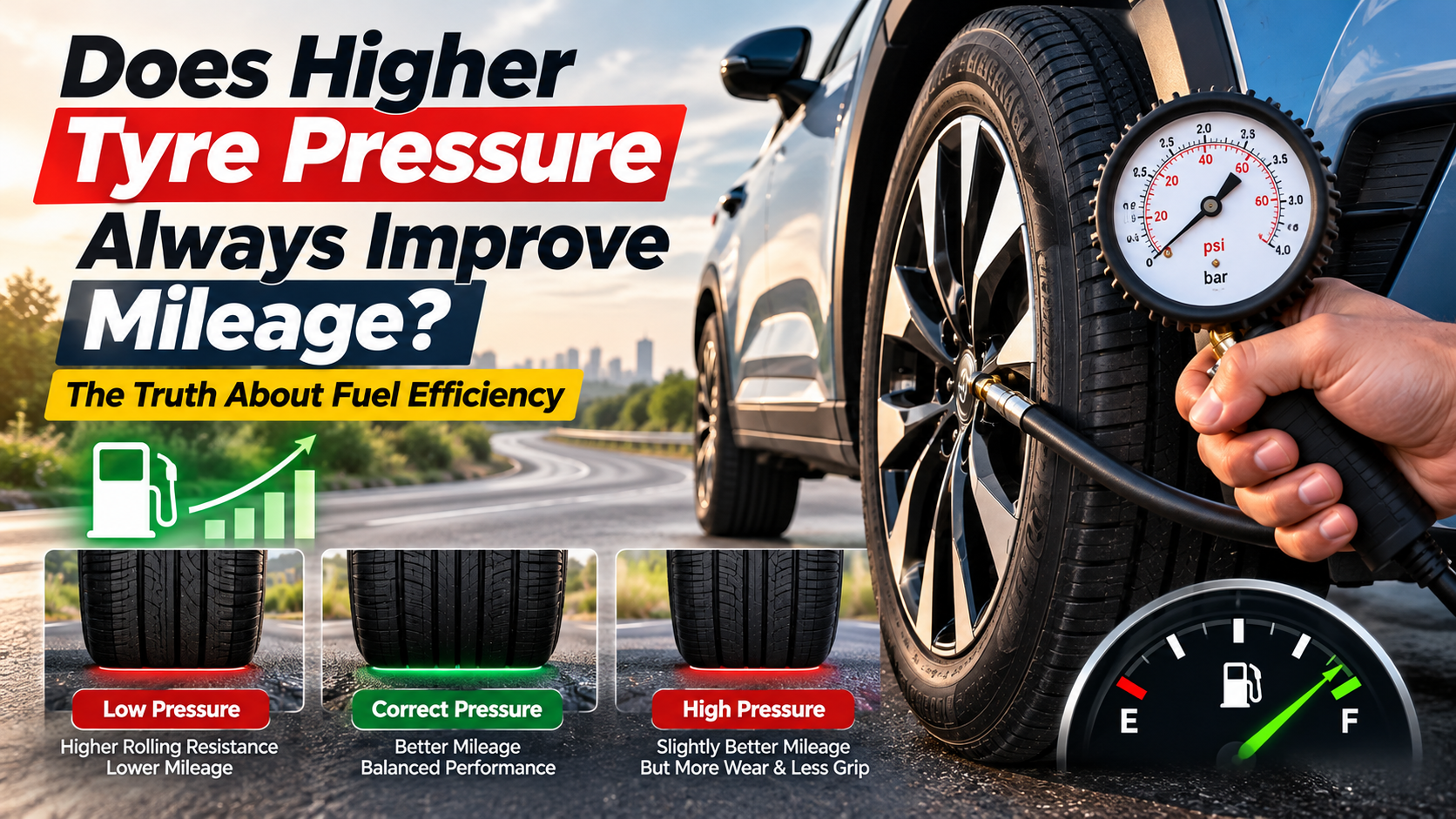
Underinflated tyres increase rolling resistance and can reduce mileage. Check tyre pressure regularly when the tyres are cold.
Service your vehicle on time
Correct engine oil, clean filters and properly maintained mechanical components help the vehicle operate as intended.
Avoid excessive speed
Even when using the highest gear, driving at high speeds can increase fuel consumption because aerodynamic resistance rises significantly.
Myth 1: Lower engine RPM always means better mileage.
Not necessarily. Engine load and operating efficiency also matter. Very low engine speed under heavy load can be inefficient and uncomfortable.
Myth 2: You should always shift into the highest gear as early as possible.
No. Shift according to vehicle speed, engine response and road conditions. An excessively early shift can make the engine struggle.
Myth 3: Driving in a lower gear always wastes fuel.
A lower gear may use more fuel when it unnecessarily increases engine speed, but it can be the appropriate and efficient choice when climbing hills, accelerating or carrying a heavy load.
Myth 4: The highest gear guarantees the best highway mileage.
A suitable high gear often helps, but speed, wind, road gradient, vehicle load and driving conditions can have a larger effect on the final result.
Driving in the highest gear is not always the most economical choice. Higher gears can improve fuel efficiency when the vehicle is travelling at a suitable speed and the engine can maintain that speed without struggling.
However, lower gears are important when starting, climbing hills, accelerating or overtaking. Using an excessively high gear at low speeds can make the engine labour and reduce responsiveness.
The key is to select the highest suitable gear, not simply the highest available gear. Combine correct gear selection with smooth acceleration, steady speeds, proper tyre pressure and regular maintenance to get the best possible fuel economy from your car.
Ultimately, economical driving is about balancing engine speed, engine load and road conditions rather than following a single rule about gear selection.





Toyota
₹18.70 - 37.71 Lakh
Ferrari
₹460.00 Lakh
_A_Checklist_Before_You_Take_Delivery.jpeg)