2026-09-22
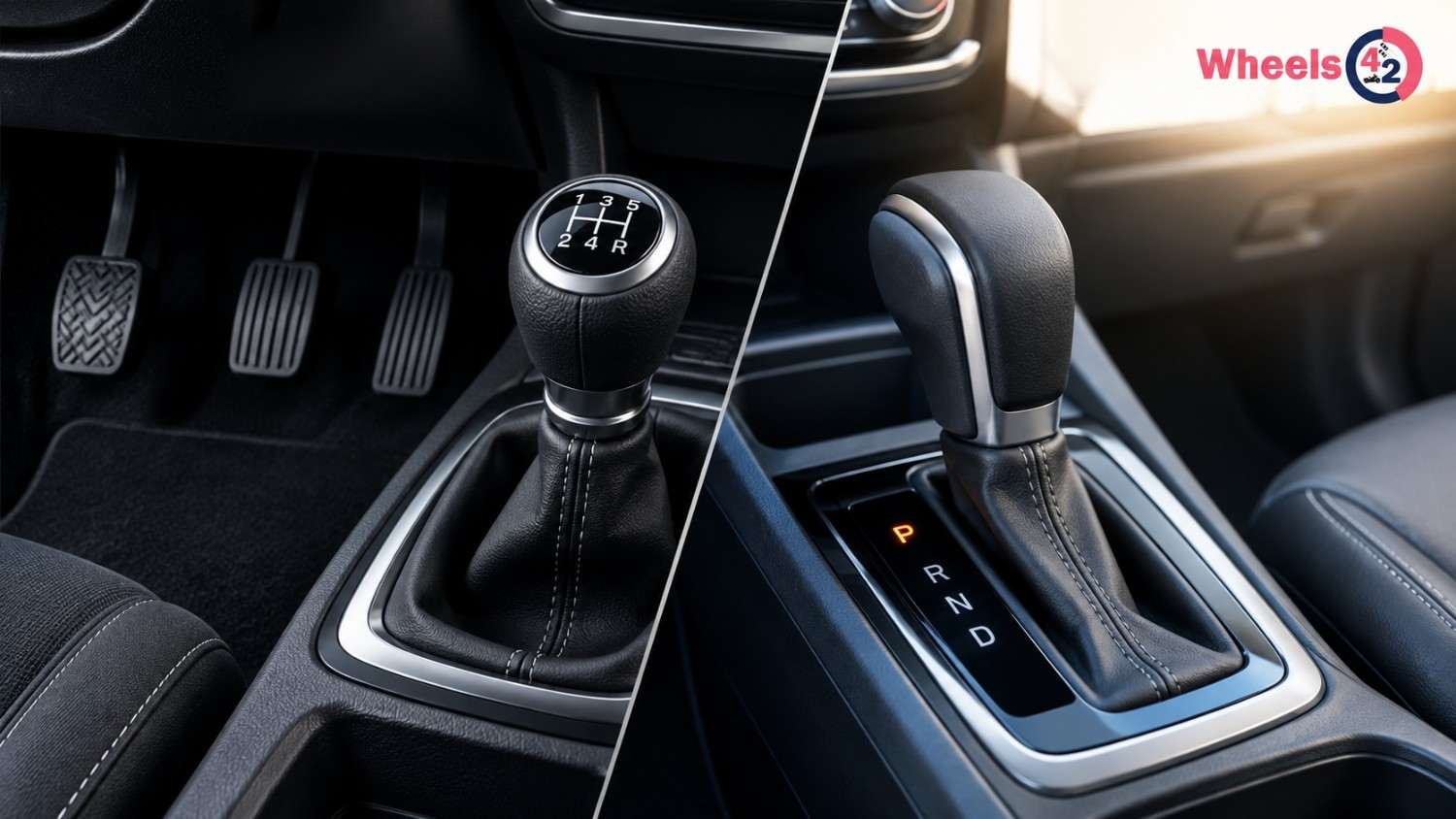
The short version: if you drive in heavy city traffic every day, Automatic wins, your left leg will thank you within a week. If you drive mostly highway, like feeling in control, or want the cheapest car to buy and fix, Manual still holds up. But here's the catch nobody explains properly: "automatic" isn't one thing. AMT, torque converter, CVT and DCT are four different technologies with different strengths, and picking the wrong one of these is how people end up disappointed with a car that's technically automatic but not what they wanted at all.
Manual vs automatic car, at its core, comes down to three questions: how you drive, what you're willing to spend, and which kind of automatic you're actually looking at. Let's go through all three properly.
Most comparisons stop at "manual or automatic," which honestly isn't specific enough to be useful anymore. AMT vs torque converter vs CVT vs dual-clutch transmission (DCT) is the real comparison, and here's what you're actually choosing between, in general terms, since execution varies by manufacturer.
| Type | How it actually works | Smoothness | Fuel efficiency | Maintenance |
|---|---|---|---|---|
| AMT | A manual-type gearbox with the clutch and gear changes automated | Usually the least smooth, a brief pause or jerk during shifts | Often close to manual, since it's mechanically similar underneath | Typically the cheapest of the four for routine upkeep |
| Torque converter | Fluid coupling handles the shifting, the classic "automatic" feel | Usually the smoothest of the four | Historically the thirstiest, though modern multi-gear units have closed much of that gap | Routine servicing is manageable, but a torque converter rebuild if it ever fails is a serious repair |
| CVT | Belt and pulleys, no fixed gears at all | Smooth, though some feel an engine drone under hard acceleration, the "rubber band" effect | Can be the most efficient automatic, depending on the specific transmission and vehicle | Belt condition depends a lot on driving style and service history |
| DCT | Two clutches, the next gear is pre-loaded | Fast, sporty shifts on the move, can feel less polished at parking-lot speeds | Usually close to manual, often better than a torque converter | More mechanically complex, and a clutch pack issue can be a costly repair |
That AMT jerk isn't a flaw exactly, it's the system automating a clutch and gear change that a human would otherwise time smoothly, and during some shifts, power delivery briefly pauses or feels abrupt. Here's the thing: a brochure won't show you that, but a proper test drive in actual traffic will. If you're considering an AMT, test drive matters more here than with almost any other gearbox type.
So do automatic cars consume more fuel than manual ones? A fair manual vs automatic car mileage comparison depends entirely on which type you're comparing, and increasingly, on how modern the specific unit is. A CVT can match or beat a manual's mileage. A torque converter used to drink noticeably more, though that gap has narrowed. AMT tends to sit closest to manual, for the reason above.
Manual vs automatic gearbox maintenance cost is really two separate questions, routine upkeep and the risk of a major repair, and it's worth keeping those apart. Routine maintenance (fluid and filter changes, inspections) is manageable across all four types and varies more by manufacturer than by gearbox type alone. The bigger risk is a major failure, a CVT belt, a DCT clutch pack, or a torque converter itself needing replacement, which is comparatively rare but expensive when it happens.
The automatic vs manual car price difference varies a lot by which automatic you're looking at. As a rough example, not a quote, AMT tends to add the smallest amount over the manual variant, torque converter and DCT usually cost meaningfully more, and CVT tends to land somewhere in between. The exact numbers shift by brand, segment and year, so treat any figure you see, including this one, as a starting point for your own checking, not gospel.
Which is cheaper to repair, automatic or manual? Manual has one advantage here worth naming directly: the clutch. Clutch replacement cost for a manual car can range from fairly modest to considerably more, depending on the car, the parts used, and whether flywheel work is needed too, and it's a wear item you'll eventually deal with regardless of how carefully you drive. Automatics don't have that specific cost, but the failure modes above tend to cost more when they do show up.
Resale value of manual vs automatic cars leans automatic in most cities now, mostly because demand has shifted that way, city buyers want one less thing to manage in traffic. Manual still holds its own in smaller towns and among buyers who see it as the more engaging drive, so this isn't universal, but the trend is fairly clear.
Best transmission for heavy city traffic isn't much of a debate anymore. Clutch fatigue in stop-start traffic is a real, physical thing, and any of the four automatic types solves it. If budget matters most, AMT gets you out of the clutch pedal for the least extra money. If smoothness matters more than budget, torque converter or CVT.
Manual transmission control on hills comes down to directness, not capability. Modern automatics handle hills well, hill-hold, low-speed creep control, manual modes and paddle shifters all help, but you have to actively use them. A manual gearbox gives you that same control by default, without hunting for a mode button first. Engine braking in manual vs automatic cars follows the same logic: manual gives it to you automatically, automatics need you to select a lower gear or pull a paddle to get the same effect.
Parking and crawling matter more than most people think about beforehand, ramps, parallel parking, reversing, inching forward in a basement. This is where AMT, CVT, torque converter and DCT can genuinely feel different from each other. A DCT, in particular, can behave a little differently at very low speed compared to a CVT or torque converter, so if most of your driving involves tight parking or a steep basement ramp, pay close attention to this during the test drive, not just how it feels on the open road.
Is it hard to learn to drive an automatic car? No, it's the opposite. Most new drivers find automatic easier precisely because there's no clutch timing to learn and no stalling at junctions. If you're picking a first car for someone just starting out, that alone is worth a lot.
Driving fatigue manual vs automatic shows up mainly in traffic, not on open roads. On a clear highway, both are relaxed. In a two-hour crawl through city traffic, manual asks a lot more of your left leg and your attention than any automatic does.
Transmission power loss comparison used to clearly favour manual, since there was no torque converter or clutch pack in the way of engine power. Modern automatics, with lock-up clutches and smarter shift logic, have closed much of that gap, so treat this as a minor factor worth knowing about, not something that should decide your purchase on its own.
|
|
|
|
|
|
|
|
|
|
|
|
|
|
|
|
|
|
|
|
|
|
|
|
A brochure can't show you how a gearbox actually behaves. On the test drive, check these specifically.
Here's the point worth remembering above everything else in this piece: don't compare only manual vs automatic. Compare the actual gearbox type, in the exact car and variant you're buying, because two cars that are both technically "automatic" can feel completely different to live with.
Whichever way you go, this decision is just one piece of the full new car buying process, and it usually comes down to the exact variant you're comparing, since transmission choice is often tied to trim level, not sold separately. It also changes your ongoing maintenance and service costs more than most buyers expect, and if the automatic premium is stretching your car loan amount, run those numbers before you commit to it