Electric cars and other vehicles (EVs) are becoming increasingly popular because of their lower running costs, smooth driving experience and reduced tailpipe emissions. However, one concern continues to trouble potential EV buyers: does fast charging damage the battery and reduce its lifespan?
Fast charging allows an electric car to recover a significant amount of driving range in a relatively short period. It is especially useful during long journeys, when drivers cannot afford to wait several hours for the battery to recharge. Despite this convenience, many people believe that frequent use of fast chargers can permanently damage an EV battery.
The reality is more complicated. Fast charging does not automatically damage an EV battery, but frequent high-power charging under certain conditions can accelerate battery degradation. Temperature, battery chemistry, charging habits and the vehicle's battery management system all influence long-term battery health.
Understanding how fast charging works and following a few simple charging practices can help Electric vehicle owners enjoy its convenience while protecting their battery.
1. How Does Fast Charging Work in an Electric Vehicle?
Electric vehicles generally support two main charging methods: AC charging and DC fast charging. Both supply electricity to the battery, but they work differently.
AC Charging
AC charging is commonly used at home, in offices and in residential parking areas. The vehicle's onboard charger converts alternating current (AC) electricity into direct current (DC), which the battery stores.
Home AC chargers typically operate at lower power levels than public DC fast chargers. This makes them suitable for overnight charging or topping up the battery while the vehicle is parked for several hours.
DC Fast Charging
DC fast charging supplies direct current to the vehicle's battery system, bypassing the need for the onboard AC-to-DC conversion process. Compatible vehicles can therefore accept substantially higher charging power.
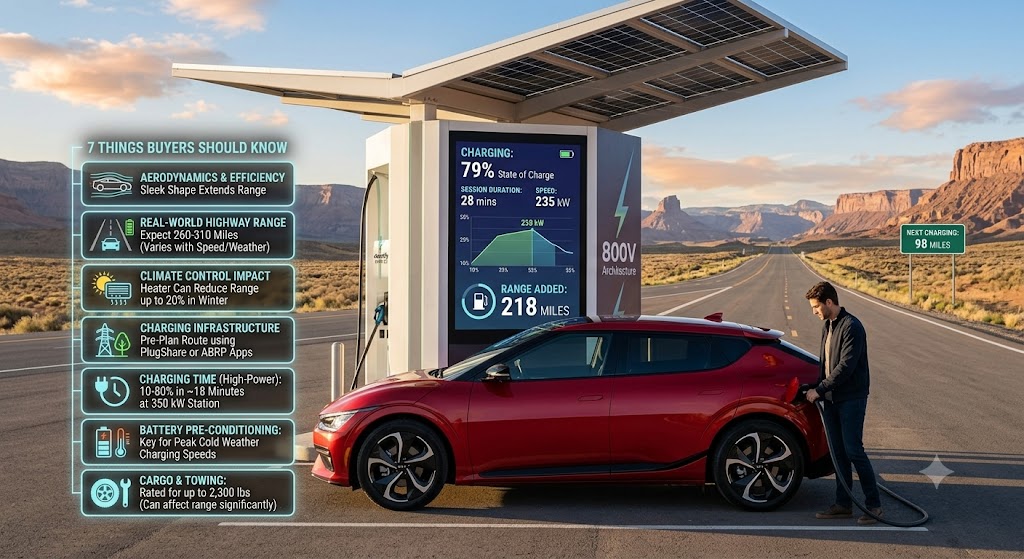
The actual charging speed depends on the vehicle's maximum charging capability, the charger's output, battery temperature and current state of charge.
For example, an EV connected to a powerful public charger will not necessarily charge at the charger's maximum rated power. If the car supports a lower charging rate, the vehicle will limit the power it accepts.

Charging speed also changes as the battery fills. Most EVs accept higher power at lower states of charge and gradually reduce charging power as they approach full capacity.
This is why charging from 10% to 50% can take considerably less time than charging from 80% to 100%.
Petrol vs Diesel vs CNG vs Electric Cars: How to Choose the Right Fuel Type
2. Does Fast Charging Really Reduce Battery Life?
Fast charging can contribute to faster battery degradation, but it does not have the same effect on every electric vehicle.
EV batteries contain cells that store and release energy through chemical reactions. Repeated charging and discharging gradually change the materials inside these cells, eventually reducing the amount of energy they can store.
High-power charging can place additional stress on battery cells, particularly when the battery is too hot or too cold. The effect depends on the battery's design, chemistry, temperature and charging rate.
Modern EVs are designed to manage these conditions. Their battery management systems monitor important operating parameters and regulate charging power to help prevent the battery from operating outside its permitted limits.
Occasional fast charging is therefore a normal part of EV ownership. Drivers who regularly travel long distances can use compatible fast chargers without automatically ruining their batteries.
However, drivers who rely heavily on high-power charging may experience faster degradation than those who primarily use lower-power charging, depending on their vehicles and operating conditions.
It is important to distinguish battery degradation from battery failure. Degradation generally means the battery gradually loses some of its original energy-storage capacity. It does not necessarily mean the battery has become unsafe or stopped working.
3. Why Can Fast Charging Affect Battery Health?
Several factors determine whether fast charging contributes to additional battery wear.
Heat Generation
Heat is one of the most important factors affecting battery longevity. Fast charging can generate heat inside battery cells, and excessive temperatures can accelerate chemical reactions associated with ageing.
If a battery repeatedly experiences high temperatures, its capacity may decline more quickly over time.
To manage this risk, many electric vehicles use liquid cooling, air cooling or other thermal management systems. These systems help maintain battery temperatures within an appropriate operating range.
High Charging Current
Fast charging requires electricity to enter the battery at a relatively high rate. Depending on the battery's design and operating conditions, this can increase electrochemical stress.
Charging power alone does not determine the amount of battery wear. A battery specifically designed for high-power charging may handle it better than a battery with a lower charging capability.
Drivers should therefore use compatible charging equipment and follow the charging limits recommended for their particular vehicle.
How to Compare Car Variants: Base vs Mid vs Top Trim
Repeated Charging to 100%
Keeping a lithium-ion battery at a very high state of charge for extended periods can contribute to degradation, particularly when temperatures are also elevated.
This is why some manufacturers recommend an everyday charging limit below 100% for certain vehicles.
However, charging to 100% is not always harmful. Some vehicles and battery chemistries have different recommendations, including periodic full charging for battery monitoring or calibration purposes.
The best approach is to follow the instructions provided for the specific EV rather than applying the same charging rule to every model.
4. Is Fast Charging Safe for Modern Electric Cars?
Yes. Fast charging is a supported and widely used feature in EVs designed for it.
Modern electric cars use a battery management system (BMS) to monitor factors such as cell voltage, temperature and charging current. It helps regulate the amount of power entering the battery and can reduce or stop charging when necessary.
Many vehicles also include battery preconditioning. This feature prepares the battery for charging by bringing it closer to a suitable temperature before the vehicle reaches a compatible fast charger.
Preconditioning can improve charging performance, particularly in cold weather, and helps the battery operate under more appropriate conditions.
However, battery management systems cannot eliminate all forms of degradation. Batteries continue to age through normal use and the passage of time.
For this reason, fast charging should be treated as a useful convenience rather than a reason to ignore battery-care recommendations.

5. Fast Charging vs Slow Charging: Which Is Better?
|
Factor
|
AC Charging
|
DC Fast Charging
|
|
Charging speed
|
Generally slower
|
Generally faster
|
|
Common use
|
Home, office and overnight charging
|
Highways and quick top-ups
|
|
Heat generation
|
Usually lower at modest power
|
Can be higher
|
|
Battery stress
|
Often lower under suitable conditions
|
May be higher depending on power and temperature
|
|
Convenience
|
Suitable when the vehicle is parked for hours
|
Useful when time is limited
|
AC charging is often the practical choice for everyday use because the vehicle can charge while the owner sleeps, works or completes other activities.
DC fast charging is more useful when driving long distances, travelling between cities or needing additional range quickly.
Neither charging method guarantees perfect battery health. Temperature, battery chemistry, charging limits and overall usage patterns also influence degradation.
For most EV owners, combining routine AC charging with occasional DC fast charging provides a convenient and sensible balance.
6. Five Ways to Protect Your EV Battery While Fast Charging
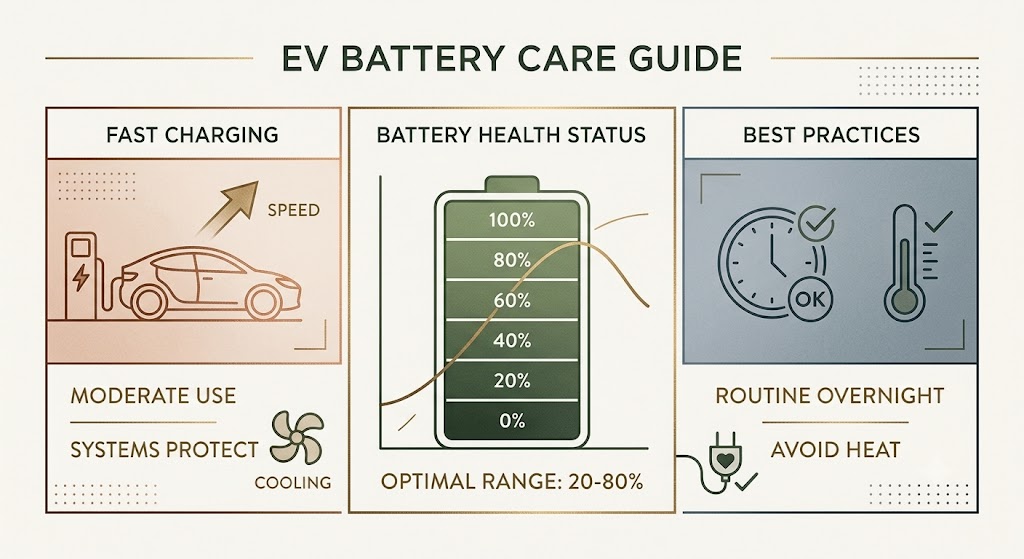
Drivers do not need to avoid fast charging completely to maintain battery health. A few practical habits can help reduce unnecessary stress.
1. Use Fast Charging When Necessary
Use DC fast charging when you need to recover range quickly, particularly during long journeys. When time allows, home or workplace AC charging can handle routine charging needs.
2. Avoid Keeping the Battery at 100% Unnecessarily
For many EVs, an everyday charging limit around 80% is a useful starting point. Charge to 100% when you need the additional range or when the manufacturer recommends it.
Check your owner's manual because the appropriate charging limit varies by vehicle and battery chemistry.
3. Pay Attention to Battery Temperature
Extremely hot batteries can experience additional stress during charging. In hot weather, use the vehicle's cooling system and follow its instructions about charging after demanding driving.
Avoid unnecessary charging practices that keep the battery excessively hot for extended periods.
4. Use Battery Preconditioning
If your vehicle supports battery preconditioning, use the navigation system to locate a compatible fast charger. The car may automatically prepare the battery for more effective charging.
This is particularly helpful in cold conditions, when a battery may otherwise accept power more slowly.
5. Choose Compatible Charging Equipment
Use charging stations that are compatible with your vehicle and follow the manufacturer's charging recommendations.
A charger with a very high power rating does not force every EV to accept that amount of electricity. The vehicle's own charging limits determine how much power it can safely receive.
7. Does Battery Chemistry Make a Difference?
Yes. Different battery chemistries have different characteristics, and these differences influence charging behaviour and battery-care recommendations.
Lithium iron phosphate (LFP) batteries are commonly used in some electric cars because of their durability and other performance characteristics. Nickel manganese cobalt (NMC) batteries are another widely used type and can offer higher energy density.
Neither chemistry is automatically immune to degradation from charging conditions.
Some LFP-equipped vehicles recommend charging to 100% periodically to help the battery management system estimate the state of charge accurately. Other vehicles may recommend different charging limits.
Charging performance also depends on cell design, battery temperature and the charging rate relative to the battery's capacity.
This means that general advice should be treated as a starting point. The manufacturer's recommendations for your particular model should always take priority.
Manual vs Automatic Car: Pros and Cons Explained
8. How Does India's Hot Climate Affect EV Charging?
Battery temperature is particularly important in India, where summer temperatures can become high and vehicles may remain parked outdoors for extended periods.
High ambient temperatures can add to battery thermal stress. Repeated fast charging in hot conditions may increase this stress, especially if the battery cooling system cannot maintain an appropriate temperature.
EV owners can follow several practical steps to manage charging during hot weather:
-
Park in the shade whenever practical.
-
Use the vehicle's battery cooling and preconditioning functions.
-
Follow the manufacturer's recommendations about charging immediately after demanding driving.
-
Avoid keeping the battery at a very high state of charge for prolonged periods unless recommended.
-
Plan charging stops according to the vehicle's charging performance and current battery temperature.

These measures can help reduce unnecessary stress without making everyday EV use inconvenient.
Battery performance also varies by model. Vehicles with effective thermal management systems may handle demanding charging conditions differently from vehicles with less sophisticated cooling arrangements.
9. Should You Stop Using Fast Chargers Completely?
No. Avoiding fast charging entirely is unnecessary for most drivers.
For people who frequently travel long distances, DC fast charging can be essential. It reduces waiting time and makes electric vehicles more practical for intercity journeys.
For people who primarily commute short distances, home or workplace charging may be more convenient. It can reduce the need to visit public charging stations and allow the battery to recharge gradually.
The right charging strategy depends on your driving distance, access to charging facilities, vehicle specifications and daily routine.
There is no need to feel concerned every time you connect your EV to a fast charger. What matters more is the overall pattern of charging, the conditions in which charging takes place and whether the vehicle is being operated within its recommended limits.
Conclusion: Does Fast Charging Always Damage an EV Battery?
Fast charging does not automatically damage an electric vehicle's battery. Modern EVs are designed to support compatible fast charging, and their battery management systems help regulate charging power, voltage and temperature.
However, frequent high-power charging can contribute to faster battery degradation under certain conditions. Excessive heat, battery chemistry, charging habits and climate all influence long-term battery health.
For most owners, the sensible approach is to use AC charging for everyday needs when convenient and rely on DC fast charging when speed matters. Avoid unnecessary prolonged periods at extreme charge levels and follow the manufacturer's recommendations for your vehicle.
With balanced charging habits, EV owners can enjoy the convenience of fast charging while taking practical steps to protect battery performance and long-term driving range.

 Khyati Sharma 2026-10-16