Khyati Sharma 2026-10-11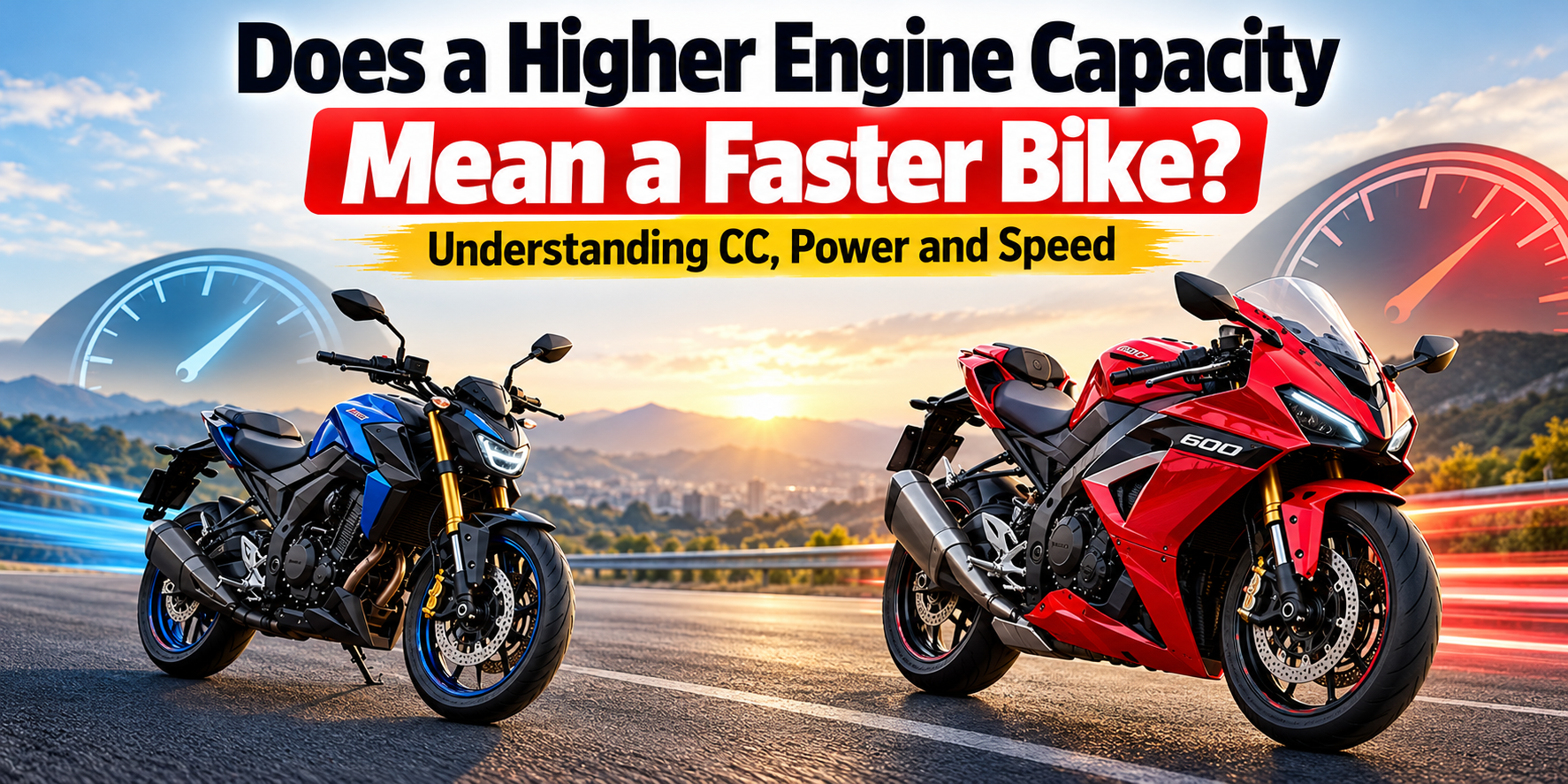
When buying a motorcycle, many people start by checking its engine capacity, commonly known as CC. In India motorcycles are available in different engine capacities, from 100cc commuter bikes to powerful superbikes with engines exceeding 1,000cc. A common belief among riders is that a motorcycle with a higher engine capacity will always be faster than one with a smaller engine.
However, this is not entirely true. Although engine capacity plays an important role in determining performance, it is not the only factor responsible for a motorcycle's acceleration or maximum speed. Horsepower, torque, kerb weight, transmission gearing, aerodynamics and engine technology also influence how quickly a bike can travel.
For example, a performance-oriented 300cc motorcycle can sometimes achieve a higher top speed than a 350cc cruiser designed for comfortable riding. Similarly, a lightweight motorcycle with a smaller engine may accelerate faster than a heavier motorcycle with a larger engine.
So, does a higher engine capacity mean a faster bike? The simple answer is no, not always. Understanding how engine capacity works alongside other performance factors can help you choose the right motorcycle for your needs.
Engine capacity, also called engine displacement, refers to the total volume swept by the pistons inside an engine's cylinders during their movement. It is measured in cubic centimetres (cc) or litres.
For example, a 150cc motorcycle has an engine displacement of approximately 150 cubic centimetres, while a 650cc motorcycle has a much larger displacement.
In simple terms, engine capacity indicates the size of the engine's working volume. A larger engine can generally process more air-fuel mixture per operating cycle, depending on its design. This can help it produce greater torque and power, but the actual output depends on engine speed, combustion efficiency and engineering.
A 125cc commuter motorcycle is usually designed to deliver fuel efficiency, affordability and dependable everyday performance. A 155cc sport-oriented motorcycle may prioritise stronger acceleration and higher engine speeds.
Even when two motorcycles have similar engine capacities, their performance can differ because manufacturers use different engine designs, tuning strategies and transmission systems.
Therefore, CC is an important specification, but it should not be treated as a direct measurement of speed.
Engine capacity can influence how a motorcycle performs, particularly when comparing models with similar technology and overall design.
A larger-displacement engine often has the potential to generate more torque. This can make acceleration easier, especially when overtaking another vehicle, climbing an incline or riding with a passenger.
However, a smaller engine designed to produce power at higher RPM may deliver stronger performance than a larger engine tuned primarily for relaxed cruising.
Engine capacity influences three main aspects of motorcycle performance:
Acceleration: How quickly the bike gains speed from a standstill or while moving.
Pulling power: How strongly the motorcycle responds to throttle input, particularly under load.
Potential top speed: The maximum speed the motorcycle can achieve under suitable conditions.

These characteristics are related, but they are not identical. A motorcycle can accelerate strongly at low speeds without having an exceptionally high top speed. Another motorcycle may build speed more gradually but achieve a higher maximum speed because of its power delivery and aerodynamic design.
This is why comparing engine capacity alone cannot tell you which motorcycle is faster.
Horsepower is one of the most important specifications to consider when comparing motorcycle performance. Manufacturers may express engine power in PS, bhp or kilowatts, depending on the market and specification sheet.
While CC measures engine displacement, horsepower describes how quickly the engine can perform work.
A motorcycle producing more usable power will generally have greater acceleration and top-speed potential when other factors are reasonably comparable.
For instance, a smaller sportbike may produce more power than a larger cruiser because its engine is designed to operate efficiently at higher RPM. This can allow the sportbike to maintain stronger acceleration at higher speeds.
Modern engine technologies, including fuel injection, liquid cooling, advanced valve timing and efficient intake systems, can also help improve power output.
When comparing two motorcycles, check their maximum power figures alongside their engine capacity. A higher-CC bike with relatively low power may not outperform a smaller, lighter motorcycle in every situation.
Horsepower is especially relevant when evaluating high-speed performance, although the motorcycle must also have suitable gearing and aerodynamic efficiency to make effective use of that power.
Torque refers to the rotational force produced by an engine. It influences how strongly a motorcycle pulls when the rider opens the throttle.
A motorcycle with strong torque at low and medium engine speeds may feel responsive during city riding. It can accelerate without requiring frequent gear changes and may feel comfortable when climbing hills or carrying a passenger.
Larger-displacement engines often have an advantage in torque delivery, particularly when they are designed for relaxed riding. This is one reason many riders prefer larger engines for touring and highway travel.
However, torque figures must be understood in context. Engine torque is not the same as the force delivered to the rear wheel. Gear ratios, engine RPM and drivetrain losses affect the final result.
A smaller motorcycle with appropriate gearing can feel quick in traffic, while a larger motorcycle may deliver its strongest performance at different speeds.
Torque and horsepower work together to determine how a motorcycle accelerates. Neither figure should be considered separately when assessing overall performance.
The weight of a motorcycle is another major factor that determines its performance. A powerful engine must move the entire motorcycle, along with the rider, fuel and any luggage.
A heavier motorcycle generally requires more force to accelerate than a lighter one, assuming other conditions remain similar. This is why lightweight sport-oriented bikes can feel energetic even when their engine capacities are relatively modest.
One useful measurement is the power-to-weight ratio, which compares engine power with the motorcycle's weight. A higher ratio generally indicates greater acceleration potential.
For example, consider two motorcycles that produce the same 40 PS of power. If one weighs 160kg and the other weighs 200kg, the lighter motorcycle has a better power-to-weight ratio.
The lighter bike may accelerate more quickly, although traction, gearing, rider weight and power delivery can change the actual result.
Weight also affects handling, braking and manoeuvrability. A motorcycle that feels manageable in city traffic may be more practical for daily use than a much heavier bike with a larger engine.
Consequently, riders should compare kerb weight and power together rather than relying only on CC figures.

Two motorcycles with similar engine capacities can produce very different performance because of their engine technology and tuning.
RPM refers to revolutions per minute and indicates how quickly the engine's crankshaft rotates. Some engines are designed to produce strong torque at lower RPM, while others generate their maximum power at higher RPM.
Sportbikes often use engines designed to deliver strong performance at higher engine speeds. Cruisers, on the other hand, may prioritise smooth power delivery and comfortable riding at moderate RPM.
Other factors that influence performance include the number of cylinders, valve design, fuel injection, cooling systems and exhaust configuration.
A well-engineered smaller engine can produce impressive power for its size, while a larger engine may be tuned for durability, efficiency or relaxed cruising. Therefore, engine design is just as important as displacement when evaluating a motorcycle's performance.
Yes. The transmission and gear ratios play an important role in determining how a motorcycle accelerates and reaches its maximum speed.
Lower gears generally provide greater torque multiplication at the rear wheel, helping the bike accelerate from a standstill. Higher gears allow the motorcycle to maintain greater road speeds without requiring excessively high engine RPM.
Manufacturers select gear ratios according to the bike's intended purpose. Commuter motorcycles are designed for practical everyday use, while sportbikes may have gearing suited to more aggressive acceleration and higher-speed riding.
Final-drive gearing also matters. On chain-driven motorcycles, changing the front or rear sprocket can alter acceleration characteristics and the theoretical speed available at a particular engine RPM.
However, taller gearing does not automatically increase the actual top speed. The engine must still produce enough power to overcome aerodynamic drag and other resistance.

Aerodynamics becomes increasingly important as motorcycle speed rises. A motorcycle must push air out of its path, and the resistance increases rapidly at higher speeds.
This explains why a fully faired sportbike can sometimes achieve a higher top speed than a naked motorcycle producing similar power.
A sportbike's fairing, windscreen and riding position may reduce aerodynamic drag. By comparison, a rider sitting upright on a naked motorcycle creates a larger frontal area, increasing air resistance.
The rider's posture, luggage, wind direction and motorcycle design can all influence performance.
At high speeds, overcoming air resistance requires substantial power. Consequently, a motorcycle with a larger engine does not necessarily achieve a proportionately higher top speed if its shape and power delivery are less suited to high-speed riding.
The ideal engine capacity depends on your riding experience, budget, daily travel requirements and preferred riding style.
100cc–125cc: These motorcycles are suitable for many commuters who prioritise fuel efficiency, affordable maintenance and easy handling.
150cc–200cc: This category offers a balance between everyday practicality and more responsive performance. It can suit riders who want additional acceleration without moving to a much larger motorcycle.
250cc–400cc: These bikes often provide stronger acceleration, more highway flexibility and sportier performance. They can be suitable for experienced commuters and riders who enjoy weekend trips.
500cc–700cc: Motorcycles in this category may offer stronger overtaking performance, smoother highway cruising and greater power reserves, depending on their design.
800cc and above: This category includes many touring motorcycles, cruisers bikes and superbikes. These bikes can offer substantial power, but they may also involve higher purchase prices, fuel expenses and maintenance costs.
These categories are general guidelines rather than fixed rules. A motorcycle's weight, seat height, handling and power delivery are just as important as its engine capacity.
Before purchasing a bike, consider where you will ride most frequently. A lightweight 150cc motorcycle may be more convenient for congested city traffic, while a larger motorcycle may be better suited to frequent long-distance highway travel.