BMW i5 LWB
79.6 Lakh*

 Khyati Sharma 2026-09-26

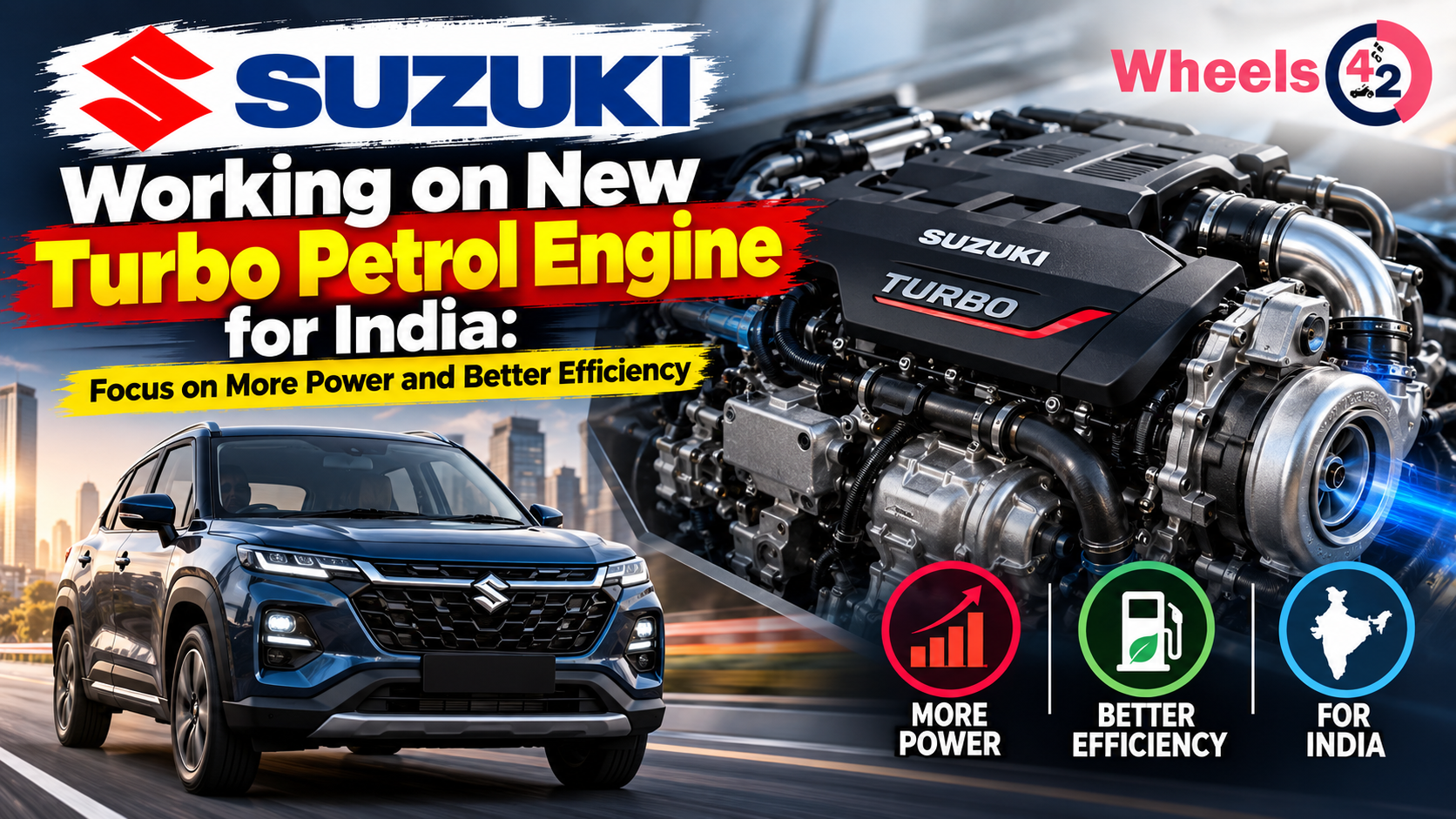
Suzuki Motor Corporation is developing a new generation of direct-injection turbocharged petrol engine for growth markets, including India. The upcoming powertrain is being developed with two key objectives in mind — stronger performance and improved fuel efficiency.
The development could become significant for the Indian market, where Maruti Suzuki is expanding its SUV portfolio while also working on hybrid, electric and alternative-fuel technologies.
Suzuki has referred to the new technology as DITC, or Direct Injection Turbo Charged, in its technology presentation. However, the company has not yet revealed the engine's final displacement, power and torque figures or the first production model that will receive it.
Suzuki's latest powertrain strategy shows that the company is continuing to invest in internal-combustion engine technology alongside electrification.
The upcoming DITC engine is being developed for growth markets, with India specifically identified as one of the markets relevant to the technology.
The objective is to combine the performance benefits of turbocharging with the efficiency advantages of direct fuel injection.
For Indian customers, this could eventually mean access to Maruti Suzuki vehicles offering stronger performance without necessarily moving to significantly larger naturally aspirated engines.
Turbocharging allows an engine to produce more power and torque from a relatively compact displacement.
A direct-injection system delivers fuel directly into the combustion chamber, allowing more precise control over the combustion process.
When these technologies are combined, manufacturers can aim for a balance between:
Suzuki's upcoming engine is being developed around precisely this combination of performance and efficiency.
However, final specifications will determine how the engine compares with existing turbocharged powertrains in the Indian market.
One of the biggest unanswered questions is the displacement.
Suzuki has not officially announced whether the new DITC engine will be a 1.0-litre, 1.2-litre, 1.4-litre or another configuration.
The company has also not announced:
Therefore, claims about a specific displacement or power output should currently be treated as speculation rather than confirmed information.
The new engine will not represent Suzuki's first experience with turbocharged petrol technology in India.
Maruti Suzuki currently offers its 1.0-litre K10 Turbo Boosterjet engine in the Fronx. The company describes this engine as using direct injection and turbocharging, with a focus on performance and efficiency.
The technology has also recently expanded to the new-generation Brezza, which is available with a 1.0-litre Turbo Boosterjet engine alongside its 1.5-litre naturally aspirated petrol engine. Suzuki's global announcement confirms the new Brezza's 1.0-litre turbo petrol option with a six-speed manual transmission.
The newly announced DITC project, however, is a next-generation development and should not automatically be assumed to be the same engine currently used in the Fronx or Brezza.
Suzuki's future engine development is not focused purely on increasing power.
The company has outlined research aimed at increasing internal-combustion-engine thermal efficiency toward 50 percent, compared with the roughly 40-percent range cited for its current technology development.
Suzuki has identified several areas of research, including reducing energy losses through cooling and exhaust, lowering friction and improving the efficiency of air intake. Lean combustion and waste-heat recovery are among the technologies being studied as part of this broader effort.
This indicates that Suzuki's future petrol engines are being developed with efficiency as an important objective rather than simply chasing higher output.
If the DITC engine reaches production in India, it could give Maruti Suzuki another powertrain option for vehicles positioned above its smaller naturally aspirated models.
Potential applications could include future:
However, Suzuki has not confirmed which Indian model will receive the new engine.
Therefore, linking the upcoming powertrain to a particular future Maruti Suzuki model would be premature at this stage.
Suzuki's strategy appears to involve multiple powertrain technologies rather than replacing every petrol engine with a single solution.
The company is simultaneously developing naturally aspirated engines, direct-injection turbo engines, dedicated hybrid engines, hybrid systems and technologies compatible with alternative fuels such as CBG and bioethanol.
This multi-pathway approach allows Suzuki to use different technologies depending on vehicle size, market requirements, fuel availability and customer demand.
For India, that could mean naturally aspirated petrol, turbo petrol, CNG, hybrid and electric powertrains continuing alongside each other.
India is one of Suzuki's most important global markets, with Maruti Suzuki having a broad portfolio covering hatchbacks, sedans and SUVs.
The company's recent move to introduce the 1.0-litre turbo-petrol engine in the Brezza shows that turbocharged petrol technology is already becoming part of its mainstream Indian product strategy.
A newer-generation turbo engine could therefore give Maruti Suzuki additional flexibility as competition increases in India's SUV and crossover segments.
Suzuki has not released official performance figures for the upcoming DITC engine.
The company has only stated that the engine is being developed to combine high efficiency with powerful driving performance.
That means it would be premature to claim a particular horsepower or torque figure.
The final output will likely depend on the engine's displacement, turbocharger configuration, compression ratio, injection system and the vehicle in which it is installed.
There is currently no confirmed Indian launch date for the new DITC engine.
Suzuki has announced the technology as part of its future engine development programme, but details about production timing and its first application have not yet been disclosed.
More information is expected as Suzuki moves the engine closer to production and begins announcing future vehicle applications


















Ferrari
₹460.00 Lakh

