BMW i5 LWB
79.6 Lakh*
 Khyati Sharma 2026-09-28

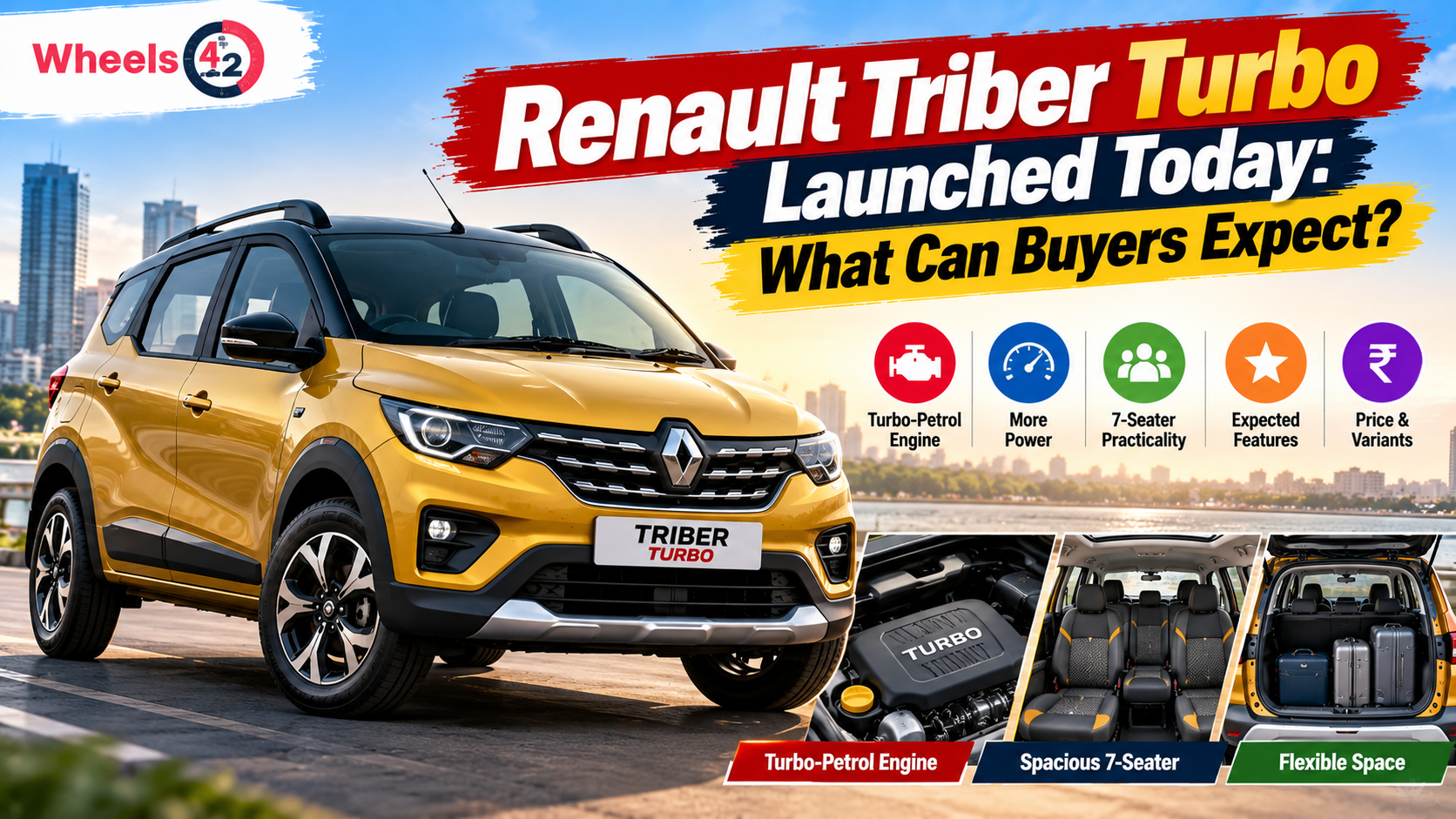
Renault has officially launched the Triber Turbo in India today, September 28, 2026, adding a turbo-petrol powertrain to its compact seven-seat MPV. The new version starts at ₹7.84 lakh (ex-showroom) and is currently offered with a five-speed manual gearbox. The turbo version is available in three variants: Evolution, Techno and Emotion.
The biggest change is under the bonnet. Renault has equipped the Triber Turbo with a 1.0-litre, three-cylinder turbo-petrol engine producing 99bhp and 180Nm. Renault also claims a fuel-efficiency figure of 21kmpl for the new version.
The Triber has traditionally been known for its compact dimensions and flexible seven-seat layout, but its naturally aspirated petrol engine was one area where buyers could want more performance.
The new turbo engine is designed to address that point. More importantly, the turbo version isn't simply an engine swap. Renault has made several changes underneath the skin, including revised suspension tuning, new anti-roll bars, changes to the thermal-management system, structural enhancements and updated calibration for the ABS, traction control and vehicle-dynamics systems. Braking performance has also been improved.
Interestingly, the exterior design remains largely unchanged. The turbo version retains the current Triber's styling, with the Turbo badge being one of the key visual identifiers.
The new 999cc three-cylinder turbo-petrol engine develops:
|
Specification |
Renault Triber Turbo |
|
Engine |
1.0-litre, 3-cylinder Turbo Petrol |
|
Displacement |
999cc |
|
Power |
99bhp |
|
Torque |
180Nm |
|
Gearbox |
5-speed Manual |
|
Claimed Mileage |
21kmpl |
|
Seating |
Up to 7 passengers |
|
Drive Type |
Front-Wheel Drive |
The biggest difference compared with the standard Triber is the torque output. The regular naturally aspirated engine produces 72hp and 96Nm, while the turbo version produces 99bhp and 180Nm.
That extra torque should be particularly relevant when the Triber is carrying several passengers. In its first-drive evaluation, CarWale reported that the turbo engine provides stronger low-end and mid-range response and reduces the need for frequent downshifts in city driving.
Renault has launched the Triber Turbo in three variants:
| Variant | Ex-Showroom Price |
|---|---|
| Triber Turbo MT Evolution | ₹7.84 lakh |
| Triber Turbo MT Techno | ₹8.53 lakh |
| Triber Turbo MT Emotion | ₹8.99 lakh |
These prices are based on the September 28, 2026 launch announcement.
The turbo engine is therefore positioned above the existing naturally aspirated Triber range. Renault's standard Triber currently starts at around ₹5.81 lakh, depending on the version and applicable location pricing.
Yes. One of the major reasons for choosing the Triber remains its flexible cabin.
Renault's current Triber offers a 5-to-7-seat configuration, with a sliding and reclining second row and removable third-row seats. Depending on how the seats are configured, the cargo area can be expanded significantly. Renault claims up to 1,065 litres of cargo space with the relevant seating configuration.
The compact exterior footprint also remains an important part of the Triber formula. Despite being under four metres long, it provides three rows of seating.
The turbo version retains much of the equipment already available on the updated Triber. Depending on the variant, buyers can get features such as a touchscreen infotainment system with Apple CarPlay and Android Auto, wireless charging, cruise control, a digital instrument cluster, rear camera, cooled storage, automatic air conditioning and a height-adjustable driver's seat.
The current Triber also offers features including one-touch second-row folding, removable third-row seats, roof rails and a 182mm ground clearance.
Safety equipment includes six airbags, electronic stability control, traction control, ABS and other electronic safety systems. The current Triber also features three-point seat belts across the seating positions and ISOFIX child-seat mounting points.
The turbo version's additional structural and chassis-related changes are another notable part of the launch. Renault has revised the suspension, added anti-roll bars and made changes to the vehicle's electronic-control calibration.
At launch, the Triber Turbo is available with a five-speed manual gearbox. Renault has not included an automatic turbo version in the launch range.
The 1.0-litre turbo engine is used with a CVT in other Renault-Nissan products, and earlier reports had pointed towards a future CVT-equipped Triber Turbo. A factory-fitted turbo-CNG version has also been reported as being under development. However, these versions should be treated as future possibilities until Renault officially confirms their launch details.
The turbo engine changes the character of the Triber more than its appearance.
The naturally aspirated version focuses on practicality and everyday efficiency, but the turbo engine's additional torque gives the MPV more performance headroom. This can be especially useful when carrying multiple passengers, climbing inclines or making highway overtakes.
At the same time, buyers should remember that the Triber remains a compact seven-seater rather than a performance-focused vehicle. Its main purpose continues to be flexible family transportation.
₹7.84 lakh starting price
The Renault Triber Turbo marks a significant mechanical update to Renault's compact MPV. Rather than changing the familiar exterior, Renault has focused on the areas that matter most for performance: the engine, torque delivery, suspension setup, braking and related vehicle controls.
With 99bhp, 180Nm and a claimed 21kmpl, the turbo version brings substantially more output than the standard 72hp/96Nm naturally aspirated Triber.
The new ₹7.84 lakh starting price puts the Turbo above the regular Triber, so buyers will need to weigh the additional performance against the higher purchase cost. For families who specifically want the Triber's flexible seven-seat layout but also want stronger engine performance, the Turbo version adds a new option to the lineup.




Tata
₹9.49 - 12.73 Lakh

Toyota
₹258.51 - 269.48 Lakh
