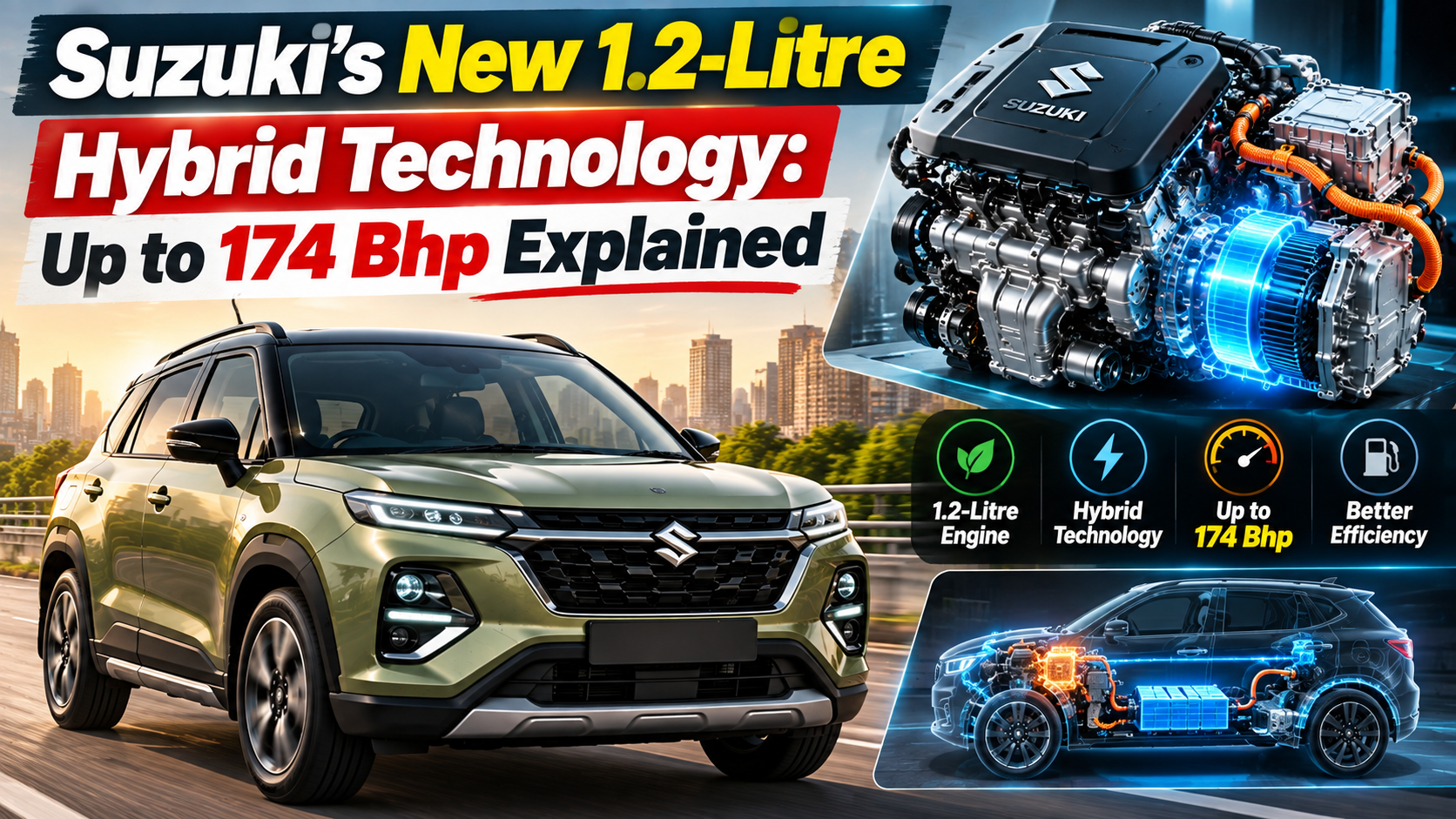
Suzuki car is expanding its hybrid technology strategy with a new generation of electrified powertrains aimed at different vehicle segments. The latest technology programme includes a 1.2-litre series-hybrid system for compact cars, a plug-in range-extender system and a more powerful turbocharged plug-in hybrid that can deliver around 174 bhp as a complete hybrid system.
The new technology was highlighted as part of Suzuki's latest technology strategy in Japan. While the company has not confirmed specific production models or an India launch for these powertrains, the developments could have significant implications for future Maruti Suzuki products.
1.2-Litre Series Hybrid for Compact Cars
One of the most interesting developments is Suzuki's new 1.2-litre series-hybrid system.
The setup uses the 1.2-litre Z12E petrol engine primarily as a generator, while an electric motor is responsible for driving the wheels. This is different from a conventional hybrid system where both the petrol engine and electric motor can directly contribute to driving the vehicle.
Suzuki's displayed specifications list the engine at around 60 kW and 108 Nm, along with a 61 kW generator and a 65 kW traction motor. The battery capacity shown for this system is 0.6 kWh.
The key idea is to combine the smooth driving characteristics of an electric motor with the convenience of a petrol engine. Drivers would not need to depend entirely on charging infrastructure because the petrol engine can generate electricity when required.
What Does 174 Bhp Actually Mean?
The 174 bhp figure needs some clarification.
It does not mean Suzuki's 1.2-litre petrol engine itself produces 174 bhp.
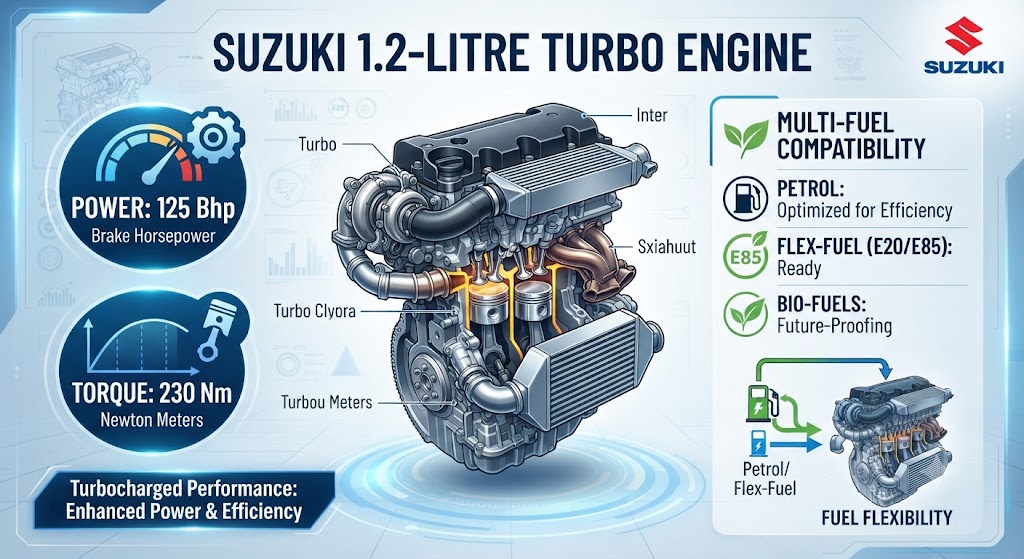
Suzuki has also presented a separate series-parallel plug-in hybrid system using a 1.2-litre direct-injection turbocharged petrol engine. The complete hybrid system is rated in the 130 kW class, equivalent to approximately 174 bhp.
In this system, the petrol engine and electric drive system can contribute to propulsion through different operating modes. This makes it fundamentally different from the smaller 1.2-litre series-hybrid setup designed for compact cars.
|
Technology
|
Engine
|
Hybrid Layout
|
Approx. Output
|
|
Compact Series Hybrid
|
1.2L Z12E
|
Series hybrid
|
65 kW motor class
|
|
REEV Light
|
1.2L-class engine
|
Series hybrid + external charging
|
85 kW class
|
|
Performance PHEV
|
1.2L turbo petrol
|
Series-parallel PHEV
|
130 kW / ~174 bhp
|
Suzuki Is Also Developing a Range-Extender Hybrid
Another important part of the programme is Suzuki's REEV Light system.
REEV stands for Range Extended Electric Vehicle. The concept combines electric propulsion with a petrol engine that can generate electricity when the battery needs additional energy.
Unlike the basic series-hybrid system, REEV Light adds external charging capability. This means the vehicle can be plugged in and charged for shorter journeys, while the petrol engine can help extend the driving range on longer trips.
Suzuki's announced concept uses a battery sized for the vehicle rather than relying on an unnecessarily large battery pack. The company has not yet announced the final battery capacity or electric-only range for REEV Light.
Potential Benefits for Indian Cars
This technology could be particularly relevant to India because compact cars account for a large portion of the market.
Suzuki's approach could allow future Maruti Suzuki models to offer electrified driving without requiring the large battery packs normally associated with full EVs.
The company is also working on reducing the cost and weight associated with hybrid systems. Its compact-car series hybrid programme is aimed at improving efficiency while keeping the technology suitable for smaller vehicles.
Suzuki estimates that its compact series-hybrid technology could reduce CO₂ emissions by around 29% compared with its stated 2022 reference, although actual results would depend on the vehicle and driving conditions.
Could Maruti Suzuki Get This Technology?
The possibility is particularly interesting for India.
Maruti Suzuki already has access to strong-hybrid technology through its existing models, while it has also started moving into the fully electric vehicle segment. A smaller, internally developed hybrid system could provide another option between conventional petrol/CNG vehicles and battery-electric cars.
Previous reporting has linked the smaller hybrid programme with models such as the Fronx and Baleno, while the 1.2-litre Z12E engine has been discussed as a possible generator. However, Suzuki has not confirmed either model for the REEV Light system, nor has it confirmed that the Z12E will definitely be used in that configuration.
Therefore, these applications should currently be treated as possibilities rather than confirmed future Maruti products.
What About Fuel Flexibility?
Suzuki's broader 1.2-litre hybrid programme is also notable for its potential compatibility with different fuels.
The technology has been discussed alongside E100, CNG and compressed biogas (CBG) compatibility. Such flexibility could become increasingly relevant as India continues to increase ethanol blending and explores alternative fuels.
However, compatibility at the technology-development stage does not automatically mean that every future Maruti Suzuki model will support all these fuels.
What Could This Mean for Future Suzuki Cars?
Suzuki appears to be developing several electrification solutions rather than relying on a single hybrid architecture.
For smaller cars, the 1.2-litre series hybrid could provide an efficient electric-motor-driven experience without requiring external charging. The REEV Light system adds the ability to plug in, while the more powerful turbocharged plug-in hybrid targets higher performance and larger vehicle applications.
The 174 bhp system could therefore be more relevant to larger or more performance-oriented vehicles, rather than being a direct replacement for the regular 1.2-litre petrol engine in compact hatchbacks.
Suzuki has not yet confirmed which production vehicles will receive the 174 bhp-class plug-in hybrid system.
Final Word
Suzuki's latest hybrid technology strategy shows how the company is looking beyond conventional mild-hybrid systems.
The most important development for compact cars is the 1.2-litre series-hybrid system, which uses the petrol engine to generate electricity while an electric motor drives the wheels. At the other end of the technology spectrum, Suzuki has also shown a 1.2-litre turbocharged plug-in hybrid system producing around 174 bhp as a combined system output.
For India, the biggest question is not simply how much power these systems can produce, but which Maruti Suzuki models will eventually receive them and at what price. Suzuki has not yet confirmed those details, so future applications will need to be watched for official announcements.

 Khyati Sharma 2026-09-28